Complete Indoor Enrichment & Cognitive Stimulation Guide for Cats — Preventing Boredom, Stress & Problem Behaviors | ブリちょく
Cats| ✍️ BreederDirect Editorial
Complete Indoor Enrichment & Cognitive Stimulation Guide for Cats — Preventing Boredom, Stress & Problem Behaviors
How to prevent boredom, stress, and problem behaviors in indoor cats through environmental enrichment: toys, cat trees, food puzzles, window perches, and cognitive stimulation techniques.
Key Takeaways
How to prevent boredom, stress, and problem behaviors in indoor cats through environmental enrichment: toys, cat trees, food puzzles, window perches, and cognitive stimulation techniques.
Complete Guide to Feline Cognitive Stimulation and Indoor Enrichment | Preventing Boredom, Stress, and Problem Behaviors
In today's world of increasing indoor-only cat ownership, have you ever wondered "what does my cat do all day?" Cats are naturally hunting animals who experience complex stimuli in outdoor environments. Cats living solely indoors tend to face monotonous environments, which can lead to boredom, stress, and problem behaviors. This article explains the importance of feline cognitive stimulation and indoor enrichment, along with practical methods to implement them.
Problem Behaviors Caused by Cat Boredom and Stress
Cats placed in environments lacking enrichment may exhibit the following problem behaviors.
Behavioral Changes
Excessive grooming (licking fur until bald spots form): A form of stress-induced compulsive behavior
Increased aggression: Sudden attacks on owners or cohabiting animals
Destructive behavior: Scratching and biting furniture, walls, and carpets
Nighttime crying and excessive vocalization: Especially prolonged crying during nighttime
Appetite fluctuations: Overeating or refusal to eat
Obesity: Weight gain due to reduced activity levels
These are almost always environment-related issues for cats, not "behavioral problems" requiring discipline.
What is Feline Enrichment?
Enrichment is the practice of enhancing an animal's environment to allow them to express natural behaviors. Feline enrichment is classified into five main categories.
Category
Content
✍️
BreederDirect Editorial
The BreederDirect editorial team specializes in care information for animals, covering veterinary care and breeding to deliver beginner-friendly guides.
Find Cats on BreederDirect
Buy directly from verified breeders
Browse Related Listings
Find Cats listings related to this article on BreederDirect. Buy directly from verified breeders.
Providing problem-solving and learning opportunities
Social Enrichment
Interaction with humans and other animals
Physical Enrichment
Expanded opportunities for exercise and exploration
Sensory Enrichment: Stimulating Your Cat's Five Senses
Visual Stimulation
Cats have exceptionally acute visual responses to movement.
Birdwatching spots by the window: Place a stable perch by the window so your cat can observe outdoor birds and insects. Installing a bird feeder outside the window increases observation opportunities.
Cat video content: YouTube videos and TV shows featuring birds, fish, and insects are highly engaging for many cats. However, individual cats vary in their ability to recognize screens.
Moving toys: Timer-activated toys or wand toys with feathers provide visual stimulation.
Olfactory Stimulation
A cat's sense of smell is said to be approximately 200,000 times stronger than humans. Olfactory stimulation increases psychological satisfaction.
Using catnip (or silvervine): Not all cats respond (genetically, only 50-70% react), but responsive cats experience intense excitement and satisfaction.
Natural material toys: Toys made of wood, bark, and feathers contain complex scents.
Exploration games: Simply placing scent-marked paper bags or cardboard boxes encourages cats to spend time exploring.
Auditory Stimulation
Cats possess excellent hearing that extends into the ultrasonic range.
Using music and natural sounds: Music designed specifically for cats (such as "Music for Cats") can capture their attention.
Bells and rattling toys: Sound stimulation that triggers hunting instincts
Television use: Some cats feel more calm with moderate background noise rather than complete silence.
Food Enrichment: Triggering Hunting Behaviors
Wild cats engage in 10-20 small hunting and foraging behaviors daily. For indoor cats, simply placing food in a bowl without any additional enrichment means missing significant opportunities to express these instinctive foraging behaviors.
Using Food Puzzles
Food puzzles allow cats to solve problems to obtain food, satisfying both cognitive stimulation and foraging behaviors.
Level 1 (Beginner): A ball with holes that rolls to dispense kibble inside
Level 2: Sliding or drawer-based puzzle combinations
When first introducing puzzles, start with the simplest type and ensure your cat experiences a sense of accomplishment. Puzzles that are too difficult can discourage motivation.
Scatter Feeding (Hide-and-Seek Feeding)
Hide small portions of food in several locations around the room, encouraging your cat to hunt and find them. This method is particularly effective with dry kibble.
Filling Kong-Style Toys
Stuffing feline rubber toys with wet food or treats that your cat licks out is also effective.
Cognitive Enrichment: Unlocking Your Cat's Intelligence
Cats are trainable animals. The belief that "cats can't learn like dogs" is a misconception—with appropriate methods, many cats can master various behaviors.
Clicker Training
Training with a clicker (a device that makes a clicking sound) and reward treats is an excellent method for cognitive stimulation in cats.
Example Commands Cats Can Learn
- High-five (paw touch)
- Sit
- Targeting an object (target training)
- Standing on a platform (station training)
Keep each session short (approximately 5 minutes) and train during times when your cat is alert (before meals is optimal).
Treasure Hunt Games
Hide treats under fabric, under paper cups, or inside cardboard boxes for your cat to find. While simple, this is an excellent enrichment activity that engages your cat's problem-solving abilities.
Physical Enrichment: Utilizing Three-Dimensional Space
Cats naturally prefer climbing to high places and entering narrow spaces—three-dimensional behaviors.
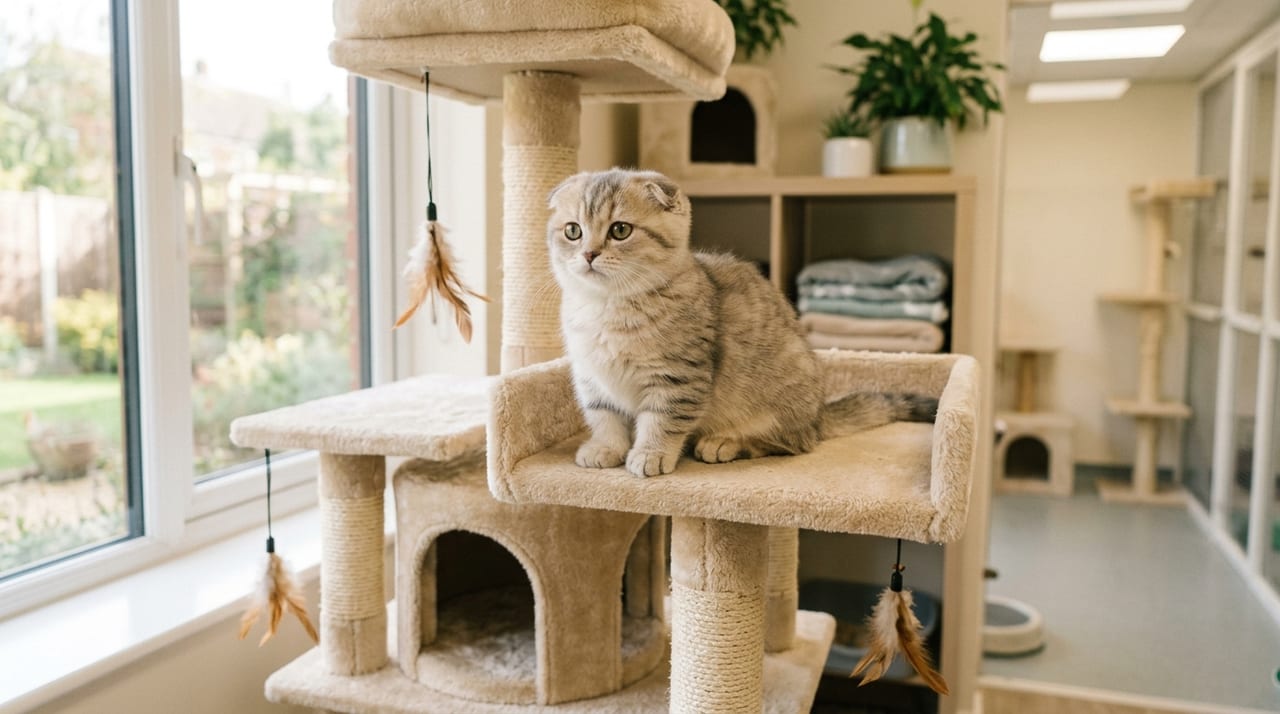
Installing Cat Walks and Cat Towers
Wall-mounted cat walks installed along walls
Cat towers with multiple heights and resting spaces
Window-mounted shelves (prime viewing spots)
Creating an environment where cats can voluntarily climb to high places provides both physical activity and psychological stability.
Tunnels and Hiding Spaces
Cats need hiding spots (hiding spaces). Provide multiple hiding places of various types: cardboard boxes with covers, fabric tunnels, cat tents, and more.
Social Enrichment: Deepening Your Bond with Your Cat
The most important enrichment element is human interaction. While cats are considered solitary animals, many individuals place significant value on bonding with their owners.
Ensuring Interactive Play
Wand toys (with feathers, yarn, or attached strings) manipulated by owners are among the most effective enrichment activities for cats.
Recommended Play Sessions
- Twice daily, 10-15 minutes each session
- Allow your cat to "catch" the toy so they experience accomplishment
- End play gradually by slowing the tempo to create a "cool-down"
Considering Dual Cat Adoption
If your single cat spends long periods alone, adopting a compatible cat of similar age is an option. However, feline compatibility varies greatly by individual, so introductions must be handled carefully.
Tips for Implementing Enrichment
Rotation: Cats become bored with the same toys always available. Rotate several toys weekly to maintain freshness.
Observe your cat's preferences: Not all cats enjoy the same enrichment. Observe their reactions and find optimal methods.
Don't force participation: Fear and coercion are counterproductive. Create an environment where cats voluntarily participate.
Don't change too much at once: Many cats dislike change, so introduce new elements gradually.
Conclusion
Intentional enrichment practice is essential to provide a rich life for indoor cats. By balancing the five elements—sensory stimulation, food enrichment, cognitive stimulation, physical activity, and social interaction—you can significantly reduce feline stress and prevent problem behaviors.
Begin by carefully observing your cat's behavior and identifying what appears most enjoyable and what generates interest. This careful observation and gradual improvement will nurture the best possible relationship with your beloved cat.