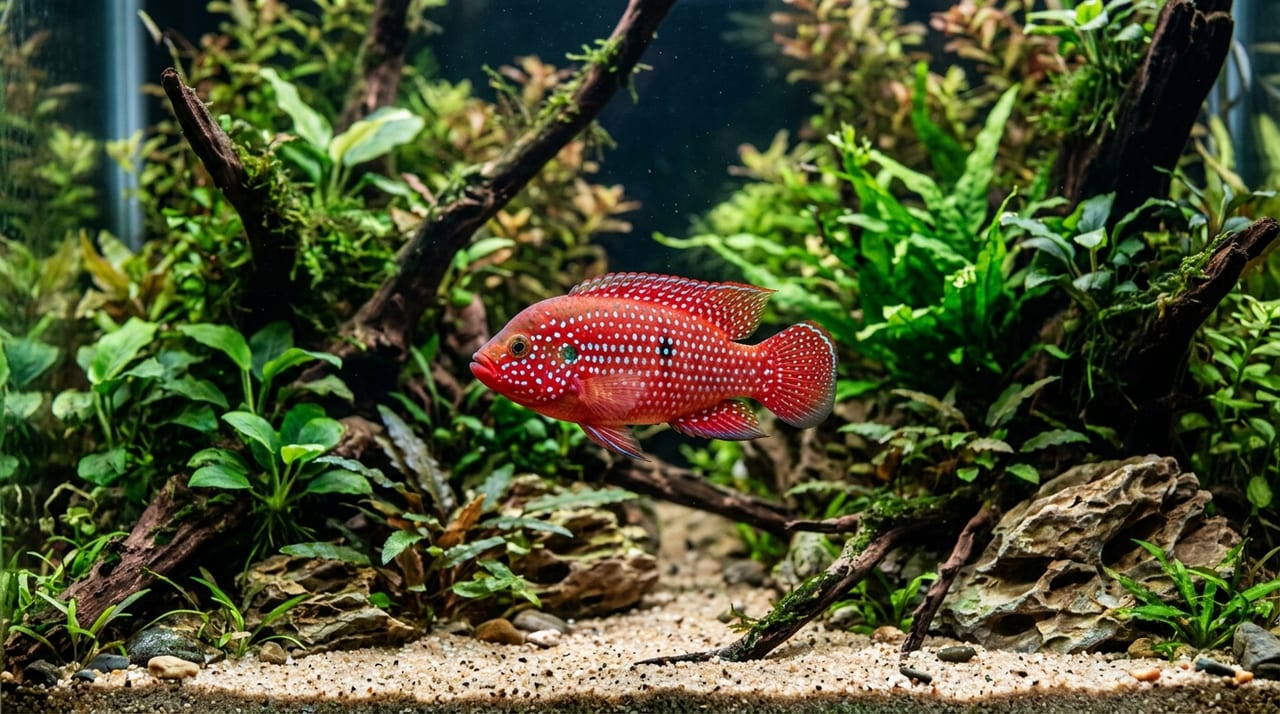
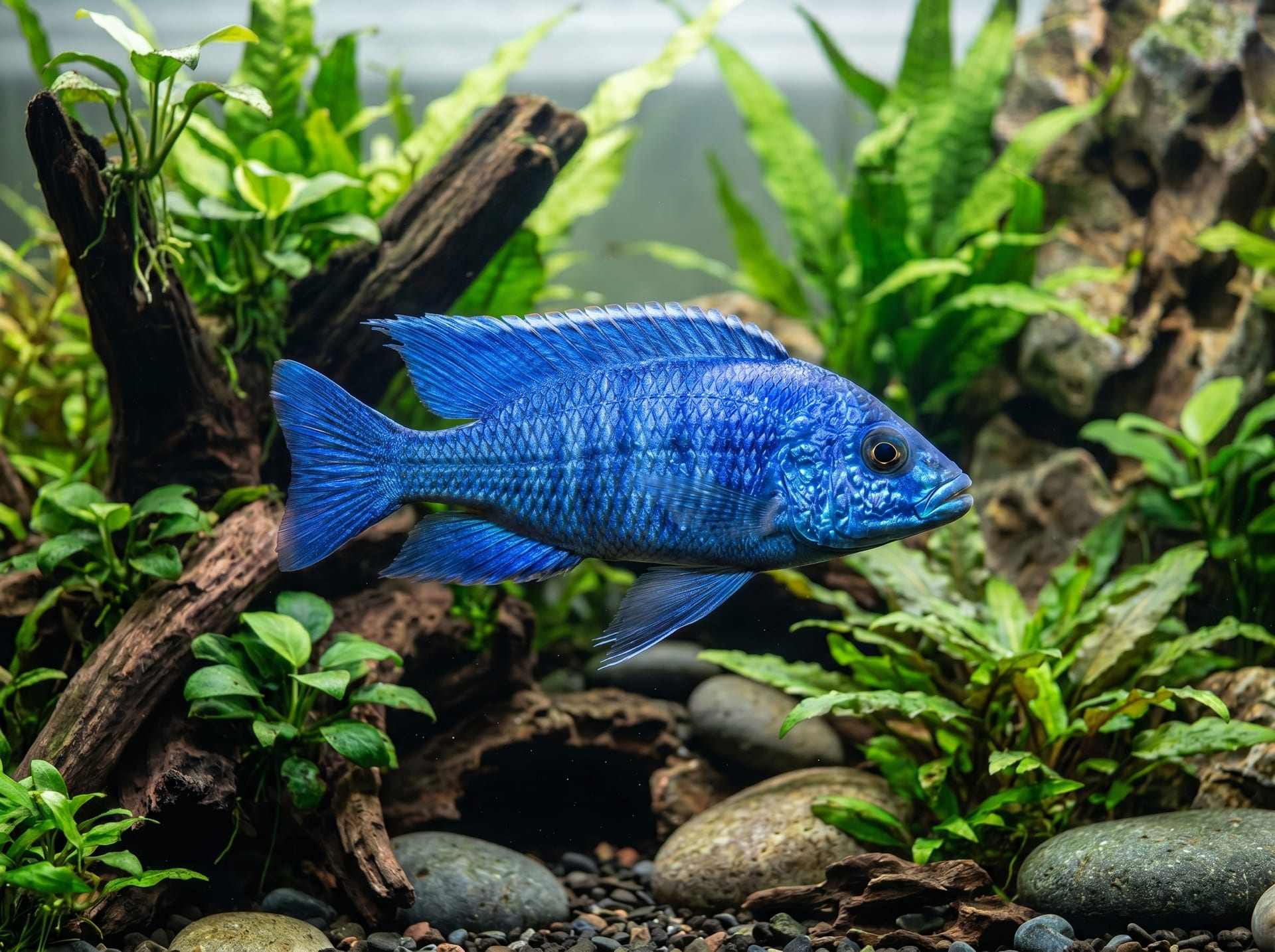
African Cichlids and the Importance of Layout
African cichlids establish territories within the tank, and stress and injuries from territorial disputes become major problems. Proper layout is not merely an aesthetic matter—it directly impacts fish safety, health, and breeding success.
The lakes where African cichlids live include Tanganyika, Malawi, Victoria, and various small lakes throughout Tanzania, each with vastly different environments. These environmental differences are reflected in layout design.
Malawi Lake Mbuna Layout
Mbuna, meaning "rock fish" in the Chichewa language, is a general term for cichlids living in the rocky areas of Lake Malawi. Cichlorma, Labidochromis, and Melanochromis are representative examples, living in the crevices of densely packed rocks as their territories.
- Rock arrangement design is fundamentally about embedding rocks firmly in the substrate and creating multiple crevices and caves between them. The number of crevices should exceed the number of fish kept, providing refuge for displaced individuals and reducing mortality risk. Stack rocks to about 60–70% of the tank height to promote three-dimensional territory distribution.
- Rock materials suitable for use include lava rock (porous basalt), limestone, and ceramic artificial rocks. Limestone naturally contributes to alkaline, high-hardness water conditions, making it effective for recreating Malawi Lake's water chemistry (pH 7.8–8.5, GH 12–20).
- Substrate should be aragonite sand (coral sand) or fine gravel, layered 3–5 cm deep. The buffering effect of substrate on pH and hardness helps maintain alkaline water more easily.
- Handling of aquatic plants should be minimal. Since Mbuna are omnivorous and eat plants, extensive plant use is impractical; planting hardy species like Vallisneria or Anubias in rock crevices is the realistic approach.
Tanganyika Lake Cichlid Layout
Tanganyika Lake cichlids are more diverse than Mbuna, with lifestyles divided among rock-dwelling species, sand-dwelling species, and shell brooders.
| Type (Representative species) | Layout characteristics |
|---|
| Julidochromis and Cyphotilapia (rock-dwelling species) | Like Malawi Mbuna, rock arrangements are extensively used. However, the rocky areas of Lake Tanganyika are relatively flat, and layouts that reflect a landscape spreading horizontally are more natural. Creating numerous stone crevices (cracks) is crucial in design. |
| Neolamprologus and shell-breeder types (such as Elatus, Multifasciatus, etc.) | These have a unique breeding ecology using shells as breeding sites. Establish a sand-bottom area of 60–90 cm or more, and distribute 30–50 or more colander clams and fan shells 3–5 cm in diameter half-buried in the sand. Greater quantities disperse territorial disputes, leading to stable breeding. Layer 5–8 cm or more of fine aragonite sand as substrate, with room to embed shells. |
| Blue-fronted cichlid and Ctenochromis (sand-bottom and open-water species) | These prefer open layouts with few shelter structures. A design that limits rocks to the tank ends and creates a wide sand-bottom area in the center is appropriate. |
Rock Arrangement Safety and Maintenance
Layout design must account for not only aesthetics and ecological recreation but also safety and ease of daily maintenance.
- Rock stability: African cichlids have a strong habit of digging through substrate. As the sand that anchors rocks gradually washes away, stacked rocks can tilt or collapse. The basic principle is to place rocks directly on the tank glass bottom or a base board, avoiding unstable stacking on substrate. When stacking large rocks in multiple tiers, securing them with aquarium adhesive or acrylic rods prevents collapse from digging.
- Pre-treatment of rocks: Before use, rocks should be thoroughly rinsed with running water to remove debris and small fragments, then placed in the tank. Rocks with sharp chips or cracks should be avoided as they risk injuring fish on contact. Naturally collected rocks may have unknown water-quality impacts or composition, so selecting materials sold specifically for aquarium use is safer.
- Maintenance access paths: Overcrowding rock arrangements makes it difficult to suction out feces and uneaten food accumulated on the bottom. Leaving small gaps in various places through which cleaning tools can reach makes daily water-quality maintenance easier.
Water Current and Overcrowding
African cichlids generally prefer strong water flow; an upper-level filter combined with a power head is the standard setup. For a 120 cm tank, a circulation rate of about 8–12 turnovers per hour is a guideline.
Mbuna and Tanganyika rock-dwelling species benefit from overcrowding that disperses territorial disputes; keeping 12–20 individuals in a standard 120 cm tank is common. However, water-quality deterioration risk increases with crowding, making powerful filtration and weekly to bi-weekly water changes essential prerequisites.
Combinations to Avoid
Keeping Tanganyika Lake and Malawi Lake species together in the same tank should generally be avoided. Water requirements may differ somewhat, and behavioral differences often lead to stress and injury.
Even within the same lake, pairing species with large size differences is dangerous. For example, within Mbuna, the large Frontosa (from Tanganyika) exceeding 40 cm becomes a predator to small Mbuna.
When to Revise Layout
As captive care continues, layout revision becomes necessary at times.
- When adding new individuals: Introducing new fish directly into a tank where existing individuals have established territories often results in severe aggression. Partially rearranging rocks to reset territorial boundaries before introducing new individuals is said to reduce existing fish dominance and ease conflict.
- When a particular individual is persistently chased: Review the number and placement of shelters, ensuring the chased individual has multiple pathways to hide. If shelter entrances lead only one direction, the individual that makes that its territory can block access, so pass-through structures are preferable.
- When rock arrangements tilt: This signals that substrate digging has destabilized the rock foundation. Rearranging rocks promptly prevents crushing or tank glass breakage from collapse.
Summary
The fundamental principle in designing African cichlid layouts is mimicking the natural habitat of the species being kept. By recreating dense rock arrangements for Mbuna, sand-bottom habitats with abundant shells for shell brooders, and horizontal rock crevices for Tanganyika rock-dwelling species, you can enjoy healthy territory formation and beautiful spawning behaviors in your tank. By paying attention to rock stability, ease of cleaning, and layout revision when adding individuals, you can maintain layouts safely over the long term.