Source: Wikimedia Commons
Society Finch
BeginnerLonchura striata domestica
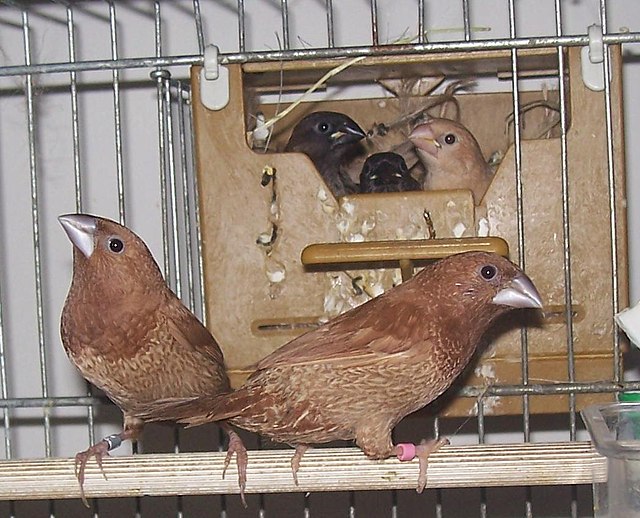
Finch selectively bred in Japan. Extremely gentle and used as foster parents for other birds. Prolific breeders for beginners.
Difficulty
Beginner
Temperature
15〜30℃
Lifespan
5-8 years
Size
12-13cm
Humidity
40〜60%
Diet
Finch seed mix, greens
About
The Society finch, also known as the Bengali finch or Bengalese finch, is a domesticated subspecies of estrildid finch. It became a popular cage and trade bird after appearing in European zoos in the 1860s through being imported from Japan, though it was domesticated in China. Coloration and behavior were modified through centuries of selection in Asia, then later in Europe and North America.
Source: Wikipedia (CC BY-SA 4.0)
Lifespan of the Society Finch
The Society Finch lives 5-8 years.
Size of the Society Finch
The Society Finch grows to 12-13cm.
Basic Info
Origin
domesticated in China
Lifespan
5-8 years
Size
12-13cm
Temperature
15〜30℃
Humidity
40〜60%
Diet
Finch seed mix, greens
Care Specifications
PeacefulGroupBreeding: Easy
Sources: Wikipedia — Society Finch (JA)
Captive Breeding
Egg-laying
- Clutch size
- 4〜6
- Incubation days
- 12〜16 days
Breeding season: In captivity, breeding can occur year-round when temperature, lighting, and nutritional conditions are adequate.
Breeding notes
Both parents share incubation and chick-rearing. Published incubation periods vary across sources (aviculture guides cite 12–13 days; a veterinary reference reports approximately 16 days); actual duration likely varies with husbandry conditions such as ambient temperature.
Breeding requires planning, proper husbandry, and responsibility. These figures are general guidelines.
Sources: Chewy – Society Finches: The Perfect Parents / Wikipedia – Society finch
Morphs (Varieties)
Java Sparrow is a domesticated breed with diverse plumage colors through selective breeding. Crested (curly-feathered) is dominant. Inheritance is omitted for color morphs lacking clear genetic documentation.
DominantVisual with a single copy; no distinct super form.
Crested
Other
ChocolateFawnWhite
A curated selection of notable morphs. Inheritance modes are a breeding-planning guide; actual appearance varies with combos.
Calls & Media
Calls / Song
Song · © Lim Ying Hien · xeno-canto XC862883 (CC BY-NC 4.0)
Call · © David Darrell-Lambert · xeno-canto XC1002985 (CC BY-NC 4.0)
Sources: xeno-canto
References & Sources
Edited & verified by: BreederDirect editorial team
The taxonomic, regulatory, and husbandry data on this page are compiled and verified against the authoritative primary sources below.
Taxonomy & Authority
Accepted name: Lonchura striata domestica (Linnaeus, 1766)
Synonyms: Loxia striata
Authority databases: GBIF
Nomenclature follows global taxonomic authority databases.
Society Finch Listings
Loading latest listingsFind listings for this species