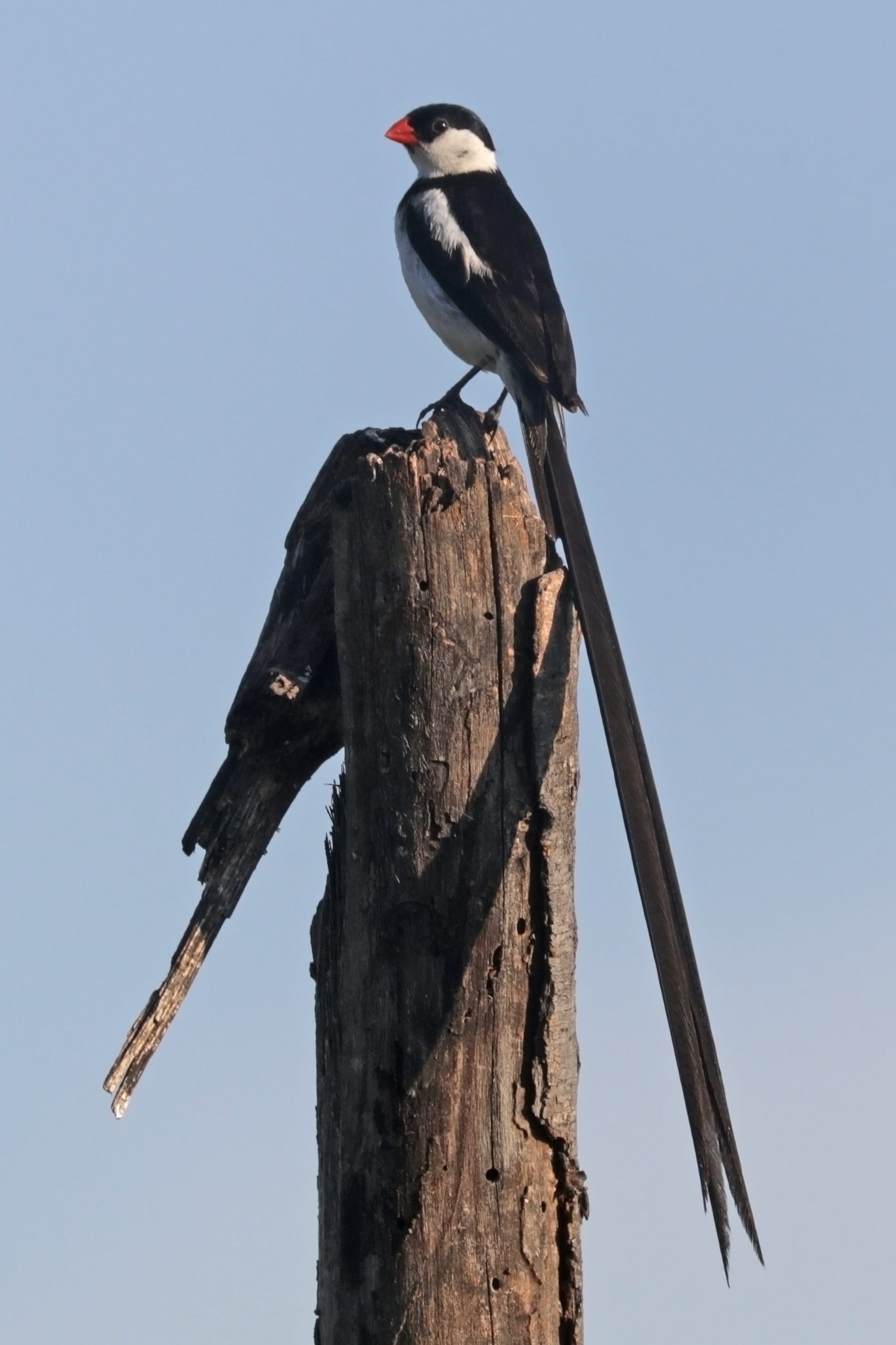
Source: Wikimedia Commons
Pin-tailed Whydah
AdvancedVidua macroura
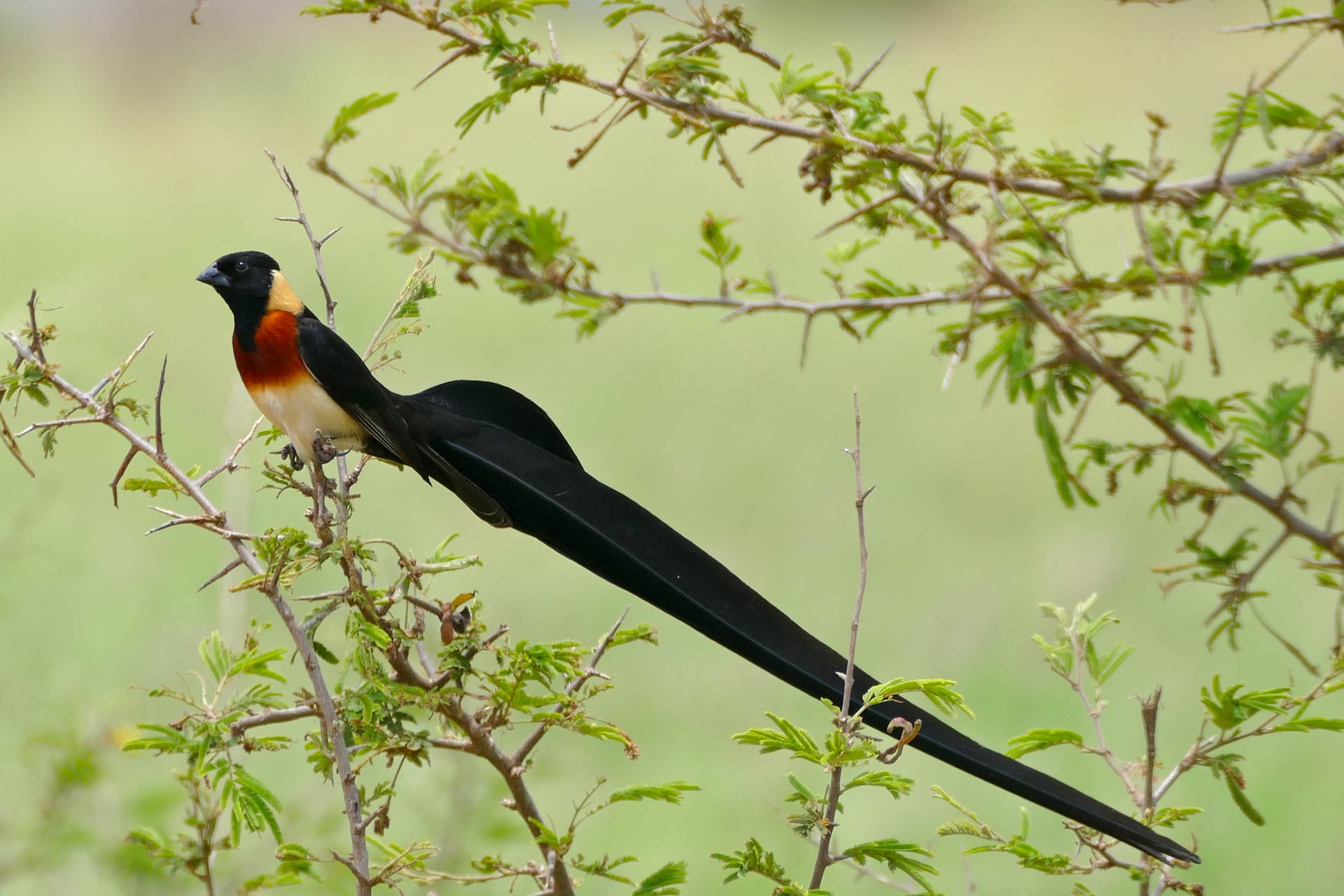
A whydah in which the breeding male grows a black pennant-like tail more than twice his body length, set off by a red bill and black-and-white plumage. It builds no nest, parasitising estrildid finches.
Difficulty
Advanced
Temperature
15〜30℃
Lifespan
6-9 years
Size
12-13cm, with a further 20cm of tail on the breeding male
Humidity
40〜60%
Diet
Mixed seed, spray millet, greens, small livefood
About
The pin-tailed whydah (Vidua macroura) is a small songbird found across most of sub-Saharan Africa. It is 12-13 cm long, though the breeding male adds another 20 cm of long black tail. The breeding male has a black back and crown, dark brown wings with white patches, and white underparts and head apart from the crown, with a bright red bill. Females and non-breeding males have streaked brown upperparts, whitish underparts with buff flanks and no tail extension, but keep the red bill. It builds no nest of its own: it is a brood parasite that adds two to four eggs to the nests of estrildid finches, especially waxbills, and unlike the common cuckoo it does not destroy the host's eggs. Nestling whydahs mimic the gape pattern of the host's young. The male is territorial, often holding several females in a small group, and performs an elaborate courtship flight that includes hovering. Introduced populations are established in Portugal, southern California, Puerto Rico and Singapore. Breeding it in captivity requires an aviary holding several pairs of the host species.
Source: Wikipedia (CC BY-SA 4.0)
Lifespan of the Pin-tailed Whydah
The Pin-tailed Whydah lives 6-9 years.
Size of the Pin-tailed Whydah
The Pin-tailed Whydah grows to 12-13cm, with a further 20cm of tail on the breeding male.
Basic Info
Origin
Most of sub-Saharan Africa, in grassland, scrub and savanna, also entering parks and gardens
Lifespan
6-9 years
Size
Care Specifications
References & Sources
Edited & verified by: BreederDirect editorial team
The taxonomic, regulatory, and husbandry data on this page are compiled and verified against the authoritative primary sources below.
Taxonomy & Authority
Accepted name: Vidua macroura (Pallas, 1764)
Synonyms: Fringilla macroura
Authority databases: GBIF
Nomenclature follows global taxonomic authority databases.
Regulations & Conservation Status
Not CITES-listedIUCN LC · Least Concern
Vidua macroura. The family Viduidae is not listed in the CITES Appendices, so this species is not covered. The IUCN assesses it as Least Concern.
Sources: CITES Appendices (Viduidae not listed) / IUCN Red List
Regulations may change. Always verify the latest information with the relevant authorities.
Pin-tailed Whydah Listings
Loading latest listingsFind listings for this species