What Kind of Animal Is a Tokay Gecko?
The Tokay gecko (scientific name: Gekko gecko) is a large gecko belonging to the family Gekkonidae, genus Gekko, and is widely distributed across Southeast Asia and South Asia. Its name derives from its vocalization "to-kkay," and it is particularly known for calling loudly at night.
Basic Specifications
- Body length: 25–40 cm (including tail)
- Body weight: 60–300 g
- Lifespan: 10–15 years (in captivity)
- Native range: India, Nepal, Bangladesh, Vietnam, Indonesia, etc.
- Activity period: Nocturnal
- Care difficulty: Intermediate to advanced (managing aggression is necessary)
Appearance
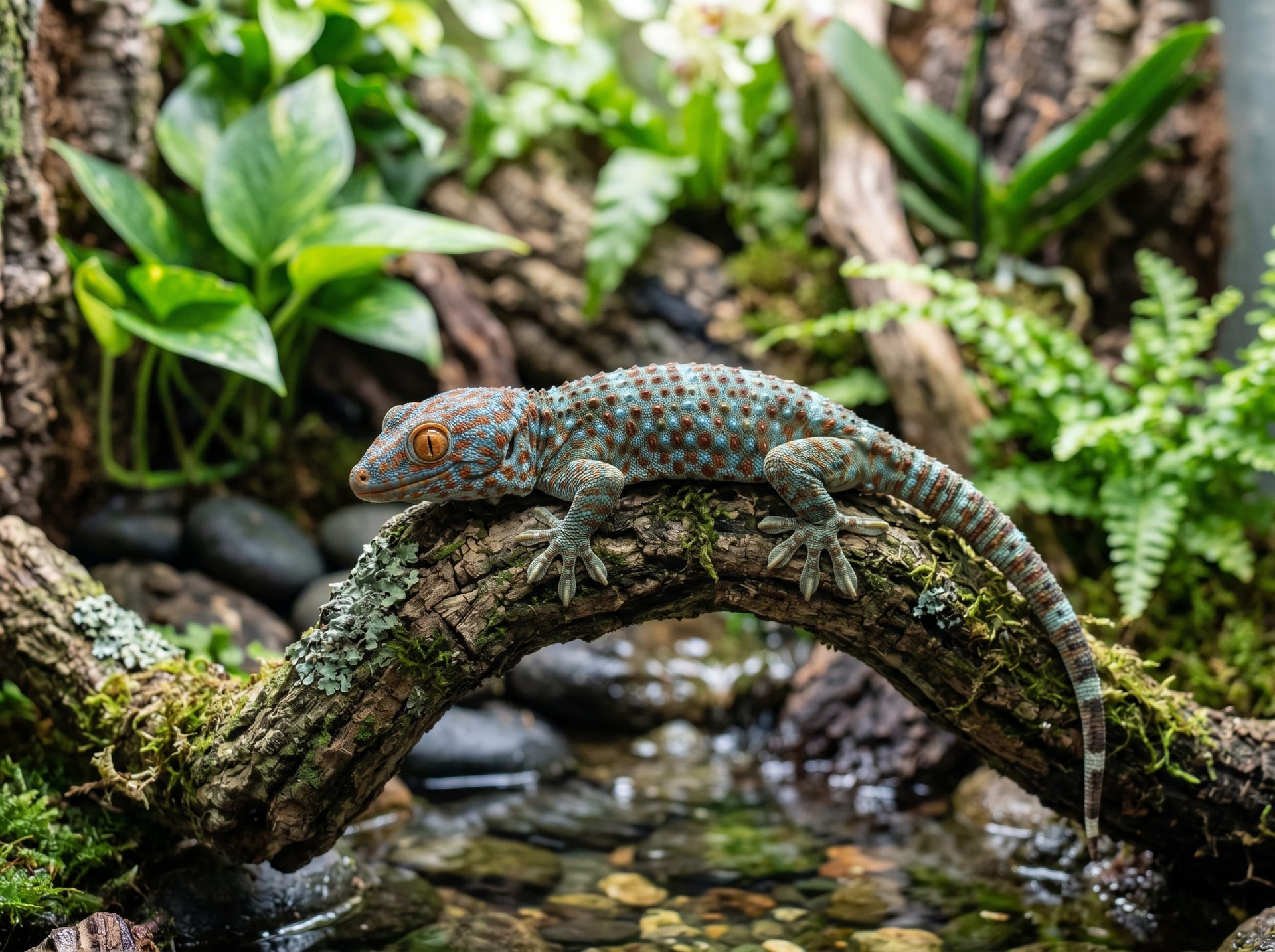
The greatest appeal is their beautiful coloration—a blue-gray to blue-green body scattered with orange to red spots. They possess lamellae on the underside of their toes, enabling them to move vertically across glass surfaces and ceilings. Their large eyes have vertically elliptical pupils characteristic of nocturnal vision.
How Long Do Tokay Geckos Live?
The lifespan of captive Tokay geckos is approximately 10–15 years. If environmental conditions remain stable, it is not uncommon for individuals to live beyond 15 years, placing them among the longer-lived large gecko species. In the wild, predation and seasonal environmental changes result in a shorter lifespan of around 7–10 years.
Four Factors That Influence Lifespan
| Factor | Impact on Lifespan | Practical Notes |
|---|
| Captive-bred (CB) vs. wild-caught (WC) | Most significant | WC individuals carry parasites and transport stress; death within months to a year of arrival is common |
| Minimum temperature | Significant | Prolonged nights below 20°C cause digestive problems and immune suppression |
| Calcium and UVB | Significant | Deficiency leads to metabolic bone disease (MBD), causing deformation of the jaw and limbs, making feeding difficult |
| Humidity and shedding | Moderate | Neglected shedding problems lead to tissue necrosis at the tips of digits and tail, and repeated occurrence depletes overall vitality |
The single most effective factor for longevity is choosing a captive-bred individual. Many Tokay geckos in commerce are wild-caught and priced affordably, but survival rates immediately after acquisition differ significantly. If you intend to keep one long-term, pay slightly more for a CB individual and have a fecal exam performed shortly after bringing it home.
Additionally, a lifespan of over 10 years places demands on the keeper for long-term life planning. Consider major life events such as college, relocation, or marriage, and determine whether you can commit to care before acquiring one.
Size and Growth of Tokay Geckos
Tokay geckos are a large species among geckos, with adult total length reaching 25–40 cm (including tail). Considering that most geckos in the pet trade measure around 10–20 cm, this represents a notably substantial size.
Growth Timeline
| Period | Length Estimate | Weight Estimate |
|---|
| Immediately after hatching | 7–9 cm | 3–5 g |
| 6 months | 15–20 cm | 25–50 g |
| 1 year | 20–30 cm | 60–120 g |
| Adult (1.5–2 years) | 25–40 cm | 60–300 g |
Growth is most rapid during the first year, after which it slows considerably. Sexual maturity is typically reached around 1 to 1.5 years.
Size Differences Between Males and Females
- Males: Larger, reaching 30–40 cm total length. The head is broad and angular; the preanal pores appear in a line anterior to the vent.
- Females: Slightly smaller, typically 20–30 cm. The head is slender; preanal pores are inconspicuous.
Size directly impacts enclosure selection. If you choose an enclosure based on juvenile size, it will become cramped within a year. It is more practical to plan for adult size from the start, preparing an enclosure of at least 60 cm wide × 45 cm deep × 90 cm tall. Adjust prey size as the gecko grows—offer small crickets to juveniles and large to extra-large crickets or medium to large dubia roaches to adults.
Understanding and Managing Aggression
The most important aspect of Tokay gecko care is managing their aggression. Tokay geckos have exceptionally strong biting habits among reptiles, and their bites can be held with considerable force.
Causes of Biting Behavior and Countermeasures
Wild-caught and WC (wild-caught) individuals especially display strong defensive responses, and rash handling is dangerous.
- Patience: Acclimatization may take several months to over a year
- Wear leather gloves: Always wear thick leather gloves when handling
- Habituation through feeding: Repeat feeding with forceps so the gecko becomes accustomed to human presence
- Avoid forced handling: Forceful contact increases aggression
If Bitten
Pulling away when bitten increases tissue damage. It is effective to slowly apply water to the mouth or blow gently on it to encourage release.
Enclosure Setup
Enclosure Size
Because Tokay geckos are active climbers, a tall enclosure is essential.
- Minimum size (one individual): At least 45 cm wide × 45 cm deep × 60 cm tall
- Recommended size: At least 60 cm wide × 45 cm deep × 90 cm tall
- Front-opening (door-style) enclosures are convenient for feeding and maintenance
Use a lid that locks completely. Tokay geckos have remarkable escape ability.
Temperature and Humidity Management
| Parameter | Recommended Value |
|---|
| Daytime temperature | 26–30°C |
| Nighttime temperature | 22–25°C |
| Basking spot | 32–35°C |
| Humidity | 60–80% |
Heating and Humidity Methods
- Install a far-infrared ceramic heat panel on the outside of the enclosure side
- Monitor for temperature drops in late night to early morning (prolonged periods below 20°C are problematic long-term)
- Maintain humidity with a misting system or manual spray bottle
- Excessive dryness causes shedding problems
Layout and Hides
Tokay geckos prefer to hide and will settle better when provided secure refuges.
- Cork bark and driftwood: Arrange vertically to create climbing structures
- Shelters: Install multiple half-cylinder or cork tube hides
- Artificial plants: Add vertical dimension and increase hiding spots
- Background: Attaching 3D background material to the back and sides of the enclosure promotes security
Lighting
Nocturnal species do not require intense lighting, but a low-output UVB light helps maintain day-night cycles and supports health.
- Duration: 10–12 hours per day
- UVB lamp (UVB 5.0 or lower, low-output): Supports vitamin D3 synthesis
Feeding and Diet
Types of Food
Tokay geckos are omnivorous with a primary diet of insects.
Crickets (most common): Use two-spotted crickets (Gryllus bimaculatus) or house crickets (Acheta domesticus) as a staple. Gut-load feeders with vegetables and flake foods before offering to increase nutritional value.
Dubia roaches: High in nutrition and easier to maintain than crickets. Select sizes appropriate to your gecko, as adults can be too large.
Mealworms and giant mealworms: Use as supplementary food. High fat content makes them unsuitable as a primary diet.
Pink mice (neonatal mice): For adults, offering once or twice monthly provides nutritional supplementation.
Feeding Frequency and Supplements
- Juveniles and growing individuals (–18 months): Once every 2–3 days
- Adults (18 months and older): 2–3 times per week
- Calcium supplement: Dust prey insects at every feeding
- Multivitamin supplement: Dust prey 1–2 times per week
Response to Feeding Refusal
Temporary refusal due to environmental changes, stress, or pre- or post-shedding is normal. If complete refusal persists for more than two weeks, check temperature, humidity, and stress factors. If problems do not resolve, consult a veterinarian.
Shedding Care
Tokay geckos shed regularly—frequently in young individuals, approximately once every 1–2 months in adults.
Signs that shedding is beginning: Body color becomes dull; the body appears whitish.
Prevention of Shedding Problems
- Maintain humidity at 65–80%
- Provide a wet hide (a shelter with moistened sponge inside)
- Avoid feeding immediately before and during shedding
Treatment of Shedding Problems
- Soak in lukewarm water (around 30°C) for 10–15 minutes to soften the skin
- Gently rub with a soft cotton swab
- Shedding problems at the tips of digits and tail can lead to tissue necrosis and require prompt attention
Common Illnesses
Stomatitis (mouth rot): Pus or cheese-like discharge appears around the mouth. Caused by bacterial infection. Antibiotic treatment by a veterinarian is necessary.
Parasitic infection: Common in WC individuals. External parasites such as mites and intestinal parasites. Perform regular fecal exams and administer deworming treatment as needed.
With proper care, the Tokay gecko becomes a long-term companion. By correctly understanding their aggression and interacting with patience, you can build a relationship of trust.