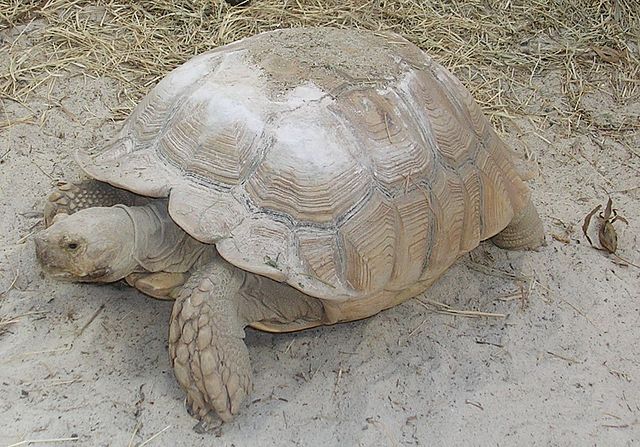
What Is the Sulcata Tortoise?
The Sulcata Tortoise (Centrochelys sulcata) is a terrestrial tortoise native to the Sahel region of sub-Saharan Africa—the arid zone stretching from Senegal to Ethiopia. It ranks third in size globally after the Galápagos and Aldabra giant tortoises, with adults reaching carapace lengths of 60–80 cm and weights of 30–50 kg not being uncommon.
The Japanese name "ケヅメリクガメ" derives from the distinctive large spurs at the base of its front legs. While hatchlings are small enough to fit in the palm of your hand and appear adorable, they grow remarkably fast—reaching over 20 cm in growth within a year under proper conditions. In the wild, they live 70–150 years; when properly cared for in captivity, they may outlive their keeper.
Most individuals in the pet trade today are captive-bred (CB) and relatively affordable, but it's essential to fully understand the reality: they become very large, eat enormous quantities, are extremely strong, and require a substantial outdoor enclosure if kept as a pair or for long-term care.
Critical Pre-Purchase Checklist
Before bringing a Sulcata tortoise home, you must verify the following points.
Space Requirements
Adult Sulcatas require a minimum of approximately 10 square meters (about 100 square feet) of outdoor space. An ideally single-family house with a garden is essential; long-term care in apartments or condominiums is practically unfeasible. Keep in mind that required space increases as the tortoise grows.
Food Costs
Adults consume large quantities of grasses and vegetables daily. Timothy hay and orchard grass serve as staples, and monthly feed costs can reach several thousand to over 10,000 yen.
Lifespan and Owner Responsibility
Taking on an animal that may live over 70 years carries lifelong responsibility. Consider in advance what you'll do if long-term care becomes impossible—identify potential alternatives such as reptile specialty shops, rescue organizations, or breeder contacts.
Creating the Proper Care Environment
Juvenile Care (Indoor)
During the juvenile stage (carapace length ≤15 cm), indoor management is standard. Prepare an enclosure of at least 90 cm and establish the following conditions.
Temperature Management
- Basking spot: 38–42°C
- Cool zone in enclosure: 25–28°C
- Nighttime minimum: 20°C or above
- Use under-floor heating (panel heaters or radiant heaters) for bottom-up warmth
UV Lighting
UVB is crucial for Sulcatas. Use metal halide lamps or T5 10.0 UVB bulbs, maintaining proper distance to support calcium metabolism. Aim for 10–12 hours of daily exposure.
Substrate
Use sand or soil-based substrates (reptile sand, river sand, or coconut husk soil mix). Since Sulcatas are burrowers, providing at least 10 cm of substrate reduces stress. Remove feces daily and replace substrate monthly or bimonthly.
Adult Care (Outdoor)
Once the carapace exceeds 20–30 cm in length (3–5 kg in weight), establish a full outdoor enclosure.
- Fencing must be at least 50 cm tall, with 10–20 cm buried underground to prevent escape digging
- Install a shelter or shed for rain protection and shade
- Move indoors or to a heated shelter at night or when temperatures drop below 20°C
- Indoor heating is essential during Japan's winter months (below 10°C)
Diet and Hydration
Sulcatas are herbivorous and thrive on high-fiber, low-protein, low-fat diets.
Primary Diet (70–80%)
- Timothy hay, orchard grass, and other quality hays
- Yard weeds (dandelions, dead-nettle, plantain, etc.)
- Hay blocks or compressed hay pellets (reconstituted in water)
Supplementary Foods (20–30%)
- Pumpkin, carrot, cabbage, and bok choy (in moderation)
- Hibiscus and rose petals (highly palatable)
- Prickly pear (Opuntia spp.) fruit and pads
Foods to Avoid
Avoid excessive fruit due to high sugar content. Lettuce, spinach, and napa cabbage contain too much water and oxalates for a staple diet. Limit cruciferous vegetables like cabbage.
Hydration
Though from the Sahel, Sulcatas need adequate hydration. Warm soaks (around 30°C for 10–15 minutes) 2–3 times weekly prevent dehydration and aid digestion. A permanent water dish or daily misting of the substrate also works well.
Calcium Supplementation
Dust meals with cuttlebone powder or calcium supplement 2–3 times weekly. Combined with proper UVB exposure, this supports healthy bone and shell development.
Common Health Issues and Prevention
Metabolic Bone Disease (MBD)
Caused primarily by insufficient UVB and calcium. Watch for soft or deformed shells. Prevent with proper lighting and calcium supplementation 1–2 times weekly.
Respiratory Infection (RI)
Triggered by low temperatures, excessive humidity, or stress. If you notice nasal discharge, open-mouth breathing, or loss of appetite, consult a reptile specialist veterinarian immediately. Antibiotic treatment may be necessary.
Internal Parasites
Nematodes and flagellates are common in wild-caught individuals and unsanitary conditions. Perform regular fecal examinations. Even captive-bred specimens carry infection risk.
Esophageal and Gastrointestinal Impaction
Impaction can occur from accidental ingestion of small stones or substrate. Use appropriately sized substrate and avoid anything the tortoise might swallow.
Winter Management and Temperature Control
Japan's winter is extremely dangerous for Sulcatas. Below 10°C, immunity drops significantly; below 5°C, hypothermia becomes life-threatening. Since Sulcatas do not hibernate, indoor heating is mandatory during winter.
- Overwinter in a warm room (minimum 20°C or above) or dedicated greenhouse
- Use layered heating with ceramic and panel heaters
- Install a thermostat to prevent rapid nighttime temperature drops
Long-Term Care Success
While sometimes described as "easy to care for," Sulcatas become extremely demanding and costly once adult. Only those who prepare adequately from the juvenile stage—imagining the adult's future needs and ensuring sufficient space, funds, and time—will succeed in long-term care.
When raised in proper conditions, Sulcatas become remarkably tame and affectionate—even responding to their names. If you're prepared for a long-term partnership, you'll find them to be truly rewarding companions.