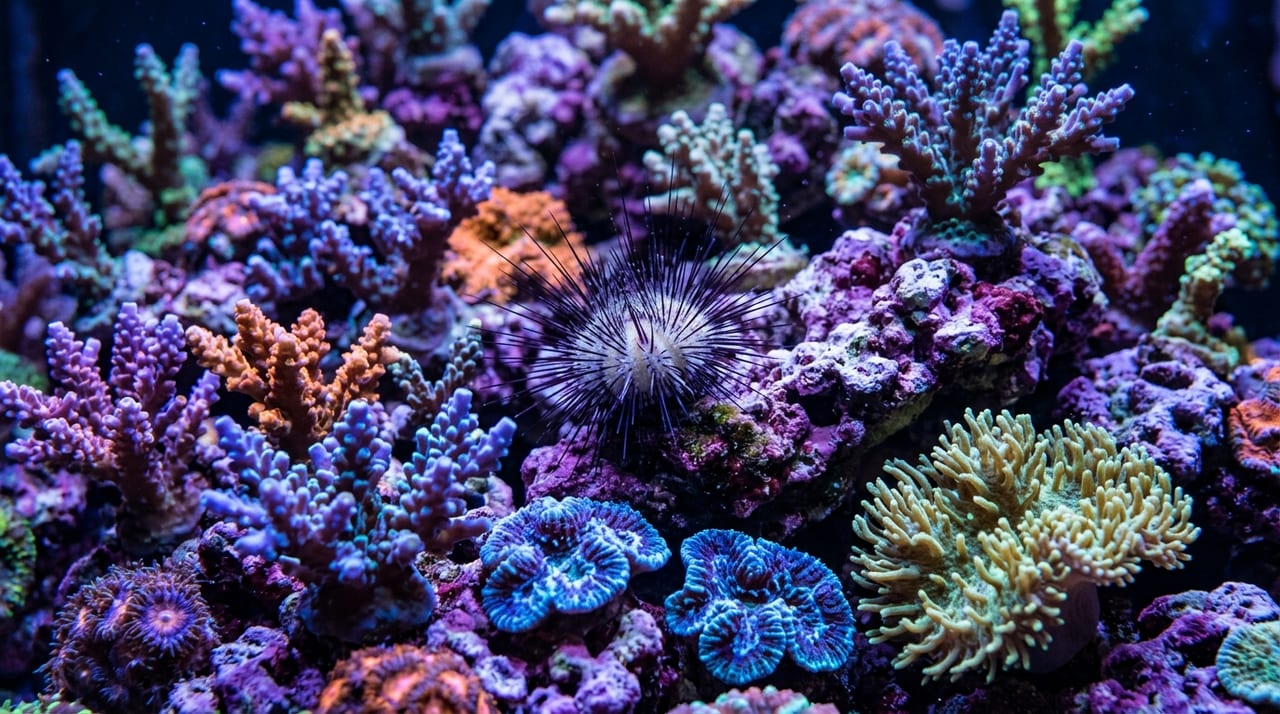
Sea Urchin Saltwater Tank Care Guide | How to Choose Species, Tank Setup, Algae-Eating Ability, and Precautions
How to keep sea urchins in reef tanks. This guide explains the characteristics of readily available species, water quality requirements, algae-eating abilities, and compatibility with corals.
Key Takeaways
How to keep sea urchins in reef tanks. This guide explains the characteristics of readily available species, water quality requirements, algae-eating abilities, and compatibility with corals.
What You Should Know Before Adding Sea Urchins to Your Reef Tank
✍️
BreederDirect Editorial
The BreederDirect editorial team specializes in care information for animals, covering veterinary care and breeding to deliver beginner-friendly guides.
Find Coral on BreederDirect
Buy directly from verified breeders
Browse Related Listings
Find Coral listings related to this article on BreederDirect. Buy directly from verified breeders.
Among the creatures that inhabit saltwater aquariums, few organisms provide as reliable and consistent algae-removal work as sea urchins. However, when setup environments are poorly chosen, sea urchins can become troublesome inhabitants that physically destroy corals and live rock. This article organizes information about the types of sea urchins that can actually be kept in home saltwater tanks and the knowledge necessary for long-term management.
The greatest strength of sea urchins as cleanup crew (CUC) is that they patrol areas that other cleaner organisms find difficult to reach—the surface of live rock and the edges of substrate. Because they can access narrow crevices and the undersides of rocks where turbo snails and other shell-eating creatures cannot go, they serve as an excellent addition when combining multiple algae-eating organisms.
On the other hand, the greatest risk posed by sea urchins is physical destruction during movement. Sea urchins are nocturnal and become highly active in darkness, and their spines can damage the tissue of delicate SPS and LPS corals they encounter along their routes. Careful consideration of aquarium layout and species selection before introduction is essential.
Recommended Species for Aquarium Keeping
Warty Sea Urchin (Mespilia globulus) is popular as an introductory species that balances aesthetic appeal with algae-eating ability. With a body diameter of 5–7 cm and bluish spines that stand out beautifully in reef tanks, they can be maintained without artificial food in environments with sufficient algae. They fit easily into rock crevices and show virtually no aggression toward corals or fish. Their relatively gentle movement minimizes physical contact risk to LPS corals.
Long-spined Sea Urchin (Diadema setosum) has long spines (up to 30 cm) with high ornamental value but is difficult for beginners to handle. Their spines are venomous, and accidental contact during tank work causes intense pain. While they rarely eat corals directly, their movement can damage SPS corals on contact. Introduction can be considered for tanks larger than 60 cm where corals are arranged only in the upper regions.
Red Sea Urchin (Tripneustes gratilla) is highly omnivorous, consuming not only algae but also soft corals and nudibranchs. Despite their beautiful appearance, introduction to reef tanks is not recommended. They are better suited for algae-only FUGEs (refugium-style sumps) or quarantine tanks for algae control purposes.
Banded Sea Urchin (Echinothrix calamaris) is medium-sized with fine, elegant-looking spines. Algae-eating ability is standard, but their active movement can collapse live rock arrangements. Their body color ranges from gray to yellow-green, somewhat drab, but specimens with long-spine contrasts can be quite beautiful.
Basic Water Quality and Setup Requirements
Sea urchins, like corals, are sensitive to rapid changes in specific gravity and water quality. Target parameters are as follows: specific gravity (salinity) 1.025–1.026, water temperature 24–26°C, pH 8.1–8.3, KH (carbonate hardness) 8–11 dKH, calcium 400–450 mg/L, magnesium 1,250–1,350 mg/L, and nitrate below 20 ppm.
After purchase, acclimate the urchin using the drip method for at least 2 hours. Because sea urchins sense water quality through their skin, they are extremely sensitive to rapid specific-gravity changes and temperature shock. By gradually diluting the bag water and acclimating them to main tank water quality, stress during introduction can be minimized.
Pay attention to dissolved oxygen levels as well. If protein skimmer aeration efficiency has declined, sea urchins can enter a dormant state. If an urchin that normally clings to the glass becomes immobile on the substrate, checking dissolved oxygen levels is a good first step.
Algae-Eating Ability: Reality and Limitations
A single Warty Sea Urchin can remove approximately one 60 cm tank-face's worth of algae per week. However, there are differences in what types of algae they will and won't eat. They actively consume filamentous green algae (Trichobius species) but tend to avoid cyanobacteria (blue-green algae) and brown diatoms (slime-type). Since diatoms are better handled by turbo snails and other shell-eating creatures, combining species creates good complementary effects.
When algae becomes scarce, sea urchins may starve. In such cases, provide dried kombu or commercial kelp sheets 2–3 times weekly. Overfeeding causes water quality degradation, so limit amounts to what can be consumed in a few hours. Always remove uneaten kelp. If the lack of algae and supplemental feeding continues, sea urchins will scrape away not only the algae on live rock but also harmless bacterial colonies and coralline algae.
Cohabitation with Coral Tanks and Important Precautions
Whether sea urchins directly consume corals varies by species, but the greatest risk is actually physical contact. Being nocturnal, sea urchins become highly active in darkness and moving around may contact and damage the tissue of delicate SPS and LPS corals.
One countermeasure is to intentionally create a "safe algae space" where urchins can move around. Leaving algae on the substrate and side glass while arranging corals only in mid to upper levels is an effective layout. It's also important to avoid over-cleaning the tank of algae before urchins consume it all.
Protein skimmer intake also requires attention. Small urchins attaching to skimmer strainers and dying has been reported. Guard with a sponge net or adjust skimmer placement to prevent entry.
Be cautious around piping and wiring as well. Sea urchins crawl up glass at any time of day and can enter gaps around tank-top pipes and wiring. Check tank cover placement and equipment position, and seal any gaps that could become escape routes.
Breeding and Long-Term Care Considerations
In-tank breeding of sea urchins should be considered nearly impossible. Larvae are planktonic and get sucked into filtration systems. The realistic approach is to focus on maintaining purchased individuals in good health over the long term.
Lifespan in captivity is reported as 5–7 years for Warty Sea Urchins. Daily observation should verify active movement on glass and normal spine arrangement. If spines fall out or the body becomes immobile, suspect water quality problems, malnutrition, or infection (sea urchin wasting disease). Sea urchin wasting disease spreads rapidly when multiple individuals are kept, making early isolation critical upon noticing abnormalities.
Sea urchins may not be flashy stars, but they serve as the "unsung heroes" supporting reef tank ecosystems. With careful species selection and environment preparation, they become excellent long-term cleanup crew members. BreederDirect carries numerous saltwater creature listings—if you're searching for cleanup organisms for your saltwater tank, please check our current listings.