Poison Dart Frog (Dendrobates) Care Guide | Vivarium, Feeding, and Breeding Basics
A comprehensive guide to caring for poison dart frogs (Dendrobates tinctorius and others), beloved for their vibrant coloration. Learn why they are non-toxic in captivity, how to build a tropical rainforest vivarium (substrate, planting, humidity control), how to start your own fruit fly cultures, and detailed information on natural breeding within the vivarium.
Key Takeaways
A comprehensive guide to caring for poison dart frogs (Dendrobates tinctorius and others), beloved for their vibrant coloration. Learn why they are non-toxic in captivity, how to build a tropical rainforest vivarium (substrate, planting, humidity control), how to start your own fruit fly cultures, and detailed information on natural breeding within the vivarium.
Poison dart frogs are small frogs that inhabit tropical rainforests in Central and South America, captivating amphibian enthusiasts worldwide with their vibrant coloration and toxicity. In captivity, they are non-toxic and therefore safe to care for, and when paired with a beautiful vivarium, they have exceptionally high ornamental value. In this article, we will focus primarily on the representative genus Dendrobates (Dendrobates spp.) and provide a detailed explanation of poison dart frog characteristics, care environments, and breeding.
What Are Poison Dart Frogs?
Poison dart frogs are a general term for amphibians belonging to the family Dendrobatidae. They are famous for accumulating toxic skin gland secretions in their small bodies (1–5 cm in length) in the wild. However, in captivity they become non-toxic because they do not eat insects containing specific toxic compounds (alkaloids), making them safe to handle.
Primary Species for Captive Care
| Species | Origin | Body Length | Characteristics |
|---|---|---|---|
| Dendrobates tinctorius (Tinctorius) | Northern Amazon | 4–5 cm | Rich color variations. Hardy and beginner-friendly |
| Dendrobates auratus (Auratus) | Central America | 3–4 cm | Striking green and black patterns. Readily available |
| Ranitomeya spp. (Spot-back types) | Peru, etc. | 1.5–2.5 cm | Extremely small and delicate. For advanced keepers |
| Oophaga pumilio (Strawberry) | Costa Rica | 2–2.5 cm | Beautiful red-toned coloration |
| Allobates zaparo (Allobates) | Ecuador | ~2 cm | Dull coloring but interesting for behavior observation |
For first-time keepers, Dendrobates tinctorius and D. auratus are hardy and easy to handle, with high satisfaction in terms of vibrant coloration.
Care Environment — How to Set Up a Vivarium
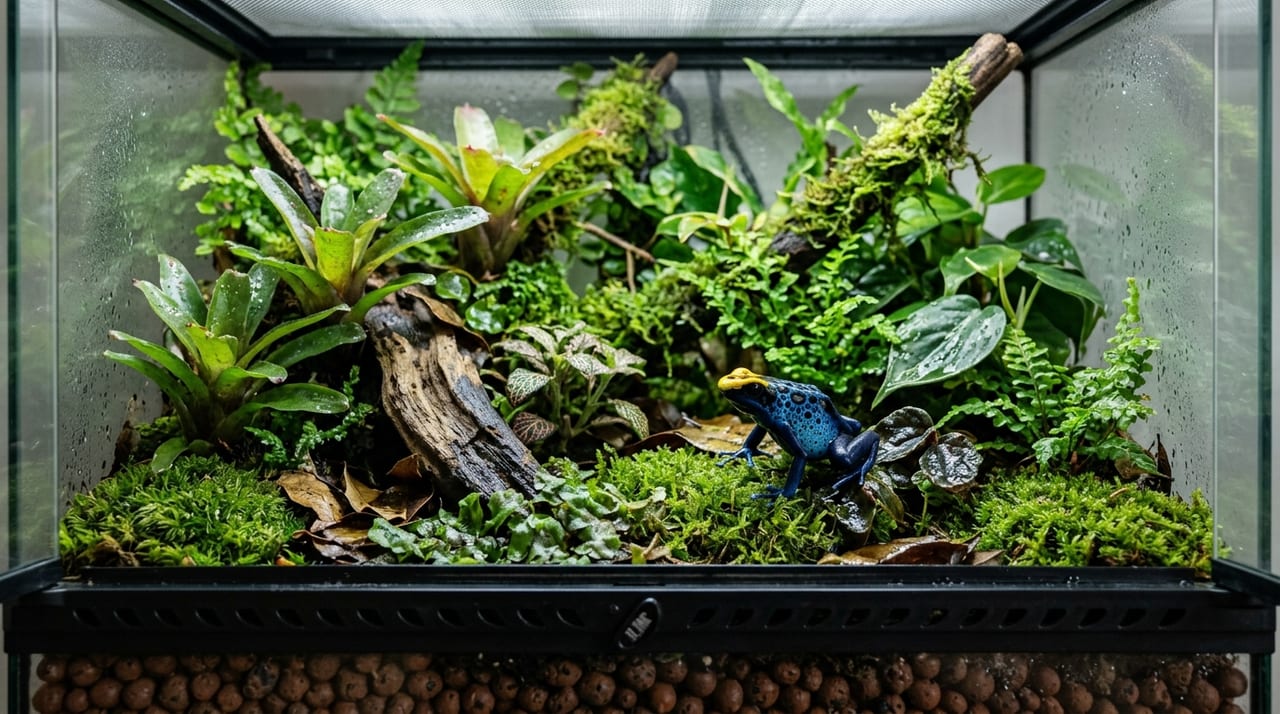
Essential to poison dart frog care is a terrarium (vivarium). The true joy of poison dart frog keeping lies in creating a high-humidity glass enclosure that mimics a tropical rainforest environment.
Enclosure Selection and Recommended Sizes
- 1–2 frogs: 30×30×45 cm (tall vertical enclosure preferred)
- Pair or group housing: 45×45×60 cm or larger
- Material: Glass or resin terrarium cases with good breathability. Sealed construction is important to prevent escaped crickets
Substrate and Planting
Poison dart frog vivarium substrates typically use a two-layer system: drainage layer plus base layer.
- Drainage layer (bottom): Lava rock, hydroton, or drainage mesh. 3–5 cm deep
- Base layer (top): ABG (American Vivarium Group) mix or homemade substrate (sphagnum moss, coco husk, charcoal, and peat mixed)
- Planting: Humidity-loving plants such as bromeliads, fittonias, peperomias, and mosses
As the plants grow dense, they create natural shelters that serve as hiding places and egg-laying sites for poison dart frogs.
Temperature and Humidity
| Item | Recommended Value |
|---|---|
| Daytime temperature | 23–26°C |
| Nighttime temperature | 18–22°C (careful management in summer) |
| Humidity | 80–100% (maintain high humidity at all times) |
| Misting | 2–3 times daily or use automatic mister |
| Lighting | Full-spectrum LED (12–14 hours) |
Summer temperature management is critical; if temperatures exceed 28°C, condition can deteriorate rapidly. Ideally, use air conditioning to maintain room temperature.
Feeding — Live Food Management is the Core of Care
Poison dart frogs only eat live food. The primary feeder insects are as follows:
Primary Live Foods
- Fruit flies (Drosophila melanogaster / D. hydei): The standard diet for poison dart frogs. Home culturing is essential
- Cricket nymphs (pinheads): Provide after gut-loading with high-nutrition supplements
- Phorid flies: Larger than fruit flies. Suitable for larger species
- Springtails: When allowed to colonize the vivarium, they are eaten naturally and help with substrate cleaning
Feed approximately once every 3 days or twice every 3 days, with 10–20 insects per feeding. Dust with calcium + vitamin D3 supplement approximately once per 10–15 insects.
Breeding — The Joy of Raising Life in a Vivarium
Poison dart frogs can breed naturally within the vivarium, and with proper conditions, breeding behavior can be observed within 1–2 years.
The Breeding Process
- Pairing: Pair housing (one male to one female) is most stable. Some Phyllobates species can house one male with multiple females
- Egg-laying: Eggs (approximately 2–10) are laid in bromeliad leaf axils, under leaves, or under shelter lids
- Egg care: For species where parents carry tadpoles (Oophaga genus), natural management is ideal. Dendrobates species can also be artificially incubated
- Tadpole rearing: Raise in small containers (200–300 ml) with dechlorinated tap water and small amounts of algae wafers or blanched vegetables
- Post-metamorphosis care: They metamorphose at 8–10 mm in body length. Within 1–2 months, they can eat fruit flies
Summary
Poison dart frogs are one of the pinnacles of amphibian keeping, offering both the concentrated beauty of a small body and the enjoyment of creating a meticulous vivarium. The difficulty of care depends on mastering home fruit fly culturing; once that hurdle is cleared, daily management is surprisingly simple. The experience of raising young frogs that have naturally bred in the vivarium is extraordinary and will draw you into the deeper world of reptile and amphibian keeping.