Complete Guide to Keeping Panther Chameleons | Enclosure, Misting, UVB, and Basic Diet
A thorough explanation of panther chameleon care methods. Introduction for beginners covering the mechanism of color change, essential UVB lighting setup, water supply through misting, cage layout for three-dimensional movement, and types of feeder insects.
Key Takeaways
A thorough explanation of panther chameleon care methods. Introduction for beginners covering the mechanism of color change, essential UVB lighting setup, water supply through misting, cage layout for three-dimensional movement, and types of feeder insects.
Related Species
What is a Panther Chameleon?
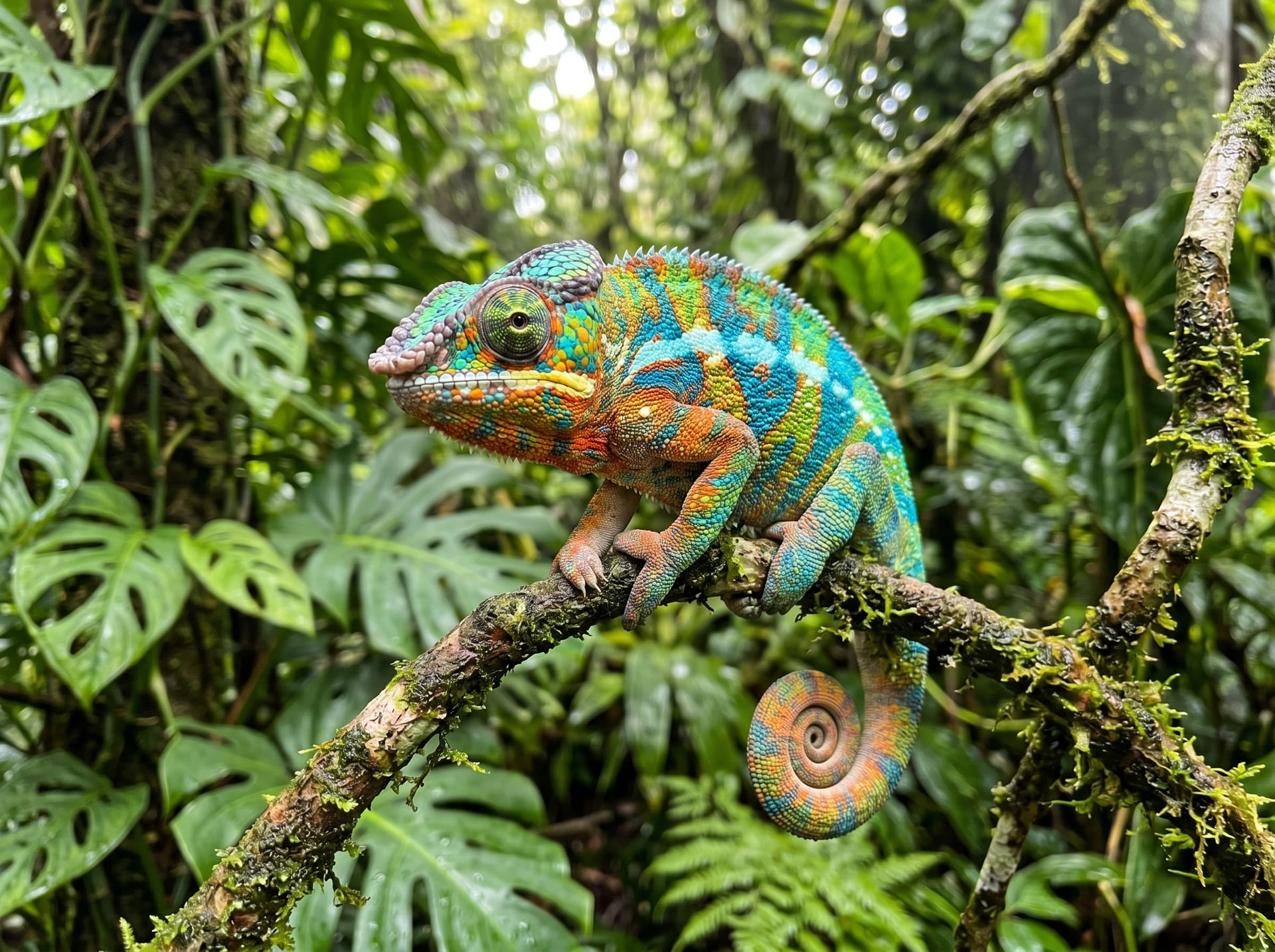
The panther chameleon (scientific name: Furcifer pardalis) is a reptile of the chameleon family that inhabits Madagascar. Males display dramatically different coloration depending on their locality, such as the turquoise blue of Ambilobe, the vibrant green of Nosy Be, and the striking red and blue contrast of Ambanja, showcasing some of nature's finest coloration.
Basic Information:
- Length: Males 40–55 cm, females 25–35 cm
- Lifespan: Males 5–7 years, females 3–5 years (females tend to have shorter lifespans due to the stress of egg-laying)
- Temperament: Solitary and highly territorial. Handling is stressful for most individuals
Panther chameleons are considered intermediate to advanced in care difficulty and are positioned as a "beginner chameleon species," but they require all special care needs (misting, ventilation, and UVB) to be met, making prior preparation essential.
How Color Change Works
Chameleon color change is primarily for "emotional expression" and "thermoregulation." The common myth that they change color to match their surroundings is not accurate.
Main situations where color change occurs:
- When excited or stressed: Changes to dark colors (black, brown)
- During courtship or territorial display (males): Displays vibrant colors at their most intense
- During basking to warm the body: Darker colors increase heat absorption
- When relaxed: Displays calm, neutral tones
Color change occurs when nanocrystal structures within the skin alter light reflection patterns. Males become more vividly colored to display health, vitality, and territorial dominance, which serves as a "health indicator" during captive care.
Enclosure Setup
Enclosure Type and Recommended Size
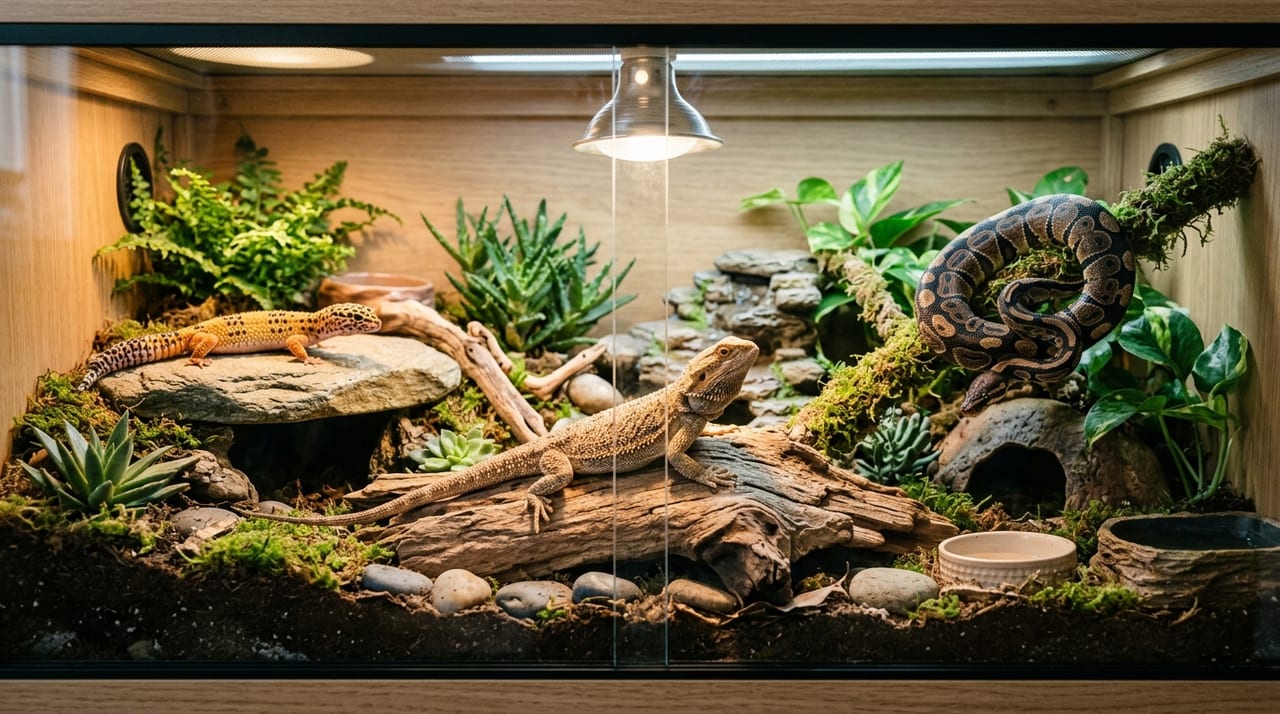
Mesh enclosures (prioritizing ventilation) are essential for panther chameleons. Glass enclosures do not provide sufficient ventilation and can lead to respiratory disease.
| Individual | Recommended Enclosure Size |
|---|---|
| Juvenile to Subadult | 45 cm × 45 cm × 60 cm or larger |
| Adult Male | 60 cm × 60 cm × 120 cm (vertical orientation) |
| Adult Female | 60 cm × 60 cm × 90 cm |
Chameleons have a climbing habit and vertical space is especially important.
Enclosure Layout
- Branches and driftwood: Provide multiple branches 2–3 cm in diameter positioned so the chameleon can grip with its entire body and move around
- Live plants: Pothos, pakira, and ficus trees add humidity retention, hiding spots, and water droplets (for drinking)
- Water dish not needed: Panther chameleons only drink dripping water droplets. Water dishes pose a drowning risk
Temperature and Humidity Management
Recommended Environmental Parameters
| Area | Target |
|---|---|
| Basking spot | 30–35°C |
| Overall (daytime) | 24–28°C |
| Nighttime | 18–22°C (cool-down essential) |
| Humidity | 50–70% (rises to 80–90% after misting) |
Chameleons require a nighttime cool-down period; maintaining high temperatures at night will compromise immune function.
Misting for Hydration
Panther chameleons obtain water by licking water droplets. Perform misting 2–3 times daily, covering the entire enclosure for 1–2 minutes.
Misting methods:
- Manual spray bottle: Perform 2–3 times daily over the entire enclosure
- Automatic misting system (recommended): Systems like ReptiBreeze MistKing or Zoo Med Misting automatically spray on a timer
- Dripper: A device that drips water one drop at a time, placed on leaves (allows observation of drinking)
If the enclosure does not dry after misting, the risk of infection (respiratory infection, dermatitis) increases. The ideal drying time for a mesh enclosure is 30–60 minutes.
UVB Lighting (Essential)
UVB is essential for vitamin D3 synthesis and calcium metabolism in chameleons.
Recommended UVB lamps:
- Linear T5 UVB 6%–10%: Arcadia's T5 Forest/Desert series is well-regarded
- Install separately from the basking lamp (higher screening rate through mesh = 6–10% UVB recommended)
- Lamp replacement: Every 6–12 months (UVB degrades even if not visually apparent)
Diet and Nutrition Management
Recommended Feeder Insects
Panther chameleons are obligate carnivores and primarily eat insects.
| Feeder Type | Characteristics | Feeding Frequency |
|---|---|---|
| Cricket (two-spotted) | Good nutritional balance. Staple | Daily to every other day |
| Dubia roach | Excellent protein and fat balance | Can be used as staple |
| Honey worm | High calorie. Use when appetite is low | Up to 1–2 times weekly |
| Madagascar hissing roach | For larger individuals | 1–2 times weekly |
| Wax worm | High fat content—avoid overfeeding | Monthly as treat |
Calcium dusting (essential): Coat all feeder insects with calcium powder (containing vitamin D3) before each feeding.
Feeding Methods
- Free-range feeding: Place feeder insects in a cup inside the enclosure and allow the chameleon to hunt freely
- Gut-loading (essential): The quality of feeder insects directly affects chameleon health. Feed crickets vegetables (carrots, collard greens, etc.) for 24+ hours before use to enhance nutrition
Health Management and Common Diseases
Dehydration (Most Common Issue)
Symptoms: Sunken eyes, wrinkled skin, reduced appetite
Treatment: Increase misting frequency and duration. In severe cases, seek veterinary fluid support
Metabolic Bone Disease (MBD)
Symptoms: Jaw deformity, bent limbs, poor balance
Cause: Insufficient UVB or calcium
Treatment: Strictly maintain UVB lighting and calcium dusting at every feeding
Respiratory Infection (RI)
Symptoms: Open-mouth breathing, mucus from mouth, decreased appetite
Cause: Excess humidity, low temperature, poor ventilation
Treatment: Seek a reptile veterinarian immediately. Early treatment is critical
Summary: What to Verify Before Getting a Panther Chameleon
Panther chameleons are demanding animals, but when kept in proper conditions, they offer a unique attraction unavailable in other reptiles: stunning color displays.
Key points to verify before acquisition:
- Can you install an automatic misting system?
- Do you have space for a vertical mesh enclosure?
- Is there a reptile veterinarian nearby?
- Can you manage live food (crickets)?
If you can meet all four requirements, you'll be able to fully enjoy keeping a panther chameleon.