A Guide to Managing Large Japanese Stag Beetles by Origin Region and Subspecies | Preserving Bloodline Value Through Preventing Strain Mixing and the Importance of Breeding Records
A comprehensive guide explaining the morphological characteristics and bloodline management methods for large Japanese stag beetles by origin region and subspecies. This article covers the characteristics of domestic Japanese stag beetle regional populations (Nose, Kurume, Yamanashi, Osaka, etc.), breeding management techniques to prevent strain mixing, and how to maintain breeding records—providing essential foundational knowledge on origin region management that every breeder should know.
Key Takeaways
A comprehensive guide explaining the morphological characteristics and bloodline management methods for large Japanese stag beetles by origin region and subspecies. This article covers the characteristics of domestic Japanese stag beetle regional populations (Nose, Kurume, Yamanashi, Osaka, etc.), breeding management techniques to prevent strain mixing, and how to maintain breeding records—providing essential foundational knowledge on origin region management that every breeder should know.
Related Species

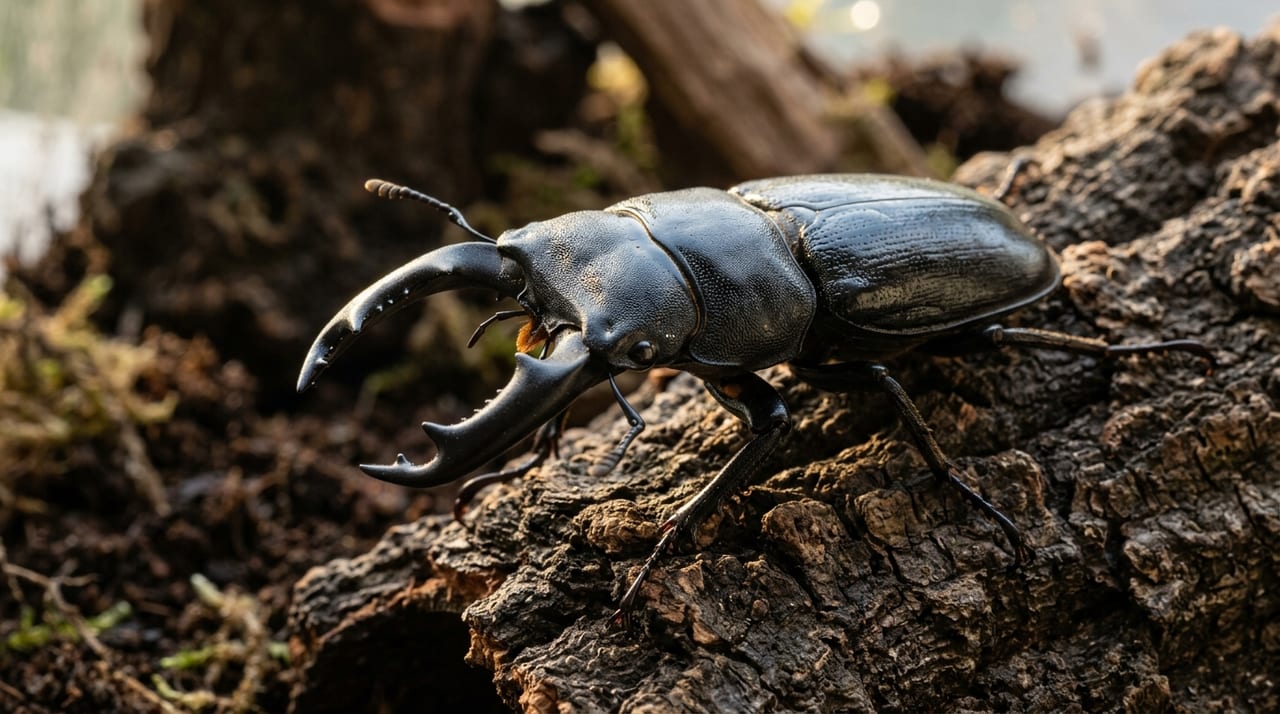
The large Japanese stag beetle (Dorcus hopei binodulosus) is one of the most important species in Japanese stag beetle breeding. Beyond simply raising large individuals, bloodline management focused on "maintaining the purity of the origin region" is highly valued among enthusiasts and breeders. In this article, we will explain the characteristics of large Japanese stag beetles by origin region and the correct methods for managing origin regions and bloodlines.
Fundamental Concepts in Large Japanese Stag Beetle Origin Management
The large Japanese stag beetle is distributed throughout Japan, but body shape, head width, mandible shape, and size tendencies vary by region. These regional differences are called "regional populations (local forms)," and breeders typically manage and breed by identifying the origin region.
Why is origin region management important?:
- Specifying the origin region guarantees the value of the individual
- Regional-specific morphological characteristics (such as size-increase trends and mandible shape) can be passed to the next generation
- Credibility increases as proof of origin for wild-collected individuals
- Strain mixing (crossing individuals from different origin regions) cannot be reversed once done
Individuals that have undergone strain mixing lose bloodline value, and conscientious breeders clearly label mixed-strain individuals as "hybrid" or "WF origin unknown" when selling them.
Major Origin Regions and Their Characteristics
Nose (Ose) YG Line (Osaka Prefecture)
One of the most famous origin regions in Japanese large stag beetle breeding is from Nose Town, Osaka Prefecture. The bloodline established as the "Nose YG Line" has produced numerous world-record-class large individuals.
Characteristics: The development of inner teeth is pronounced, with particularly high potential for size increase. A "straight-line type" mandible shape with thick, well-developed inner teeth from the base is commonly seen. It is known as a high-potential origin region where individuals exceeding 80mm appear relatively frequently.
Kurume (Fukuoka Prefecture)
Kurume, produced in northern Kyushu, is one of the two major brand origin regions alongside Nose.
Characteristics: The width of the body (thorax and abdomen width) is striking, with many individuals having a sturdy appearance. The mandibles tend to be slightly curved compared to the Nose type. This is an origin region valued for its beautiful body shape along with size increase.
Yamanashi/Kofu (Yamanashi Prefecture)
Yamanashi, from central Honshu, has high circulation of wild-collected specimens and is also famous as a collection point.
Characteristics: The balance between medium and large sizes is good, with large individuals around 80mm also recorded in the wild. The "intermediate type" with inner teeth developing at a moderate position is commonly seen.
Other Major Origin Regions
- Gifu Prefecture origin: Has potential for size increase characteristic of western Japan
- Ehime Prefecture origin: Has body shape tendencies unique to Shikoku
- Hokkaido origin: Has unique characteristics as a northern population
Management Practices to Prevent Strain Mixing
Maintaining Detailed Breeding Records
The foundation of origin region management is "record-keeping." You must always record and manage the following information.
Information that should be included in breeding records:
- Origin region (prefecture, municipality, collection location name)
- Source of acquisition (wild collection / direct purchase from breeder / shop purchase)
- Date of acquisition
- Information on parent individuals (size and bloodline name if available)
- Date of emergence
- Larval management information (type of fungal substrate bottle, replacement history, temperature)
- Adult size (head width and body length)
Using spreadsheets or specialized apps and assigning IDs for each pairing makes management easier.
Cage Identification Management
When keeping multiple origin regions simultaneously, thorough identification is necessary to prevent mixing.
- Always attach labels with origin region name and individual ID to cages
- Use different colored labels or management seals for each origin region
- Always record the origin region information for the pair on breeding cases
Origin Region Management of Egg-Laying Sets
When setting up multiple egg-laying sets simultaneously, be careful to absolutely prevent mixing. After extracting eggs or larvae, attach labels with inherited origin region information to the fungal substrate bottles and substrate bottles.
Differences Between Wild-Collected and Captive-Bred Individuals
Wild-Collected Individuals (WD stock): Individuals collected from the natural environment. They have clear origin regions and possess genetic diversity from the wild. However, quarantine (removal of mites, fungi, etc.) is necessary after collection.
Captive-Bred Individuals (CB stock): Individuals bred by breeders under managed conditions. Health status and origin region information are managed, and many bloodlines have high potential for size increase. When purchasing, check for the presence of origin region certificates or pedigree documents.
Management of Foreign-Origin Large Japanese Stag Beetles
As closely related species, subspecies from China, Taiwan, and Vietnam are also in circulation.
- Chinese (Sichuan/Yunnan Province) origin (Dorcus hopei hopei): Considered the parent subspecies of Japanese large stag beetles. Body shape differs somewhat.
- Taiwan origin (Dorcus hopei binodulosus Taiwan line): Same subspecies as Japanese origin but distinguished as a separate origin region
Absolutely do not cross foreign subspecies with domestic large Japanese stag beetles. From a biodiversity protection perspective, strain mixing causes irreversible problems.
BreederDirect has many breeders with clear origin region and bloodline information registered. Confirming origin region information when purchasing and acquiring individuals from trustworthy breeders also helps protect Japanese large stag beetle culture. Through proper origin region management, pass your bloodline to the next generation.