Saltwater Aquarium Water Change Techniques | Frequency, Quantity, and How to Choose Artificial Seawater | ブリちょく
Marine Fish| ✍️ BreederDirect Editorial
Saltwater Aquarium Water Change Techniques | Frequency, Quantity, and How to Choose Artificial Seawater
A detailed guide to saltwater aquarium water change methods. Introduces types of artificial seawater, how to dissolve them, and the importance of RO/DI water.
Key Takeaways
A detailed guide to saltwater aquarium water change methods. Introduces types of artificial seawater, how to dissolve them, and the importance of RO/DI water.
Related Species
Saltwater Aquarium Water Change Techniques | Frequency, Quantity, and How to Choose Artificial Seawater
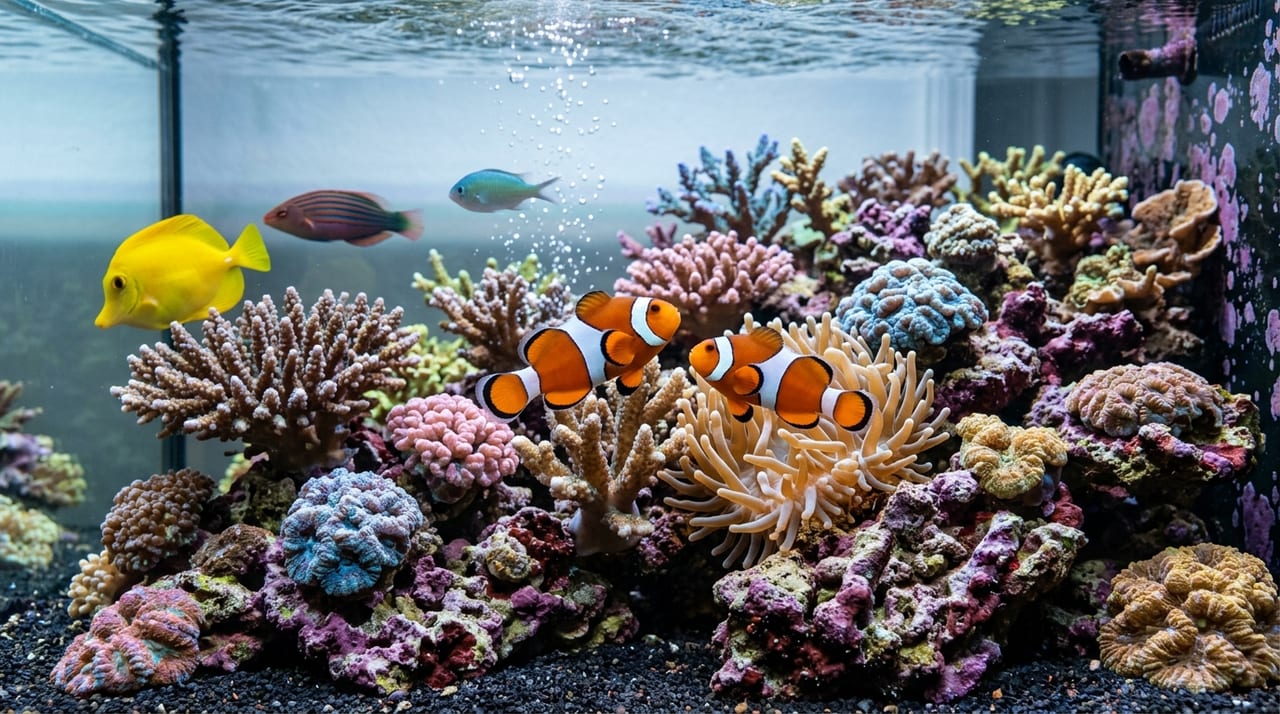
Among the maintenance tasks for saltwater aquariums, water changes are one of the most fundamental and effective management techniques. Regular water changes are essential to maintain an environment where fish and corals can thrive. However, unlike freshwater aquariums, saltwater aquariums have unique requirements, including preparing artificial seawater, using RO/DI water, and adjusting specific gravity and water temperature. This article systematically explains everything from optimal water change frequency by tank type to selecting artificial seawater and the actual procedures. We provide content useful for both those setting up their first saltwater fish aquarium and experienced reef keepers.
---
Why Water Changes Are Essential for Saltwater Aquariums
In saltwater aquariums, harmful substances such as nitrates and phosphates accumulate as fish waste and uneaten food decompose. While there are methods to remove these substances, such as protein skimmers, activated carbon, and bacterial decomposition via live rock, these methods have limitations. By performing water changes to remove contaminated water and replenish fresh seawater, you achieve the following benefits:
Dilution and removal of nitrates and phosphates: Suppresses algae growth and reduces stress on organisms
Correction of mineral balance: Replenishes trace elements such as calcium (Ca), alkalinity (KH), and magnesium (Mg)
pH stabilization: Prevents acidification and maintains water quality suitable for corals and fish
Removal of suspended organic matter: Maintains water clarity and contributes to the health of organisms
Especially in reef tanks housing SPS corals (such as Acropora), even minor parameter fluctuations can affect growth, making a stable water change routine critically important. For broader perspectives on water quality management, please also see the Saltwater Fish Water Quality Management Guide.
✍️
BreederDirect Editorial
The BreederDirect editorial team specializes in care information for animals, covering veterinary care and breeding to deliver beginner-friendly guides.
Find Marine Fish on BreederDirect
Buy directly from verified breeders
Browse Related Listings
Find Marine Fish listings related to this article on BreederDirect. Buy directly from verified breeders.
Water change frequency and quantity vary depending on the types of organisms you keep. Use the following as a guide to create a schedule suited to your tank type.
Fish-Only Tanks (FO: Fish-Only)
Frequency: Once every two weeks
Quantity: 15–25% of total water volume
Fish-only tanks are less sensitive to water quality than those with corals, so they can be managed on a relatively relaxed schedule. However, if you keep many fish or feed heavily, nitrate accumulation accelerates, so consider increasing the frequency. If you're unsure about tank mate combinations, the Saltwater Fish Compatibility Guide can also help.
Reef Tanks Centered on Soft Corals
Frequency: Once per week
Quantity: 10–15% of total water volume
In tanks centered on soft corals and LPS corals such as mushroom anemones, toadstools, and branching anemones, weekly water changes are effective for stable mineral replenishment. Cleaning the substrate during water changes also helps suppress detritus accumulation.
Reef Tanks Centered on SPS Corals
Frequency: Once per week
Quantity: 5–10% of total water volume
SPS corals such as Acropora are extremely sensitive to water quality, and rapid parameter changes can cause stress and bleaching. The best practice is to change small amounts frequently to prevent sudden parameter shifts while maintaining water stability. Installing automatic water changers (AWC) allows for even more stable management.
---
How to Choose Artificial Seawater
Commercial artificial seawater is primarily available in two types: "regular type" and "reef type (high-grade type)." Choosing the right type for your tank's purpose leads to easier management.
Regular Type
Ca, KH, and Mg composition similar to natural seawater (Ca: approximately 400mg/L, KH: approximately 8dKH)
Ideal for fish-only tanks and soft coral tanks
Relatively low cost and widely available
Representative products: Instant Ocean, Tetra Marine Salt Pro, etc.
Reef Type (High-Grade Type)
Ca, KH, and Mg are set higher (Ca: 450mg/L or more, KH: approximately 10–12dKH)
Designed for SPS and LPS-centered reef tanks
Supplies the minerals needed for coral growth through water changes alone, reducing the need for supplements
Representative products: Coral Pro Salt (Red Sea), Prismaline, Triton BASE SEA, etc.
Before purchasing, check the measured values after dissolution and choose one that matches your tank parameters for peace of mind. The choice of artificial seawater brand and composition is something of a personal preference, with even breeders and advanced aquarists having different favorites. Brand comparisons are detailed in the Artificial Seawater Brand Comparison Guide.
---
Why RO/DI Water Is Essential
The quality of water used as the "base" for water changes is extremely important in saltwater aquariums. Using tap water directly can cause the impurities it contains to deteriorate the tank environment.
Primary Problematic Substances in Tap Water
Substance
Effect
Chlorine and chloramine
Damage to bacteria and organisms
Silicates
Mass growth of diatoms (brown algae)
Phosphates
Algae proliferation and inhibition of coral growth
Heavy metals
Toxicity to organisms
Comparison of Water Purification Methods
RO water (reverse osmosis): Removes 95% or more of impurities. For typical saltwater aquariums, this alone is often sufficient
DI water (deionized water): Further removes trace ions remaining in RO water through adsorption. Can bring TDS (total dissolved solids) to nearly zero
RO/DI purifier: The most effective method combining both. Highly recommended for reef tanks. Installation steps are detailed in the Complete RO/DI Water Generation System Guide
While RO/DI purifiers require initial investment, they significantly reduce water quality issues over the long term, making them quite cost-effective.
---
Correct Water Change Procedure
Simply replacing water reduces effectiveness. By following these steps, you can perform an effective water change while minimizing stress on your organisms.
Prepare artificial seawater the day before: Dissolve artificial seawater in RO/DI water and vigorously aerate or pump for a full night
Adjust specific gravity: Use a refractometer or electronic specific gravity meter to adjust to appropriate specific gravity (around 1.025, or your existing tank value)
Match water temperature: Use a heater or ice to adjust the temperature to within ±0.5°C of your tank water
Remove water: Slowly drain from the bottom of the tank (near the substrate) using a hose or siphon. It's also effective to remove detritus at the same time
Add water: Slowly add the prepared fresh seawater along the side of the tank, ensuring it doesn't directly impact organisms
Clean simultaneously: Use the removed seawater to clean algae on glass surfaces and clean the skimmer cup and equipment
Points to Check During Water Changes
Measure and record specific gravity, pH, and water temperature before and after water changes
Clean the skimmer cup every time during water changes
Use prepared artificial seawater within 24 hours (composition may change if stored for extended periods)
Vigorously stirring substrate can collapse anaerobic layers and cause hydrogen sulfide generation, so gently remove only the surface layer
---
Summary | Ask Saltwater Fish and Coral Experts on Breeder Choku
Saltwater aquarium water changes involve many considerations: frequency, quantity, water type, and artificial seawater choice. However, with proper knowledge and procedures, it's not difficult. Establishing a routine suited to your tank type is the shortcut to long-term stability.
On Breeder Choku, you can purchase saltwater fish and corals directly from breeders with extensive experience. By asking breeders questions like "What artificial seawater do you use?" and "How often do you do water changes?" before and after purchase, you can receive advice tailored to actual rearing conditions.
Being able to ask detailed questions directly to the breeder who raised the organisms—questions you couldn't ask at a shop—is one of Breeder Choku's major attractions. With healthy organisms and solid knowledge, build your ideal saltwater aquarium.