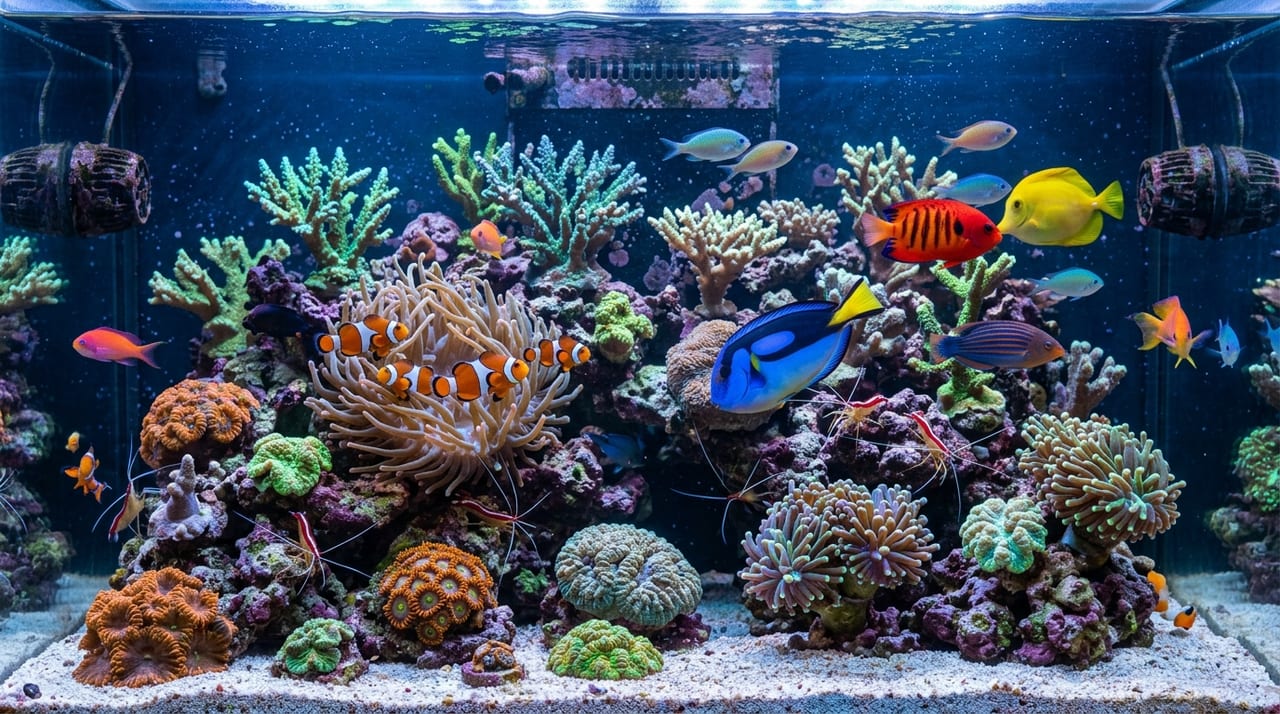
Specific Gravity Management: The Foundation of Saltwater Fish Keeping
In saltwater fish keeping, specific gravity (salinity) management is the most critical aspect of water quality control. Natural seawater has a salinity of approximately 3.5% (with a specific gravity of around 1.023–1.025 at 25°C), but salinity in aquariums gradually increases due to evaporation of freshwater.
When specific gravity rises too high, osmotic stress on fish increases; when it drops too low, fish become weak due to disrupted electrolyte balance. Corals and anemones are particularly sensitive to specific gravity fluctuations, requiring constant stable management.
What Should Saltwater Specific Gravity Be? [1.023–1.025 at 25°C is the Target]
"Specific gravity" is the ratio of seawater density to freshwater density (freshwater = 1). When measuring with an aquarium hydrometer, approximately 1.023–1.025 at 25°C is the target range. Natural seawater has a salinity of around 3.5%, with specific gravity ranging from approximately 1.021–1.030 (at 25°C) depending on ocean region and season. In aquariums, you should maintain specific gravity within the following ranges based on bioload:
- Fish-only tanks: 1.020–1.025 (maintaining around 1.023 makes management easier)
- Tanks with anemones or corals: 1.023–1.026 (detailed recommendations for different compositions are covered in the recommended specific gravity range section below)
An important note: specific gravity changes with water temperature. Even at the same salinity level, warmer water displays lower specific gravity readings, so measurement must be taken at your hydrometer's calibration temperature (typically 25°C for most products). Specific gravity readings of 1.023 taken at 20°C and 1.023 taken at 25°C do not represent the same salinity. Using a refractometer with temperature compensation eliminates this measurement error.
How to Prepare Artificial Seawater
Using commercially available artificial seawater mixes, you can easily prepare properly salinated seawater at home.
Recommended Use of RO Water
Tap water contains impurities such as chlorine, heavy metals, and phosphates that can cause algae blooms and inhibit coral growth. For serious saltwater fish and coral keeping, the best approach is using RO (reverse osmosis) water purified with an RO filter. Home RO water generators are available starting from around ¥10,000–30,000.
While you can keep saltwater fish using tap water treated with dechlorinator (sodium thiosulfate), long-term water stability may be compromised.
Steps for Preparing Artificial Seawater
- Pour measured RO water (or dechlorinated tap water) into a bucket
- Add artificial seawater mix at the prescribed amount (follow product instructions)
- Aerate for 1–2 hours while dissolving thoroughly
- Measure specific gravity with a hydrometer and adjust to the 1.023–1.025 range
- Match the water temperature to your tank before using for water changes
Major artificial seawater brands include Instant Ocean, Reef Crystals, and Red Sea. For fish-only tanks, the economical Instant Ocean is suitable, while for coral cultivation, Reef Crystals or Red Sea—which are rich in calcium, magnesium, and trace elements—are more appropriate.
Types of Hydrometers and How to Use Them
There are three main types of instruments for measuring specific gravity.
Float-Style Hydrometer (Arm Type)
The most affordable option (¥500–1,500), it goes directly into the aquarium for measurement. However, accuracy is low and air bubbles easily cause measurement errors—a common pitfall for beginners. Long-term reliability is poor, so it is not recommended.
Refractometer (Salinity Meter)
This device measures specific gravity using light refraction and offers high accuracy at ¥1,500–5,000. Requiring only a small water sample, it is portable and the most widely used instrument. Selecting one with temperature compensation ensures accurate readings. Usage is simple: place a few drops of water on the prism face and look through the eyepiece.
Digital Hydrometer (Salinity Meter)
The most accurate and most expensive option (¥5,000–20,000). Digital displays are easy to read, making it essential for serious reef tanks. Regular calibration ensures accurate measurements over extended periods.
Recommended Specific Gravity Ranges
- Fish-only tanks: 1.020–1.025
- Fish + anemones: 1.023–1.025
- Fish + corals (reef tank): 1.024–1.026
pH Management and Stabilization
In saltwater aquariums, pH management is equally important as salinity control. The ideal pH for seawater is 8.1–8.3.
Causes of pH Decline
- CO2 accumulation from fish respiration
- Organic matter decomposition by bacteria
- High indoor CO2 levels (poor ventilation)
- Nitrate accumulation (nitric acid is weakly acidic)
Methods for pH Stabilization
- Regular water changes: Restore pH through frequent partial water changes
- Enhanced aeration: Agitate the water surface to release CO2 and increase dissolved oxygen
- Live rock: Composed primarily of calcium carbonate, live rock acts as a pH buffer
- pH adjusters: For rapid drops, add small amounts of sodium bicarbonate (baking soda); never add large amounts suddenly
- Coral sand substrate: Calcium carbonate-based substrates help stabilize pH
Daily Management Tips
Make it a habit to check specific gravity at the same time each day. Evaporation rates vary by season, room temperature, and filter type. Be especially watchful during summer when evaporation is faster.
- Top off with RO water when water level drops: Topping off with saltwater increases salinity
- Weekly 10–20% water changes: Removes accumulated nitrates and replenishes minerals
- Record specific gravity, pH, and temperature: Documentation helps detect problems early
Summary
Once you master the fundamentals of salinity and specific gravity management, saltwater fish keeping becomes straightforward.
- Maintain specific gravity at 1.023–1.025 (adjust based on tank type)
- Measure regularly with a refractometer
- Top off evaporation with RO water, use fresh artificial seawater for water changes
- Target pH of 8.1–8.3 through aeration and water changes
At BreederDirect, you can purchase healthy saltwater fish directly from experienced breeders who manage proper specific gravity. Fish raised in stable water quality environments face less post-purchase stress, making them ideal for beginners.