LED Lighting Guide for Saltwater Aquariums | Optimal Spectrum and Light Intensity
A guide to selecting the optimal LED lighting for saltwater aquariums. Learn about spectrum settings to enhance fish coloration, compatibility with corals, product comparisons, and lighting schedule management.
Key Takeaways
A guide to selecting the optimal LED lighting for saltwater aquariums. Learn about spectrum settings to enhance fish coloration, compatibility with corals, product comparisons, and lighting schedule management.
Lighting in saltwater aquariums is not simply about illuminating the tank, but a critical piece of equipment that affects fish coloration, coral photosynthesis, the behavioral rhythms of organisms, and the aesthetic beauty of the tank itself. In recent years, LED lighting has become the standard, and products that allow fine adjustment of spectrum (light wavelength composition) have increased. However, with so many options available, many aquarists are uncertain about which lighting to choose. This article explains how to select the optimal lighting for saltwater aquariums.
✍️
BreederDirect Editorial
The BreederDirect editorial team specializes in care information for animals, covering veterinary care and breeding to deliver beginner-friendly guides.
Find Marine Fish on BreederDirect
Buy directly from verified breeders
Browse Related Listings
Find Marine Fish listings related to this article on BreederDirect. Buy directly from verified breeders.
Related Tools
Related Articles
Browse by Category
🪸Coral
🐠Marine Fish
🐟Tropical Fish
🐡Goldfish
🐟Medaka
🦎Reptiles
Share
LED Lighting Basics and Spectrum
LED (Light Emitting Diode) lighting has advantages over fluorescent lamps and metal halide lamps: lower power consumption, longer lifespan, and less heat generation. LEDs for saltwater aquariums are composed of spectrum by combining LED chips of multiple wavelengths. The main wavelength bands and their effects are as follows.
Wavelength Band
Effect
Blue LED (450–470 nm)
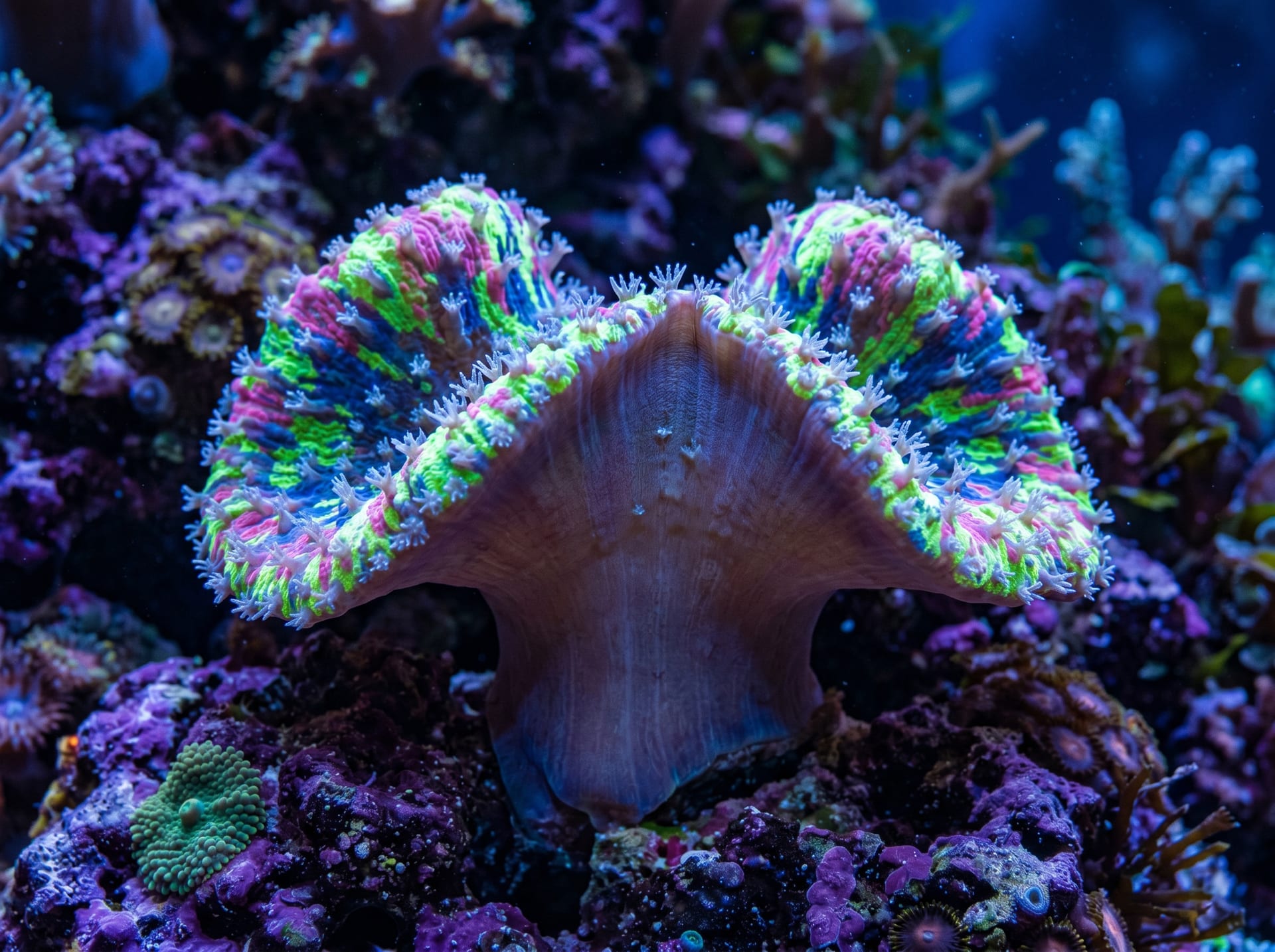
Creates the appearance of ocean depth and excites coral fluorescent proteins to bring out beautiful coloration
Violet LED (400–420 nm)
Makes coral fluorescent colors more vibrant and contributes to photosynthesis in some corals
White LED (6500–20000 K)
Natural light to the human eye, necessary for confirming the fish's true body color
Red LED (620–660 nm)
Enhances the red body color of fish, but also promotes algae growth, so usage should be monitored carefully
Green LED (520–560 nm)
Enhances green and yellow coloration in fish
For saltwater aquariums, a blue-dominant spectrum is the standard, with white typically added in moderation to ensure visibility.
Choosing Lighting for Fish-Only Tanks
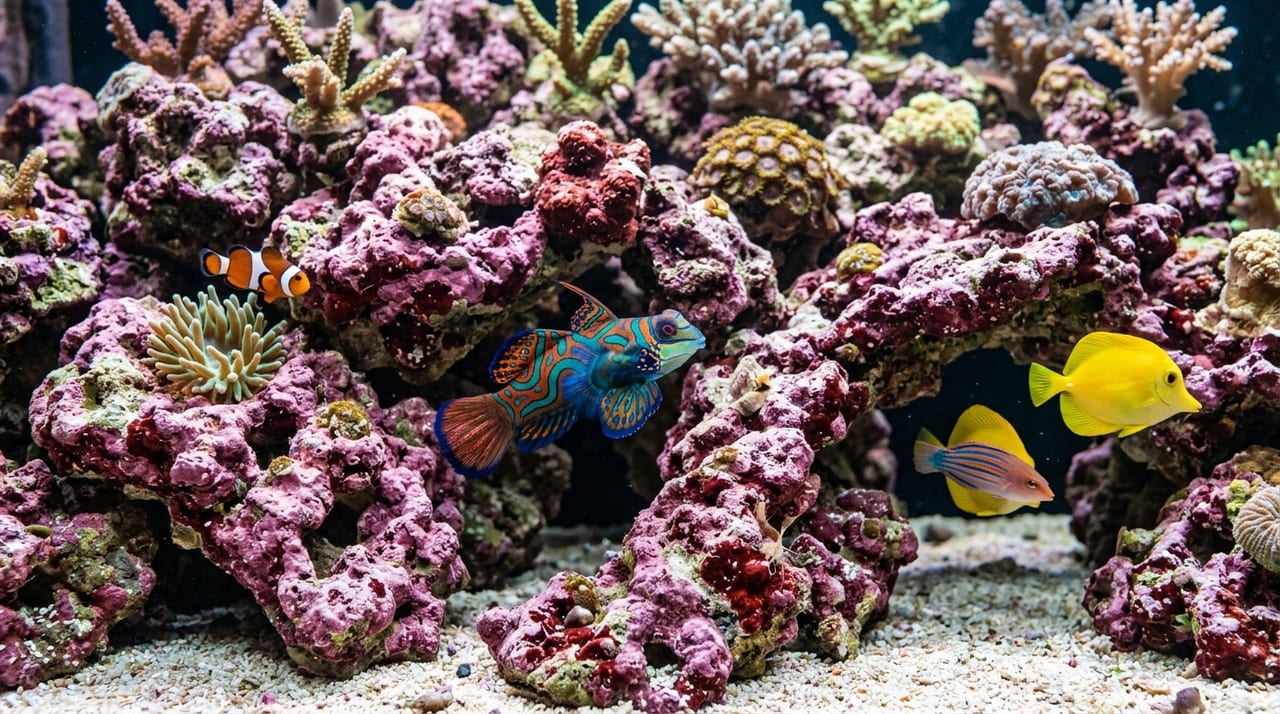
In fish-only tanks without corals (FO: Fish Only), there is greater flexibility in lighting choices. Since there is no need to provide the high-output PAR (photosynthetically active radiation) required for corals, relatively inexpensive lighting is sufficient. To display fish colors beautifully, the balance between white and blue is important. When blue accounts for approximately 70–80% of the total light output, it creates an oceanic atmosphere while still allowing fish colors to appear distinct. While 100% blue lighting creates the atmosphere of deep ocean, fish colors may appear unnatural, making routine observation and early disease detection difficult.
Key considerations for FO tank lighting include the following.
Dimming capability
Timer function
Gentle on/off lamp function that doesn't startle fish
Premium LEDs have more channels, allowing individual adjustment of blue, white, red, green, and other colors for customized color preferences. For light intensity, approximately 30–50 PAR (at tank bottom) is sufficient for FO tanks.
Lighting Settings for Reef Tanks with Corals and Fish
In reef tanks where corals and fish coexist, lighting becomes the most critical equipment affecting coral survival. The light intensity (PAR value) required varies significantly depending on coral type.
Coral Type
PAR Value Guide
Soft Corals (Zoanthids, Leather Corals, etc.)
50–100 PAR
LPS (Plate Corals, Branching Corals, etc.)
100–200 PAR
SPS (Acropora, Montipora, etc.)
200–400 PAR
High-output LED lighting (examples: Ecotech Marine Radion, AI Hydra, Maxspect Razor) can provide the light intensity to meet these requirements. However, if light intensity is too strong, corals may bleach or become stressed; ideally, measurements should be taken with a PAR meter to adjust accordingly. From the fish's perspective, if lighting is too intense, they tend to hide in the shadows of live rock during the day. By setting the lighting schedule to include "intense midday light" and "dim dawn and dusk," you can create periods when fish feel comfortable swimming openly. Setting a "blue light time" in the evening to enjoy coral fluorescence is also a popular configuration.
Lighting Schedules and Managing Daily Rhythms
To maintain the health of saltwater fish and corals, it is important to replicate natural daily rhythms (light-dark cycles). An ideal lighting schedule has the following composition.
Turn on lighting in the morning by running blue light only at low intensity for 30 minutes, then gradually add white light in a "sunrise mode."
The main lighting period should be 8–10 hours, with a bell-curve program that peaks at midday, creating the most natural light environment.
In the evening, reverse the process: first reduce white light, then run blue-only "moonlight" mode for 30–60 minutes before turning off completely.
This gradual transition between light and dark gives fish time to find hiding places and prevents panic from sudden darkness (collisions with glass). Some aquarists keep moonlight (very dim blue light mimicking moonlight) on all night, but this risks promoting algae growth, so keep it at the minimum necessary brightness.
Recommended LED Lighting and Selection by Price Range
Below is an introduction to LED lighting for saltwater aquariums organized by price range.
Price Range
Representative Models
Compatible Tank/Features
Entry-level (¥10,000–¥30,000)
AI Prime 16HD, Kessil A80
Suitable for small tanks (30–45 cm), with sufficient light output and spectrum adjustment capabilities to also support soft coral keeping
Mid-range (¥30,000–¥70,000)
AI Hydra 32HD, Maxspect Razor X
Compatible with 60–90 cm tanks, adequate for LPS coral keeping
High-end (¥70,000–¥150,000+)
Ecotech Marine Radion G6, Orpek Atlantik V4
Provides superior light output and spectrum control, suitable for SPS tanks
Key points when selecting are as follows.
Choose lighting with output suitable for your tank size and the coral species you are keeping
Ensure spectrum and schedules can be finely adjusted via app or controller
Select products from established manufacturers
Be cautious with inexpensive, lesser-known LED brands, as their actual light output may differ from catalog specifications.
Fish-only tanks with live rock (FOWLR) do not have lighting requirements as strict as reef tanks. However, selecting appropriate lighting is important to maintain coralline algae on live rock and display fish colors beautifully. A balanced blue and white spectrum in LED lighting creates a natural appearance. A light duration of 8–10 hours is recommended and should be managed with a timer.
When selecting LED lighting, the balance between coverage area for your tank size and light output is important. As a guideline, use one light for a 60 cm tank and two lights for a 90 cm tank. Choosing a model with dimming capability allows flexibility if you later add corals. Ideally, lighting schedules should mimic sunrise and sunset with gradual transitions; sudden on/off cycles stress fish.
Consult with BreederDirect about Your Lighting Setup
Lighting is critical equipment that affects both the appearance of your saltwater tank and the health of its inhabitants. At BreederDirect, you can ask questions directly about the lighting models and settings used by saltwater fish and coral breeders. Consult with experienced breeders about how to choose lighting suited to your home tank size and keeping goals.