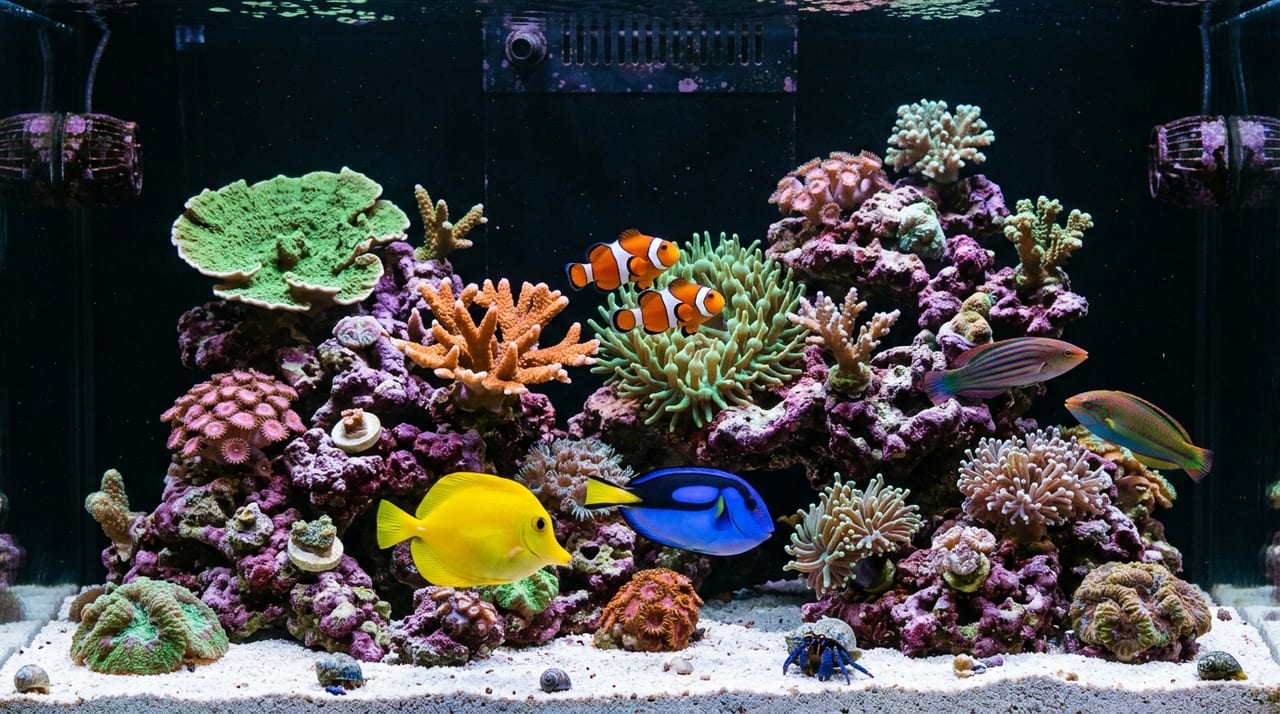
Temperature management is one of the most overlooked factors in long-term saltwater aquarium maintenance. Particularly during Japanese summers when room temperature exceeds 30°C, maintaining proper water temperature (24–26°C) without a chiller is nearly impossible. This article systematically explains saltwater aquarium chillers—from how they work to model selection, installation, plumbing, and daily temperature management.
Why Cooling Is Essential for Saltwater Aquariums
Coral reefs, where saltwater fish and corals naturally live, maintain a stable water temperature between 22–28°C year-round. When water temperature exceeds 29°C, fish immunity drops and the risk of infectious diseases like white spot disease surges sharply. Above 30°C, corals begin to bleach, and SPS corals show signs of damage within 48 hours.
Meanwhile, lighting (especially metal halide and high-output LED), protein skimmer motors, and pumps continuously generate heat during operation. In a 60 cm tank, these combined can generate 100–200 W of heat. In environments where summer room temperature exceeds 28°C, a fan alone cannot keep up—a dedicated aquarium chiller becomes essential.
Types of Cooling Methods and Their Characteristics
Aquarium cooling can be broadly divided into three categories.
Fan cooling is the most affordable (a few thousand yen) and easiest to install, but it relies on evaporative cooling, which causes water level drop and salinity increase. It typically lowers temperature only 3–5°C below room temperature. In environments where room temperature exceeds 28°C, it falls short.
Peltier coolers use Peltier elements (thermoelectric semiconductors) for cooling and are compact and quiet. However, their cooling efficiency (COP relative to power consumption) is low, limiting them to approximately 60 cm tanks. They are unsuitable for large aquariums or high-heat-generating equipment.
Compressor-type chillers use the same vapor-compression refrigeration cycle as home air conditioners. They offer high cooling capacity (rated in HP such as 1/10 to 1 HP), accommodate large tanks, and while the initial cost is high (roughly ¥30,000–¥150,000), they excel in long-term reliability and are preferred by most serious hobbyists.
How to Calculate Required Cooling Capacity
Chiller size (HP) selection follows this approach.
First, estimate the "heat to be removed (W)". Assume 70–80% of the total equipment power consumption (lighting + pumps + skimmers, etc.) becomes heat in the water. For example, if total power consumption is 300 W, heat generation is approximately 210–240 W.
Next, check the "target temperature differential"—the difference between the maximum room temperature and target water temperature. A larger differential requires greater cooling capacity. If room temperature is 32°C and target water temperature is 25°C, the differential is 7°C.
As a general guideline, a 60 cm tank (approximately 65 L) in ~30°C room temperature requires 1/15–1/10 HP (compact model); a 90 cm tank (around 200 L) requires 1/5–1/4 HP; tanks 120 cm or larger (over 400 L) require 1/2–1 HP. If lighting is powerful or the space is enclosed, selecting one size larger is advisable.
Major Manufacturers and Model Comparison
Here are the main domestic compressor-type chillers readily available.
Zensui (Japan) offers the ZC and ZR series as its mainstays, with strong support in domestic quality and service accessibility. The ZC-100E is popular as an entry-level model, offering good performance for 60–100 L tanks at a competitive price.
AquaExcel (Taiwan) distributes the AC/IE series at relatively affordable price points. Its detailed power consumption specifications make model selection easier.
Tetra/YellowReef (Korea) offers diverse mid-size options and excels in the intermediate class for 200–600 L tanks.
Key specs to verify when selecting a model: ① maximum cooling flow rate (L), ② ambient temperature limit (cooling capacity drops above this), ③ power consumption (estimated kWh/month), ④ noise level (dB), ⑤ plumbing port diameter.
Installation Location and Piping Best Practices
Since chillers generate heat from their bodies, site selection is critical. Follow these guidelines.
Maintain 10–15 cm or more of clearance around the unit to allow heat exhaust. Installing the chiller inside an enclosed cabinet circulates exhaust heat and dramatically reduces performance—ventilation outlets or a fan are essential. An indoor location with good air circulation is ideal; avoid direct sunlight.
Use silicone tubing in the diameter specified by the chiller—most models use 3/4 inch (approximately 19 mm internal diameter). Install a small circulation pump between the tank and chiller, aiming for a flow rate of 3–5 times the tank volume per hour. Shorter plumbing minimizes resistance and improves efficiency.
Inline installation (plumbed into the sump return pathway) is easier to maintain and is standard in most overflow tank systems.
Target Water Temperature and Heater Coordination
We recommend keeping the chiller's setpoint the same year-round, regardless of season. For fish and corals, stable water temperature with minimal fluctuation is critical—varying temperature by 2–3°C between summer and winter creates stress risk.
General recommended setpoints are as follows: fish-dominant tanks (including LPS and soft corals): 25–26°C; SPS-coral dominant tanks: 24–25°C; tanks containing mandarin fish or cold-water saltwater species: 22–24°C.
Set the heater to activate 1–1.5°C below the chiller's setpoint. For example, if the chiller is set to 25°C, set the heater to activate at 23.5–24°C. This prevents both chiller and heater from running simultaneously. Using an external controller (such as marine control systems) allows independent configuration of both upper and lower limits, making management easier.
Daily Maintenance and Notes
The most important daily chiller maintenance is filter cleaning. Dust accumulation in the unit's intake and exhaust filters reduces heat-dissipation efficiency and causes performance loss or failure. Clean with a vacuum or brush approximately once monthly.
Periodically rinse plumbing lines with dilute citric acid (1–2%) to remove biofilm and algae. Doing this annually prevents increased plumbing resistance.
Chiller refrigerant is not a consumable; with proper use, the unit operates for 5–10 years. If cooling suddenly stops, the cause is more often a blocked line or insufficient flow rather than compressor failure—first check flow rate with a flowmeter.
Summary
Selecting a saltwater aquarium chiller depends on three factors: tank size, lighting intensity, and installation environment. Compressor-type chillers excel in long-term stability and are worth the investment for 60 cm tanks and larger. During installation, ensuring adequate heat-exhaust space and proper circulation flow are the keys to maximizing performance. Incorporate chiller placement and plumbing routes into your aquarium design from the initial planning stage, and establish a habit of testing operation before summer.