Insect Pheromones and Instinctive Behavior Guide | How Breeding, Territorial, and Aggregation Pheromones Work and Their Application in Rearing
Explaining how insect pheromone communication works. We introduce the types of breeding, territorial, and aggregation pheromones, and specifically explain their practical application in rearing pet insects such as Japanese beetles, stag beetles, and crickets.
Key Takeaways
Explaining how insect pheromone communication works. We introduce the types of breeding, territorial, and aggregation pheromones, and specifically explain their practical application in rearing pet insects such as Japanese beetles, stag beetles, and crickets.
Related Species

Why Do Insects Communicate with Pheromones?
In the insect world, chemical substances called "pheromones" serve as the dominant means of communication instead of spoken language. Pheromones are volatile chemical substances that transmit information between individuals of the same species. They are secreted from glands on the insect's body surface, diffuse into the air, and are detected by olfactory receptors on the recipient's antennae. Compared to human smell, insects' chemical sensing is remarkably acute, and some species are known to respond to pheromones at the level of just a few molecules.
Pheromones developed in insects for two main reasons. First, many insects have more developed chemical senses than vision or hearing, allowing them to function even in dark places such as at night, in dense forests, or underground. Second, chemical signals are persistent and remain in space even after the sender departs, making time-delayed information transmission possible. Because of these characteristics, pheromones have evolved as key elements in reproduction, defense, and social behavior.
Sex Pheromones: The Chemical Language of Successful Reproduction
Sex pheromones are the most extensively researched type of pheromone and serve to attract members of the opposite sex and promote mating. In most insects, females secrete and males detect them, but in some species the reverse occurs. The "bombykol" secreted by female silkmoths (Bombyx mori) can reportedly be detected by males from several kilometers away even at concentrations below 100 ng, and is known as an iconic example of the high sensitivity of sex pheromones.
The concept of sex pheromones can also be applied in the rearing of Japanese beetles and stag beetles. After a mature female undergoes post-emergence feeding (the first feeding after adult emergence), the amount of sex pheromone secretion increases and males become more active. When pairing under rearing conditions, it is important to confirm that the female has undergone sufficient post-emergence maturation and feeding. If you place a female and male together before the female's post-emergence feeding, cases increase where the male courts and the female merely flees without mating occurring.
Aggregation Pheromones: Gathering and Securing Food Resources
Aggregation pheromones function to gather individuals of the same species in specific locations. It is thought that when Japanese beetles and stag beetles that feed on tree sap gather at spots where sap oozes out, they are partly attracted by aggregation pheromones secreted by individuals that arrived earlier.
This mechanism is also well-developed in social insects such as honeybees and ants, where workers that discover food sources perform recruitment (gathering of nestmates) accompanied by aggregation pheromones. The fact that crickets tend to cluster in specific corners within a rearing container may also be influenced by aggregation pheromones. Understanding this habit allows you to disperse cannibalism caused by crowding by installing multiple hiding places (such as egg trays) preferred by crickets within the container.
Alarm Pheromones: Instantaneous Signals for Conveying Danger
Alarm pheromones are released by individuals that sense danger and trigger defensive behaviors such as fleeing or attacking in conspecific individuals. They are well-known in ant and honeybee colonies, but are also seen in solitary insects.
In rearing, alarm pheromones provide a hint for management. For example, if you suddenly open a cricket rearing container or expose it to strong light, the crickets may all become agitated at once. This is behavior that combines the release of alarm pheromones with responses to direct stimulation. By making slow movements during feeding and cleaning and avoiding startling them, you can prevent escapes and reduce individual exhaustion.
Territorial Pheromones: Space Monopoly and Competition
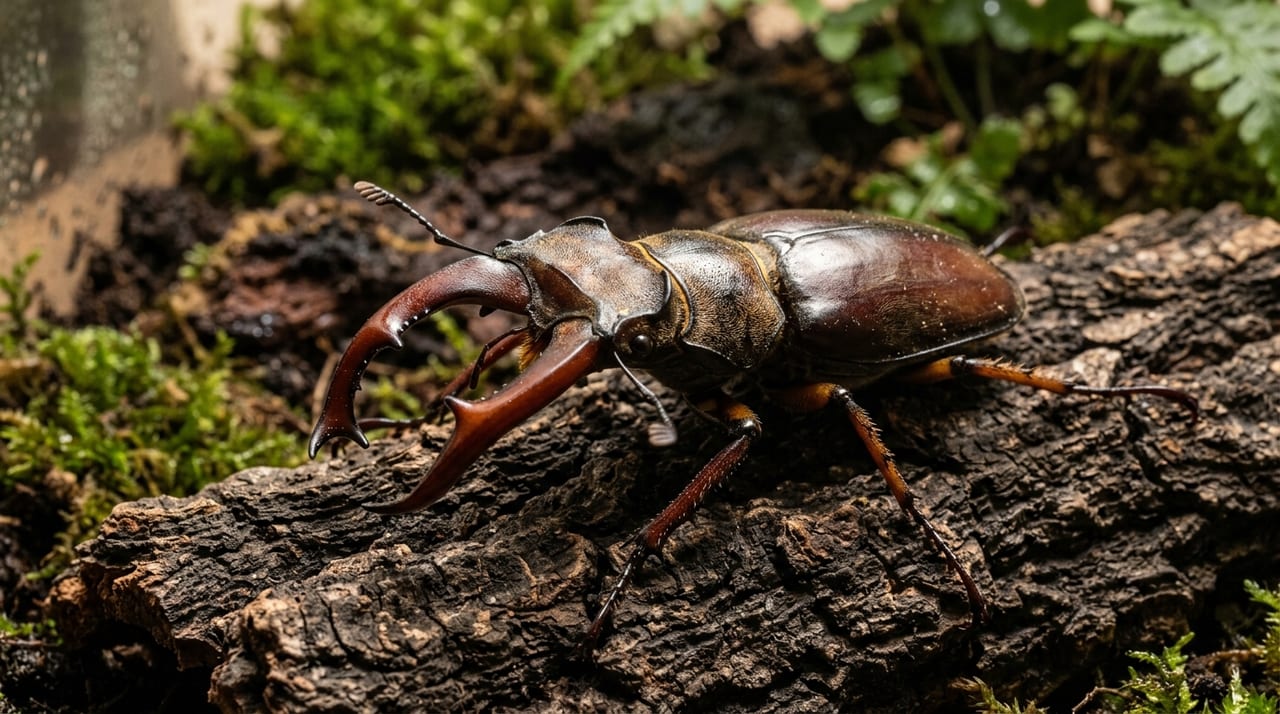
Behind intense fighting between male stag beetles and Japanese beetles within a container, the involvement of territorial pheromones and competitive signals is suggested. In particular, black-horned stag beetles and flat-horned stag beetles are very aggressive toward males of the same species, and mandible and leg loss frequently occurs when multiple males are kept in the same container.
This involves not only pheromones but also visual and tactile stimuli, but it is known from experience that attacks intensify especially when new individuals are introduced into a container still bearing the chemical traces of previous inhabitants. When exchanging containers, by completely replacing the used substrate and resetting the pheromone traces, new individuals can be introduced more easily. Additionally, if a male chases a female after pairing, separation is the basic approach. Females in egg-laying setups tend to concentrate better on egg-laying in environments without male pheromones.
Practical Application in Rearing
When incorporating knowledge from pheromone biology into rearing practices, the following practical advice emerges.
- Timing Management for Pairing: The peak of sex pheromone secretion is thought to occur 2 to 4 weeks after the female begins post-emergence feeding. Performing pairing during this period increases mating success rates.
- Commitment to Individual Rearing: Not keeping males of the same species in the same container is not only to prevent fighting but also to eliminate chemical and behavioral stress related to territorial disputes. Stress affects an individual's lifespan.
- Container Cleaning and Trace Reset: When moving females after egg-laying ends or when introducing new males, complete replacement of the old substrate and removal of previous individuals' pheromone traces makes the process smoother.
- Stable Rearing Environment: To avoid triggering alarm pheromones, perform feeding and observation quietly and minimize lighting changes. In particular, since nocturnal Japanese beetles and stag beetles are active at night, it is ideal to keep observation brief under dimmer lighting.
On BreederDirect, you can purchase healthy adult and larval insects from breeders well-versed in such ecology. Beginning rearing with an understanding of pheromone and instinctive behavior mechanisms leads to improved breeding success rates and reduced individual loss from fighting and stress.