Guppy Genetics Complete Guide | Color Fading Prevention & Color Fixation Practical Techniques
Complete explanation from the basics of guppy body color genetics to practical color fading prevention and color fixation techniques. From X-linked and Y-linked inheritance mechanisms, selective breeding procedures, to optimizing rearing environments and feed for enhanced coloration—presented from a breeder's practical perspective.
Key Takeaways
Complete explanation from the basics of guppy body color genetics to practical color fading prevention and color fixation techniques. From X-linked and Y-linked inheritance mechanisms, selective breeding procedures, to optimizing rearing environments and feed for enhanced coloration—presented from a breeder's practical perspective.
Related Species
Guppy Body Color Genetics Fundamentals
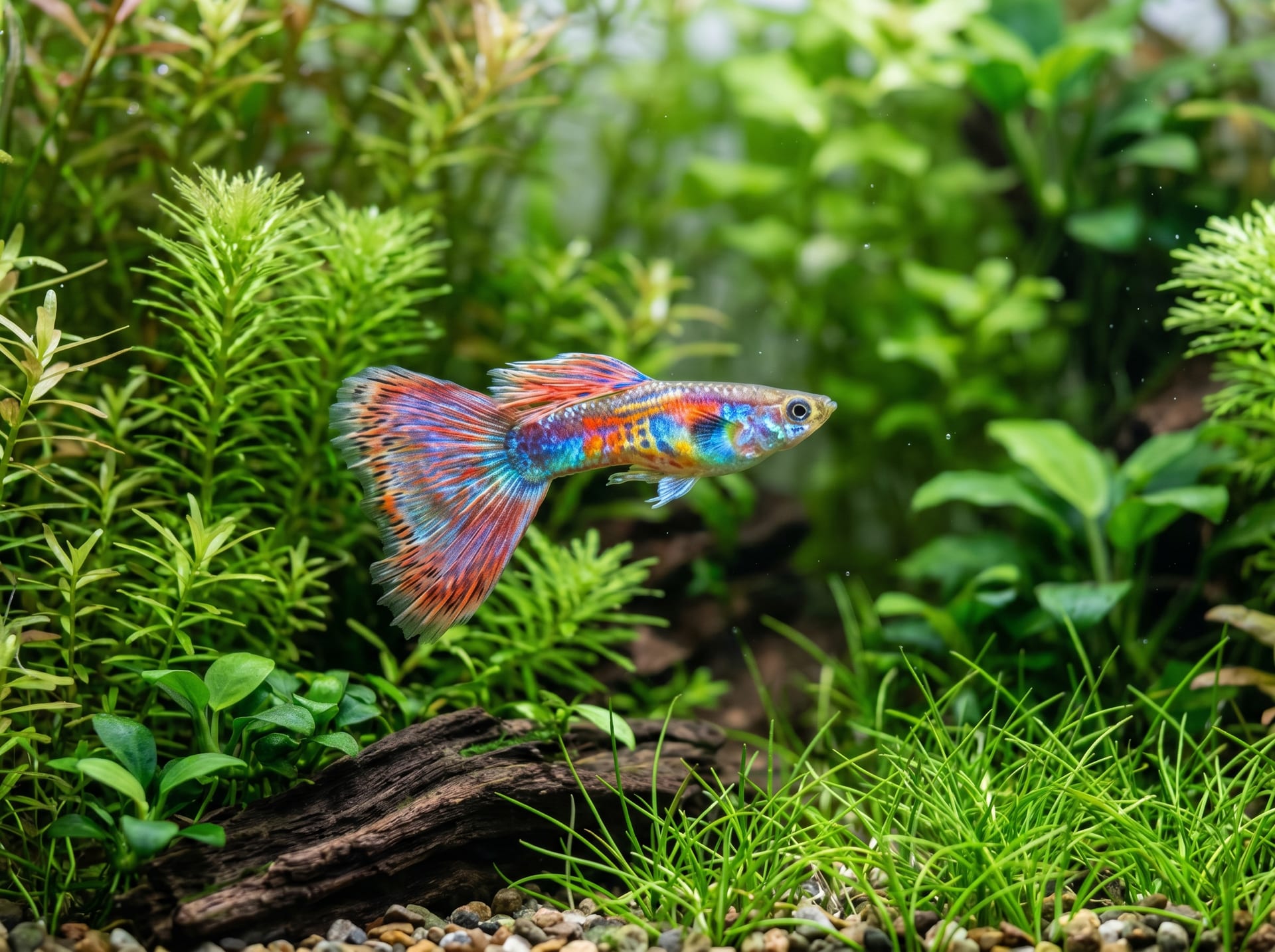
Guppies are among the most genetically researched species in tropical aquarium fish. Especially in males, body color and tail fin patterns involve complex interplays of diverse genetic traits, and this beauty has fascinated breeders.
The first concepts to understand regarding guppy body color genetics are the differences between "X-linked inheritance" and "Y-linked inheritance."
X-Linked and Y-Linked Inheritance
Male guppies have XY chromosomes, while females have XX chromosomes.
Y-Linked Inheritance (Passed directly from father to son): Genes carried on the Y chromosome are passed from father to son with approximately 100% certainty. Traits such as sword tail and glass berry patterns are believed to be primarily Y-linked. When aiming to fix the father's body color directly in offspring, Y-linked traits are utilized.
X-Linked Inheritance (Transmitted via females): Genes carried on the X chromosome pass to the next generation through females. Metallic luster and certain body colors are influenced by X-linked inheritance. Even if females have subdued coloration, rich coloration can appear in offspring depending on the genes on their X chromosomes.
Autosomal Inheritance: Many genes affecting body color are also carried on autosomes, and many cases cannot be explained by simple X/Y-linked inheritance alone.
Primary Causes of Color Fading and Prevention Methods
After purchasing guppies, you may notice that "the color has become duller compared to when first received." This can be attributed to several causes.
Color Suppression Due to Stress
Guppies lose coloration under stress from water chemistry changes, chasing by tank mates, and overcrowding. The increase in cortisol (stress hormone) suppresses the activity of pigment cells.
Measures:
- Tank size of 60 cm or larger (up to 20–30 fish)
- Reduce the ratio of males to each other (ideally 1 male : 2–3 females)
- Provide abundant hiding places (aquatic plants, driftwood)
Impact of Water Chemistry and Temperature
pH 6.5–7.5, hardness 8–12 dGH, and water temperature 25–28°C are optimal for coloration. If water temperature is too low, metabolism decreases and pigment production declines.
Measures:
- Perform 20–30% water change once per week
- Monitor hardness with a TDS meter
- Set heater to 25°C
Nutritional Deficiency
Carotenoids (red, orange, and yellow pigments) needed for coloration cannot be synthesized by fish themselves and must be obtained from food. Inexpensive artificial feeds alone tend to be insufficient.
Measures:
- Feed spirulina-containing food 2–3 times per week
- Provide brine shrimp (rich in carotenoids) once per week
- Utilize color-enhancement feed containing astaxanthin
Selective Breeding for Color Fixation
To consistently breed guppies with desired body color and patterns, "selective breeding" is essential.
Basics of Selection: Line Maintenance and Strain Management
Line Maintenance (Consecutive breeding): Continuously breeding males and females of the same bloodline. Y-linked traits are easy to maintain, but inbreeding depression must be monitored.
Typically, outbreeding (introducing a different line) is done every 5–6 generations to maintain vigor.
Backcross: Rebreeding an improved F1 generation with a parent (or grandparent) to strengthen specific traits. This is effective when aiming to strongly express Y-linked traits.
Selection Timing and Criteria
Male body color begins to express 4–6 weeks after hatching. Selection is done at this stage using the following criteria.
Criteria for keeping individuals:
- Target body color is clearly expressed
- Body shape is well-proportioned (no spine curvature)
- Tail fin shape meets breed standards
- Swimming actively (healthy individuals)
Excluded individuals:
- Faded color or disrupted patterns
- Deformities (spine curvature, fin fusion)
- Significantly stunted growth
Risk Management for Sibling Mating
Continuing inbreeding within a narrow lineage increases the expression of lethal genes, raising deformity and mortality rates.
Measures:
- Keep offspring from multiple pairs mixed together
- Breed with a different line of the same variety every 5–6 generations
- Introduce outbreeding early if weak individuals increase
Feed and Environmental Techniques for Enhanced Coloration
Effective Use of Carotenoid-Based Feed
Carotenoids are sensitive to heat, light, and oxygen, so keep them in a cool, dark place after opening. Overfeeding can cause digestive issues, so the basic rule is to feed amounts that can be consumed in 2–3 minutes twice daily.
Recommended foods:
- Brine shrimp (live or frozen): Rich in β-carotene and astaxanthin. A standard for color enhancement
- Spirulina: Carotenoids derived from green algae, effective for blue and green coloration
- Kyorin Hikari FD Vitamins: Effective for enhancing red coloration
- Tetra Colorine: Well-regarded color-enhancement feed
Utilization of Lighting and Aquatic Plants
Lighting with appropriate spectrum (white LEDs around 6500K) not only makes body colors appear vibrant but also activates the guppy's own metabolism. In low-light environments, body color tends to deteriorate, so 8–10 hours of illumination daily is recommended.
Dense aquatic plants (especially moss and stem plants) not only reduce stress but also allow natural carotenoid intake as fish consume the algae attached to leaves.
Strain Management Tips Practiced by Breeders
Keeping Detailed Records
Breeders successful at color fixation always keep breeding records. The minimum record content is as follows.
- Breeding date, pair number (parental lineage)
- Spawning date, number of fry
- Selection criteria and results (how many kept out of how many)
- Generation tracking (F1, F2, etc.)
It is common to manage this using smartphone memo apps or dedicated spreadsheets.
Parallel Maintenance of Multiple Strains
Maintaining only one strain risks total loss due to disease or accidents. It is safer to maintain at least 2–3 strains in parallel and perform periodic crosses between strains.
Guppy genetics is profound, and complete understanding takes time. However, by grasping the basics—"X/Y-linked inheritance," "selection criteria," and "strain management"—the accuracy of color fixation can be significantly improved. Start with a small number and build your own beautiful guppy strain while keeping records.