Emerald Tree Boa Care Guide | High-Humidity Management, Perch Installation, and Feeding Practices for Arboreal Snakes
This guide explains the care methods for the South American Emerald Tree Boa (Corallus caninus). We provide comprehensive coverage of vertical enclosures, high-humidity management, perch placement, handling precautions for their exceptionally long fangs, rare feeding behaviors, and feeding strategies.
Key Takeaways
This guide explains the care methods for the South American Emerald Tree Boa (Corallus caninus). We provide comprehensive coverage of vertical enclosures, high-humidity management, perch placement, handling precautions for their exceptionally long fangs, rare feeding behaviors, and feeding strategies.
Related Species
About the Emerald Tree Boa
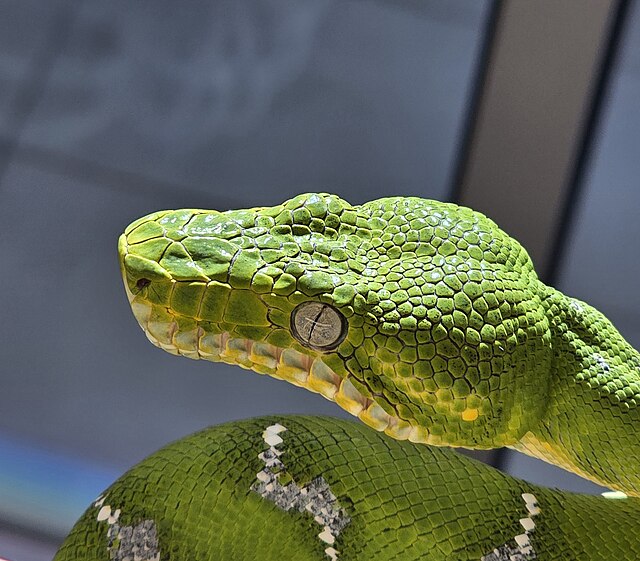
The Emerald Tree Boa (Corallus caninus) is an arboreal boa species native to South America, inhabiting lowland tropical rainforests centered around the Amazon Basin. Adult individuals are characterized by a vibrant emerald-green coloration with white lateral stripes (lightning-bolt pattern) and a distinctive posture of coiling their curved body in a circular shape on horizontal perches.
They are often confused with the similarly arboreal and green-colored Green Tree Python (Morelia viridis), but they are taxonomically distinct. A major difference is that boas are ovoviviparous (giving birth to live young), while pythons are oviparous (egg-laying).
- Adult Length: Approximately 1.5–2m
- Maximum Weight: 1–1.5kg
- Native Range: Amazon Basin lowlands of Brazil, Venezuela, Colombia, Peru, and other regions
- CITES Appendix II: Documentation is required for import and sale
Required Enclosure and Environmental Setup
Enclosure Type and Dimensions
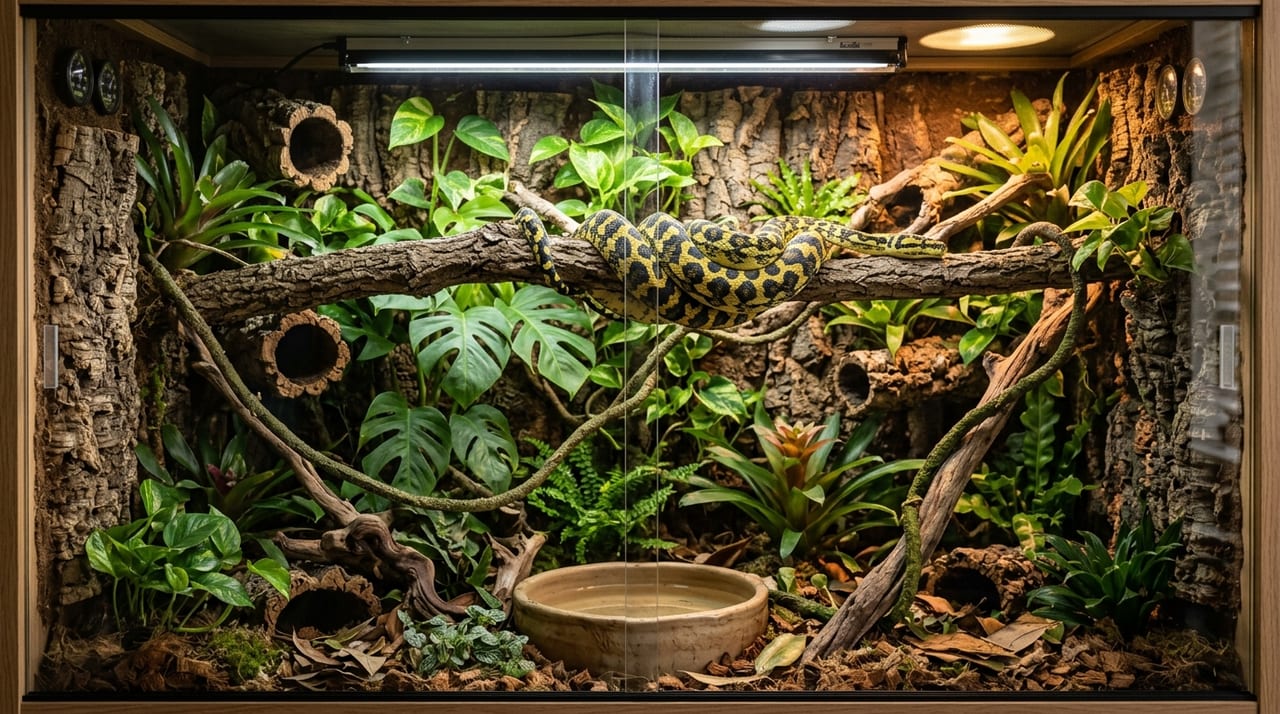
The Emerald Tree Boa is strictly arboreal and rarely descends to the ground. A vertical (arboreal-style) enclosure is essential.
Recommended Enclosure Size (Adults):
- Height: 90–120cm or more
- Width: 60cm or more
- Depth: 60cm or more
A front-opening double-door design is easier to manage, and side mesh ventilation ports facilitate humidity control.
Perch Installation
Install horizontal perches with a diameter of 3–5cm in the upper two-thirds to the top of the enclosure. Use natural branches made from non-toxic wood such as paulownia, pawpaw, or hibiscus, or PVC artificial perches, ensuring adequate thickness and stability for the snake to grip securely.
Temperature and Humidity Management
Temperature Gradient
Emerald Tree Boas tend to prefer slightly higher temperatures than Green Tree Pythons.
- Basking Spot (Peak Temperature): 29–32°C
- Ambient Temperature (Enclosure Average): 26–28°C
- Nighttime Temperature: 24–26°C
Use radiant heat panels or halogen spot lamps for heating. A thermostat is essential.
High-Humidity Management
Humidity is one of the most critical management factors. Because they originate from the Amazon lowland tropical rainforest, an ideal enclosure humidity level is 80–90%.
Methods to Maintain Humidity:
- Automated Misting System (spray every 1–2 hours) is most reliable
- Manual misting: 2–3 times daily (before lights on, after lights on, before lights off)
- Place a water bowl (shallow water dish) at the enclosure base to add humidity through evaporation
- Use moisture-retentive substrates such as coconut fiber or sphagnum moss
Poor shedding is often caused by low humidity, so pay special attention to humidity levels before and after shedding.
Feeding Management
Diet and Food Types
In the wild, they primarily hunt birds and small mammals in trees. In captive care, thawed frozen mice and rats are the staple diet.
- Juveniles: Pink mice (~5g) once or twice weekly
- Subadults: Fuzzy mice to small mice once every 10–14 days
- Adults: Appropriately-sized rats or mice once every 2–3 weeks
Adults require longer intervals between feedings due to the larger meal size.
Feeding Challenges and Strategies
Even captive-bred Emerald Tree Boas can be difficult to feed. Offering food suspended from the perch (hanging method) mimics natural hunting behavior and is more readily accepted by many individuals.
Wild-caught individuals show even stronger feeding resistance and may need to start with live prey before gradually transitioning to frozen-thawed food. If prolonged feeding refusal persists for more than 3 months, consult a veterinarian.
Caution Regarding Long Teeth
Emerald Tree Boas possess unusually long and curved teeth, even for boas, specialized for piercing bird feathers. These teeth are extremely sharp, and bites result in deep wounds.
Always use a snake hook to remove the snake from the enclosure, and keep your hands away from the head. If bitten, do not pull away (to avoid breaking teeth), but wait for it to release naturally.
Health Management and Common Diseases
Respiratory Infection (RI)
Bacterial and viral respiratory infections frequently occur in cold, high-humidity environments with inadequate ventilation. Seek veterinary care if the snake breathes with its mouth open or shows wheezing.
Improper Shedding
Continued keeping in low-humidity conditions results in incomplete shedding. If shed skin remains on the eyes (spectacles) or tail tip, it can lead to tissue death. Treat with warm water soaks (approximately 30°C).
Parasites
Wild-caught individuals are especially prone to introducing mites (Ophionyssus natricis) and internal parasites, so establish a quarantine period (minimum 30 days) following acquisition.
Summary
The Emerald Tree Boa is a visually stunning arboreal snake with jewel-like green coloration, but due to the demands of high-humidity management, vertical enclosure requirements, and feeding challenges, it is considered an intermediate to advanced-level species. While often compared to the Green Tree Python, the Emerald Tree Boa offers the unique appeal of ovoviviparous reproduction. With proper environmental setup and patient care, this fascinating species can thrive for 10–20 years, becoming a remarkable long-term companion.