Coral Tank Record Management and Measurement Logs | Building a Habit of Science-Based Care Through Data
Keeping tank logs is essential for improving coral husbandry. By recording and analyzing water quality parameters, equipment settings, and trouble history, early problem detection and continuous improvement in husbandry quality can be achieved.
Key Takeaways
Keeping tank logs is essential for improving coral husbandry. By recording and analyzing water quality parameters, equipment settings, and trouble history, early problem detection and continuous improvement in husbandry quality can be achieved.
Why Record Management Transforms Coral Husbandry
Among aquarists who take on the challenge of coral husbandry, those who keep proper tank logs are in the minority. However, most veteran aquarists who maintain corals stably over long periods keep records in some form.
Without records, you cannot trace back "why did the coral become healthier" or "why did bleaching suddenly begin." Human memory is unreliable, and it is virtually impossible to accurately recall water quality data or work performed from one or two weeks ago. With data, causal relationships become clear—for example, "bleaching started three days after I suddenly raised KH by 2 dKH."
Basic Items to Record
Water Quality Parameters (record at every measurement)
KH (alkalinity) — dKH
Ca (calcium) — mg/L
Mg (magnesium) — mg/L
NO3 (nitrate) — mg/L
PO4 (phosphate) — μg/L or mg/L
pH (continuous monitoring if possible)
Salinity (specific gravity or actual salinity)
Water temperature
Work Records
Date and time of water changes and volume (% of total tank volume)
Type, amount, and date of additives
Date, species, and source of new livestock introductions
Date, time, and details of equipment replacement, cleaning, or adjustments
Tank anomalies (algae growth, livestock health changes)
Photo documentation (fixed-point photos approximately once per month)
✍️
BreederDirect Editorial
The BreederDirect editorial team specializes in care information for animals, covering veterinary care and breeding to deliver beginner-friendly guides.
Find Coral on BreederDirect
Buy directly from verified breeders
Browse Related Listings
Find Coral listings related to this article on BreederDirect. Buy directly from verified breeders.
Related Tools
Related Articles
Browse by Category
🪸Coral
🐠Marine Fish
🐟Tropical Fish
🐡Goldfish
🐟Medaka
🦎Reptiles
Share
Options for Recording Tools
There are many ways to keep records, from analog to digital. Since continuity is the priority, choose a tool that works for you.
Notebook or Planner
The simplest and most convenient method. A tabular notebook with dates, measurements, and work notes is sufficient for good record-keeping. Keeping it near the tank makes it easier to remember to record.
Spreadsheet (Google Sheets / Excel)
Numerical data can be graphed, making it easy to visualize trends in KH and Ca changes. Managing multiple tabs for "water quality log," "work history," and "livestock list" keeps things organized.
Dedicated Apps
Coral husbandry-specific logging apps such as "Reef Journal" and "CoralCare" exist. Input measurement values, graph display, and reminder functions are integrated, allowing easy recording from your smartphone.
Smart Controller Integration (Apex, etc.)
If using smart controllers like Apex or GHL, pH, ORP, water temperature, and power status are automatically recorded to the cloud. By manually entering measurement values, you can build a complete log.
Using Data to Anticipate and Solve Problems
The true value of record-keeping lies in reading and using accumulated data. Here are specific examples of how to use data.
Understanding KH Consumption Rate
By laying out KH measurements from the past three months, you can calculate consumption per week. As corals grow, consumption increases, so additive amounts need regular adjustment. When consumption rate spikes, it is often due to newly added corals or tank environment changes.
Tracing the Cause of Bleaching and Troubles
When trouble occurs, reviewing logs from the preceding two to three weeks reveals the cause. Quick diagnosis becomes possible with records—for example, "KH rose too high at 12 dKH," or "nitrate exceeded 30 ppm in the week I skipped water changes."
Identifying Seasonal Patterns
Once data accumulates over a year or more, seasonal trends become visible—such as summer water temperature rise patterns and winter consumption changes. With this, you can manage proactively: "KH tends to be unstable every August, so I'll increase dosing from late July."
Tips for Maintaining Record-Keeping
The hardest part of record management is keeping it up. Don't aim for perfection; the key is establishing a habit of "recording immediately after measuring."
Fixing a measurement day once per week (for example, every Sunday morning for measurement and recording) makes habit formation easier. If you miss a week of recording, simply restart with "I'll pick it up again this week." As data accumulates, its value increases, and eventually record-keeping itself becomes part of the enjoyment of husbandry.
Making Growth and Change Visible Through Photo Documentation
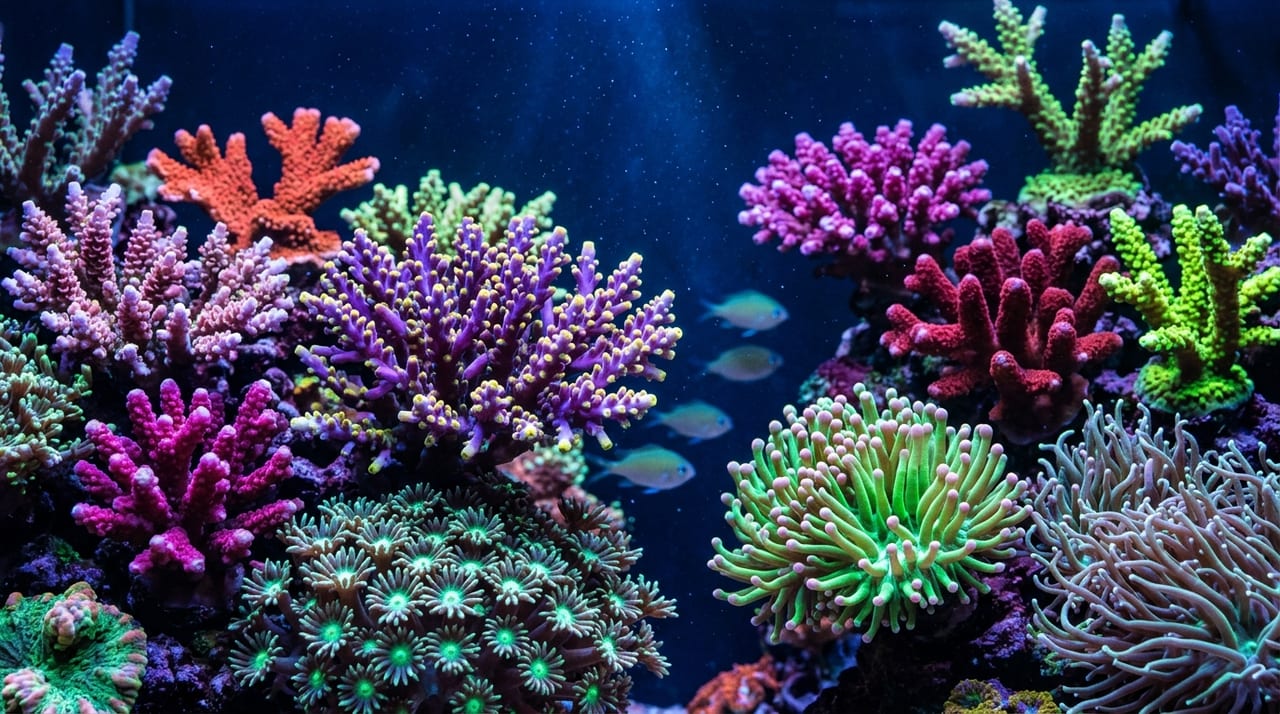
Photo records are as important as numerical data. By taking photos of the entire tank once per month from the same position under the same lighting conditions, you can objectively document coral growth and color changes.
Comparison photos from right after purchase and one to three months later are especially valuable for judging whether a coral has adapted to your tank environment. Rather than "the color seems to have faded somehow," comparing photos lets you perceive changes accurately.
Smartphone photos are sufficient. Save files with dates in the filename or create a dedicated folder and organize chronologically. After years of photos accumulate, they become a valuable archive of your tank's history.