Cat Territorial Behavior and Indoor Space Management Guide | Handling Marking, Spraying, and Conflict
Explains the causes and solutions for cat territorial behavior (marking, scratching, spraying). Introduces space management in multi-cat households, vertical space utilization, and steps for introducing new cats.
Key Takeaways
Explains the causes and solutions for cat territorial behavior (marking, scratching, spraying). Introduces space management in multi-cat households, vertical space utilization, and steps for introducing new cats.
Cats are inherently territorial animals. Even in indoor environments, territorial instinct remains strong and manifests in various forms—marking behavior (urine spraying), scratching (claw marking), and aggression toward other cats or people. This article explains the mechanisms of feline territorial behavior and provides guidance on proper space management and addressing behavioral problems in indoor environments.
Understanding Cat Territorial Behavior
Why Do Cats Have Territories?
Wild cats hunt alone, so they maintain territories to secure food resources, breeding partners, and safe resting places. While indoor environments cannot eliminate this instinct, proper environmental setup can minimize behavioral problems.
Types and Range of Territories
Cat territories consist of multiple "zones."
| Zone | Characteristics | Role |
|---|---|---|
| Core Area | Most important. Sleeping area, feeding place, litter box location | Defended most strongly |
| Home Range | Wider area where daily activity occurs | Regularly patrolled |
| Buffer Zone | Area that may overlap with other cats' territories | Prone to tension |
In indoor environments, the entire home becomes these zones.
Main Territorial Behaviors and Their Meanings
1. Urine Spraying (Marking)
This is the behavior of standing with the back to a wall or furniture and spraying a small amount of urine. It's particularly common in unneutered male cats, but spayed females and neutered males may also do this.
Main Causes:
- Stress or anxiety (moving, addition of new pets or family members)
- Feeling threatened in their territory
- Influence of sex hormones (unneutered or unspayed)
- Territory competition in multi-cat households
Solutions:
- Neutering or spaying (most effective; often reduces spraying behavior by over 90%)
- Identify and remove stress sources
- Use of pheromone products (such as Feliway)
- Thoroughly clean soiled areas with enzyme-based cleaners
2. Scratching (Claw Marking)
This is the behavior of scratching furniture or walls. This is not just claw maintenance but also serves as visual and olfactory marking.
Solutions:
- Install scratching posts (sisal rope, cardboard, or wood) in appropriate locations
- Apply double-sided tape (adhesive side facing out) to problem furniture
- Praise the cat when using scratching posts (positive reinforcement)
- Regular nail trimming
Choosing Scratching Posts:
- Height: High enough that cats can reach when extending their front legs (ideally 40-60cm or more)
- Stability: Weight and structure that won't tip over
- Material: Match the cat's preference (sisal is popular, but individual preferences vary)
- Location: Near frequently used furniture and near the cat's resting areas
3. Facial and Body Rubbing (Bunting)
This is when a cat rubs their face, head, or body against people or objects. It's a friendly form of marking in which facial pheromones are deposited, expressing comfort and affection.
No action is needed; this is a sign that the cat recognizes people or objects as "safe territory."
4. Kneading (Treading)
This is alternately pushing soft surfaces with the front paws. It's a remnant of the behavior kittens use to stimulate milk flow from their mothers, and expresses relaxation and affection.
Territory Management in Multi-Cat Households
Why Problems Occur
Cats are naturally solitary animals, so living together creates constant pressure on their territory. However, with proper environmental setup, multiple cats can coexist peacefully.
Basic Principle: Resource Distribution
The "Plus One Per Cat" Rule:
- Litter boxes: Number of cats + 1 (3 boxes for 2 cats)
- Food bowls: Separate bowls for each cat
- Water stations: Multiple locations throughout the home
- Scratching posts: One or more in each area
- High places (cat trees, etc.): Multiple options
Vertical Space Utilization
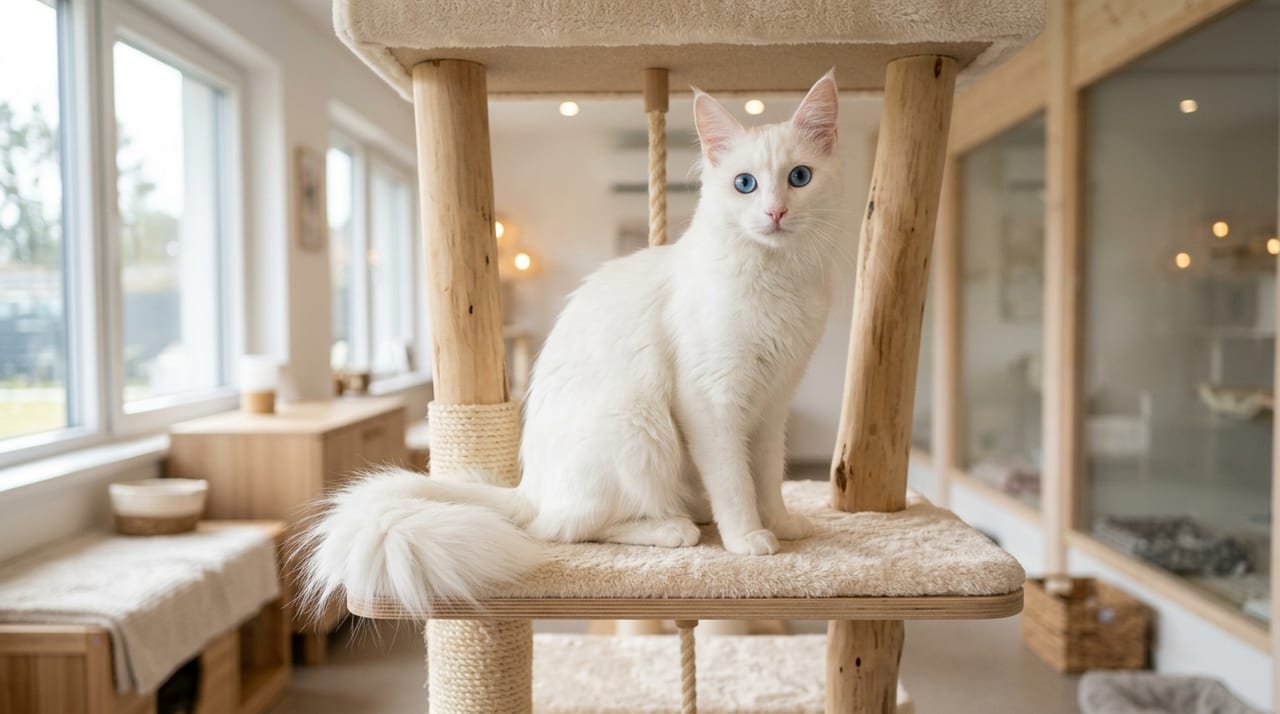
Cats prefer high places and utilize vertical space as territory.
Ways to Increase Vertical Space:
- Cat trees (ideally reaching near the ceiling)
- Wall-mounted cat walks
- Clear shelves and bookcases to create spaces for cats to climb
- Window perches and hammocks
Having high places allows cats to "declare" their social status, reducing their stress.
Steps for Introducing a New Cat
Gradual Introduction Is Key to Success:
- Isolation Period (1-2 weeks): Keep the new cat in a separate room with no direct contact with resident cats
- Scent Swapping: Exchange towels to familiarize them with each other's scents
- Door-Gap Contact: Allow them to smell and sense each other through the door crack
- Pheromone Product Use: Apply Feliway to both the resident cat's and new cat's spaces
- Supervised Face-to-Face Contact: Start with short sessions and gradually extend if no problems occur
Solutions by Root Cause of Stress and Territory Issues
Spraying After Moving or Environmental Changes
In a new home, the lack of familiar scents can cause cats to begin marking due to anxiety.
Solutions:
- Use Feliway (facial pheromone product)
- Prioritize placing items with the cat's scent
- Arrange familiar furniture and beds in the same layout if possible
- Allow gradual exploration of new areas (don't open all rooms at once)
When Outdoor Cats Are Visible Through Windows
Spraying after seeing outdoor strays is a reaction to a perceived territory invader.
Solutions:
- Limit the view with window film or lower window panels
- Use pheromone products
- Enrich the indoor territory (increase playtime)
Conflict in Multi-Cat Households
If territorial conflicts persist, fundamental environmental improvements are necessary.
- Increase and distribute resources
- Add vertical space
- Separate feeding locations (prevent conflicts during meals)
- For cats with poor compatibility, use "management" to reduce risk
- Consult with a feline behavior specialist (veterinary behaviorist) if needed
Relationship Between Cat Territorial Behavior and Health
Elimination Issues
Elimination outside the litter box must be distinguished from spraying.
| Spraying | Inappropriate Elimination |
|---|---|
| Standing with back to target | Squatting position |
| Small amount on walls/furniture | Normal amount on floors/horizontal surfaces |
| Territory-related | Related to litter box issues (cleanliness, location, illness) |
For inappropriate elimination, consider medical causes (lower urinary tract disease, diabetes, etc.) and consult your veterinarian.
Stress and Immunity/Health
Chronic stress directly leads to decreased immune function, idiopathic cystitis (stress-related cystitis), and loss of appetite. Resolving territory issues is part of health management.
Summary
Cat territorial behavior is rooted in instinct and cannot be completely eliminated. However, problem behaviors can be significantly reduced through proper environmental setup (resource distribution and vertical space), stress management, use of pheromone products, and neutering or spaying when appropriate.
In multi-cat households especially, utilizing vertical space to ensure each cat has "their own space" and adequately distributing resources is fundamental to peaceful coexistence. Don't hesitate to consult a feline behavior specialist if problems are severe.