Complete Guide to Setting Up a Brackish Water Aquarium | Salinity and Care for Bumble Bee Goby and Monodactylus
How to care for Bumble Bee Goby, Monodactylus, and other fish that live in brackish water (between freshwater and saltwater). Detailed explanation of salinity settings, suitable fish species, and water quality management methods.
Key Takeaways
How to care for Bumble Bee Goby, Monodactylus, and other fish that live in brackish water (between freshwater and saltwater). Detailed explanation of salinity settings, suitable fish species, and water quality management methods.
Related Species
What is a Brackish Water Aquarium?
Brackish water (kishui) refers to a transitional aquatic environment found in estuaries, mangrove forests, and brackish lakes where freshwater rivers and seawater mix. Salinity concentrations range between approximately 0% (freshwater) and 3.5% (seawater, specific gravity around 1.025). Fish adapted to this unique environment are called "brackish water fish" and form their own unique niche in the aquarium hobby.
The main characteristic of a brackish water aquarium is that it requires care that falls between that of freshwater and saltwater tanks. Salinity management is less stringent than for fully marine fish, and equipment costs are lower than for corals and saltwater fish. However, they have water quality requirements distinct from freshwater fish, so they can be considered an "intermediate-level" category. Adding salinity (artificial seawater) has unique effects on bacterial activity and the fish's osmotic regulation, and resistance to certain diseases is higher than in freshwater.
Types and Characteristics of Representative Brackish Water Fish
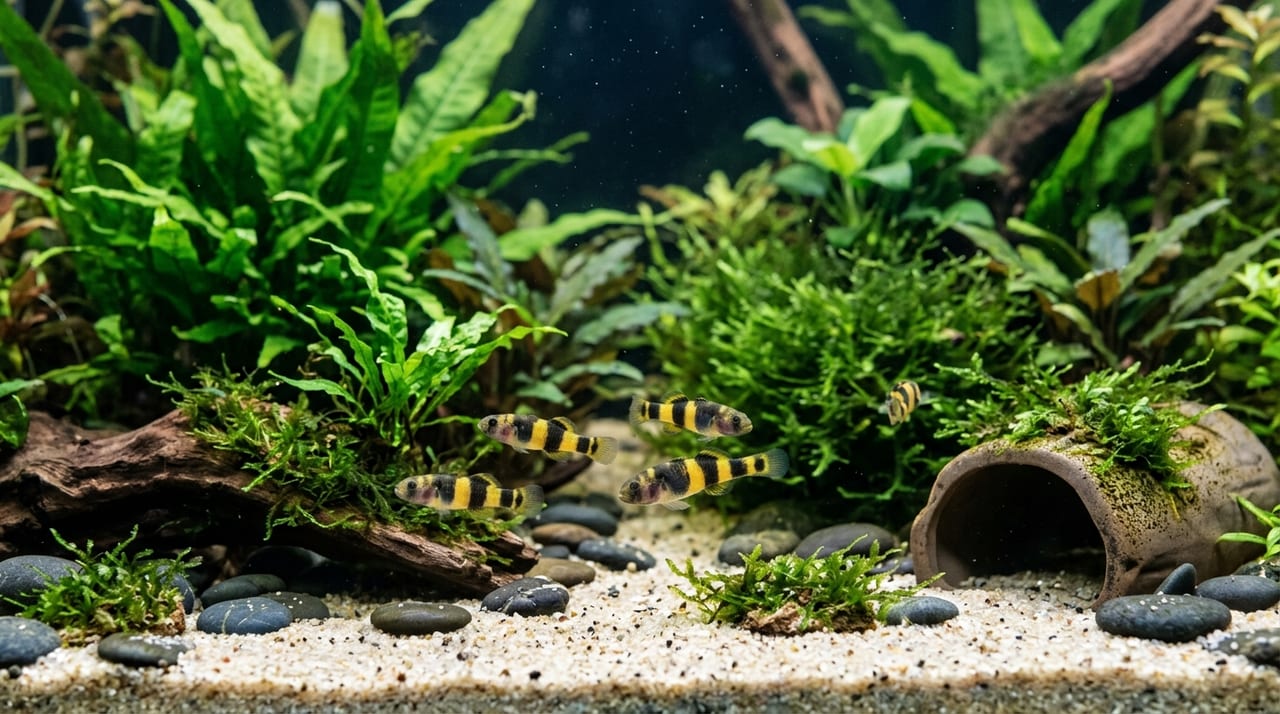
Bumble Bee Goby (Brachygobius genus) is one of the most popular types of brackish water fish. They are ultra-small, measuring about 2–4 cm in body length, and are named for their yellow and black striped pattern, which resembles a bumblebee. Brackish water with a specific gravity of around 1.005–1.015 is ideal, and while they can survive briefly in pure freshwater, they remain healthier long-term in brackish conditions. They inhabit the bottom layer and tend to prefer live food (frozen bloodworms, daphnia, and brine shrimp) over artificial food. Multiple individuals will exhibit territorial aggression, but cohabitation is possible if sufficient hiding places (rocks, tubes, and shelters) are provided.
Monodactylus (Monodactylus argenteus) is a brackish water fish native to Asia and Africa, characterized by a tall body profile and a diamond-like body shape. Adults grow to 25 cm or larger. They are beautiful fish with silver bodies and vertical black lines, and they exhibit schooling behavior. While juveniles can be reared in brackish to freshwater conditions, this species is known to prefer higher specific gravity (1.018–1.025) closer to seawater as it matures.
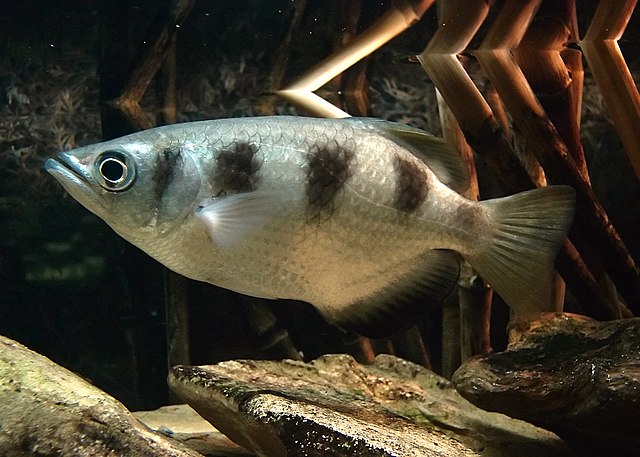
Archer fish (Toxotes species) are covered in detail in another article on this site, but as a representative brackish water fish, they are maintained at a specific gravity of 1.005–1.015.
Other representative brackish water fish include the puffer family's Green Spotted Pufferfish (Dichotomyctere nigroviridis, specific gravity 1.005–1.015), mudskippers (Periophthalmus), and scats.
Setting Up a Brackish Water Aquarium and Adjusting Salinity
To set up a brackish water aquarium, first determine the specific gravity (salinity) that matches the fish species you want to keep. Use a hydrometer or refractometer (salinity meter) to measure specific gravity. A refractometer is recommended for its superior accuracy.
Create the water using artificial marine salt (marine salt mix). The amount to add per liter varies by product, but adjust according to your target specific gravity. For Bumble Bee Goby, specific gravity of 1.005–1.010 (approximately 7–15 g per liter) is typical. Remember to measure at 25–28°C, as specific gravity fluctuates with temperature.
Using coral sand (fine grain) or aragonite sand for the substrate makes pH stabilization easier and is suitable for maintaining the slightly alkaline to neutral pH (7.5–8.5) that brackish water fish prefer. External or hang-on filters work well, but extended use in brackish water can cause corrosion of impellers and metal parts. It is recommended to either select salt-resistant equipment or clean it regularly.
When changing water, use replacement water adjusted to the same specific gravity. As evaporation lowers the water level, salinity concentrations increase, so adding pure freshwater to maintain specific gravity is an important maintenance task.
Water Quality Management and Important Points
Here are the key points to watch when maintaining a brackish water aquarium.
Stable specific gravity is the top priority. Rapid changes in specific gravity cause osmotic shock and fish death. Perform water changes and top-offs gradually while monitoring specific gravity, and aim not to fluctuate specific gravity by more than 0.001–0.002 per water change.
While pathogenic bacteria and parasites tend to proliferate less in brackish water than in freshwater, the brackish water version of ich (Cryptocaryon) can still occur. Regarding treatments, most freshwater medications can be used on brackish water fish, but dosage adjustments and caution are necessary.
When it comes to aquatic plants, the selection suitable for brackish water aquariums is limited. Willow moss, Java fern, and mangrove seedlings (which tolerate brackish water) are commonly used. Most plants intended for pure freshwater will die in brackish conditions.
Regarding tankmates, even among brackish water fish, housing species with different salinity requirements creates an inappropriate environment for one or both. The key is to select species that prefer similar specific gravity ranges.
Summary: Introduction to the World of Brackish Water Fish
A brackish water aquarium represents a third world distinct from freshwater and saltwater, offering encounters with unique fish species. You can enjoy a wide variety of care styles, from ultra-small species like the Bumble Bee Goby to the Monodactylus, which transitions to saltwater as it grows. While specific gravity management requires specialized technique, it is not difficult once you master the basics. The true joy of a brackish water aquarium is the opportunity to observe up close the ecology of fish living in this special environment.