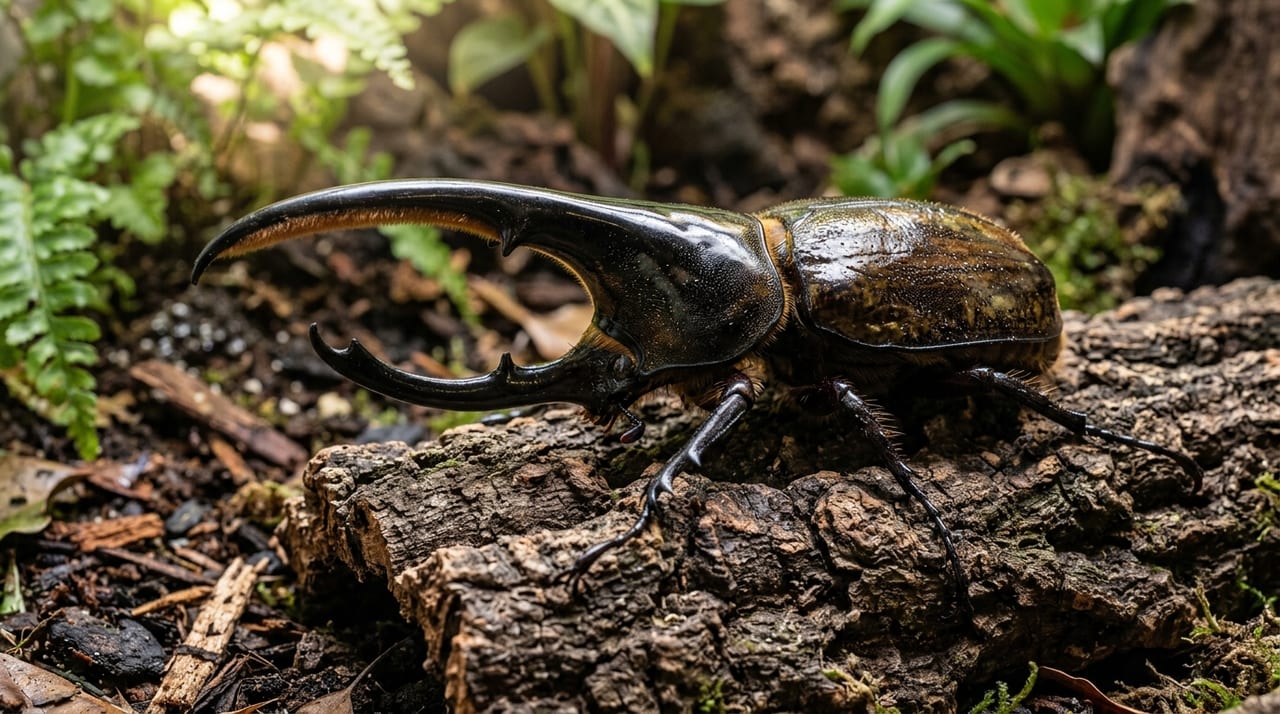
Mites and Their Relationship with Beetles and Stag Beetles
When raising beetles or stag beetles, you may discover a large number of small white or reddish-brown particles moving around inside the case. These are "mites." Mite infestation is one of the common problems in insect breeding using breeding substrate or leaf mold, but depending on the species, they can have serious effects on the health of both adults and larvae, requiring proper knowledge and countermeasures.
Types of Mites That Appear in Insect Breeding
False Gourd Mites (White Mites)
The most commonly observed whitish small mites in breeding cases. They may attach in large numbers to adult beetles and stag beetles. They are typically "detritivorous mites" that feed on leaf mold decomposition products and decaying organic matter, but when they proliferate in large numbers, they gather around the mouth and spiracles (breathing openings) of adults, adversely affecting feeding and respiration.
Flour Mites and Hairy Flour Mites
Extremely small mites that appear as white powder. They tend to proliferate in large numbers in dried substrate, grain, and mycelium bottles, and may damage fungal beds. Because they can act as allergens, attention must be paid to potential health effects on humans.
Japanese Rhinoceros Beetle Mites and Parasitic Mites
Relatively large reddish-brown to brown mites (approximately 1-3mm). They often become attached to beetles and stag beetles collected from the field. These are "parasitic mites" that suck body fluids, and when heavily parasitized, they exhaust the insect's strength and can be a cause of death.
Smooth Mites (a type of detritivorous mite)
Detritivorous mites commonly found in the gut and around the feces of larvae. If present in small numbers, there is no particular harm, but large-scale proliferation is a sign of substrate environmental deterioration.
Causes of Large-Scale Mite Proliferation
Substrate That Is Too Moist
While moderate humidity is necessary for beetle and stag beetle breeding, when substrate becomes too moist, it creates an ideal breeding environment for mites. Particular caution is needed during high-temperature, high-humidity periods.
Substrate should be at a level where it clumps together when squeezed but does not drip water—a moisture content of approximately 45-55% is appropriate. Substrate so wet that water runs out becomes a breeding ground for mites and fungi.
Substrate Degradation and Feces Accumulation
In larval cases, when larval feces accumulate, the ammonia concentration in the substrate increases, causing specific mites to proliferate in large numbers. As mycelium bottles age, the filamentous fungi change character and attract flour mites.
Unsterilized or Low-Quality Substrate
Inexpensive leaf mold or non-heat-treated substrate may contain mite eggs and larvae. It is fundamental to use heat-treated substrate designed for breeding.
Introducing Collected Specimens
Beetles and stag beetles collected outdoors often have various mites attached. Placing them directly into existing breeding cases causes mites to spread.
Practical Mite Control: Five Approaches
Countermeasure 1: Removing Mites from Adults
Water Washing (Most Effective):
Gently wash the beetles under running water using a toothbrush or cotton swabs to remove mites. Carefully remove mites hiding between joints, at the base of legs, and around the mouth. After this, replace all the breeding substrate with fresh material.
Method of Moving Over Newspaper:
When you place an adult on newspaper, mites will fall onto the paper for a while. Repeat this multiple times to remove a certain amount of mites.
Countermeasure 2: Heat Treatment of Substrate
As insurance, even new breeding substrate should be heat-treated by heating in a microwave for 2-3 minutes or placing in a heat-resistant bag and heating at 70°C or higher for one hour to kill mite eggs and larvae. After heating, cool thoroughly and allow gases to dissipate before use.
Commercially available "mite-catching mats" and "hinoki chip mats" also have mite-repelling effects.
Countermeasure 3: Review of Breeding Environment
- Improving ventilation: Use cases with numerous ventilation holes in the lid. Fruit fly sheets may impede ventilation, so prioritize ventilation temporarily during periods of high mite infestation.
- Proper humidity management: Maintain substrate at a level where it clumps when squeezed. Check approximately twice a month.
- Case cleaning: Cases where mites have proliferated in large numbers should be re-used after hot water sterilization or bleach washing.
Countermeasure 4: Use of Mite-Catching Sheets
A method of applying commercially available "mite-catching sheets (such as Dani Capture Robot)" to the outside walls of cases. While not complete elimination, this is effective in suppressing spread outside the case.
Countermeasure 5: Regular Substrate Replacement
Larval cases: When feces have accumulated to one-third or more, this is a guideline for substrate replacement.
Adult cases: Replace all substrate once every 1-2 months.
When replacing, do not place new substrate directly—check the moisture content before use.
Effects of Mites on Larvae and How to Handle Them
This is how to handle cases where mites proliferate in large numbers in larval containers.
- Remove larvae: Dig out larvae from the substrate and gently wipe away mites attached to the larval body with moistened tissue.
- Discard all substrate: Discard entirely any substrate where mites have proliferated in large numbers, and wash and dry the container.
- Transfer to fresh substrate: Transfer larvae to heat-treated fresh substrate.
- Environmental improvement: Review ventilation and humidity.
Caution Regarding Health Effects on Humans
Flour mites can become causative allergens for human allergies (mite allergies and asthma). Wearing a mask is recommended when replacing substrate with large mite infestations. Also consider separating the breeding area from living spaces.
To Maintain a Healthy Breeding Environment Free of Mites
Regular observation is key to early detection and handling of mites. Make it a habit to check the condition of the substrate, the body surface of adults, and the state of larvae by opening the breeding case lid once a month.
| Check Frequency | Items to Confirm |
|---|
| Daily (during feeding) | Whether numerous mites are attached to the adult's body |
| Once or twice a month | Substrate moisture, color, and odor; mite infestation status |
| During substrate replacement | Larval condition; confirmation of mites in substrate |
Frequently Asked Question: Do Mites Kill Beetles and Stag Beetles?
Conclusion: While mites are not often a direct cause of death, neglecting them can lead to death.
The most commonly seen white mites in captivity (false gourd mites) and flour mites are types that feed on leaf mold decomposition products and leftover food and do not suck the body fluids of adults. If only a small number are attached, it is unlikely they would die from that cause.
However, the risk of death increases in the following situations.
- Heavy parasitization: When mites cover the joints and spiracles (breathing openings) of the body, respiration is obstructed and the insect becomes weakened and unable to feed. If mites are attached so thickly that the body surface appears white, remove them immediately.
- Parasitization by predatory mites: Large reddish-brown mites that come attached to collected specimens (such as Japanese rhinoceros beetle mites) suck body fluids, and when heavily parasitized, can exhaust their strength and result in death.
- The environment itself where mites proliferate: Substrate where mites proliferate in large numbers is high-humidity and deteriorated. The real cause of the insect becoming weak is this environment, and mites increase as a result. Not only remove the mites, but simultaneously replace the substrate and review humidity.
In the case of larvae, it is uncommon for mites to intensively attach to healthy larvae, and there is a tendency for mites to gather on already weakened or dead larvae. When numerous mites are attached to a larva's body, check the substrate condition and larval health rather than focusing on the mites.
Summary
The mite problem in beetles and stag beetles can be greatly reduced by maintaining proper breeding conditions and regular care. By simply following three points—"substrate moisture management," "regular replacement," and "isolation of collected specimens"—most large-scale mite infestations can be prevented. Even if large-scale proliferation occurs, it can be handled with water washing and complete substrate replacement. By properly understanding mites, let's create an environment where beetles and stag beetles can grow healthily.