A Care Guide for Aodaisho | Basics of Enclosure, Temperature, Feeding, and Handling
A comprehensive guide to caring for the Aodaisho (*Elaphe climacophora*), a species endemic to Japan. This complete practical guide covers sourcing CB (captive-bred) individuals, enclosure sizing and escape prevention, creating temperature gradients, acclimating to frozen mice, addressing feeding refusal, shedding care, and handling precautions—all organized with beginners in mind.
Key Takeaways
A comprehensive guide to caring for the Aodaisho (*Elaphe climacophora*), a species endemic to Japan. This complete practical guide covers sourcing CB (captive-bred) individuals, enclosure sizing and escape prevention, creating temperature gradients, acclimating to frozen mice, addressing feeding refusal, shedding care, and handling precautions—all organized with beginners in mind.
The Aodaisho (Elaphe climacophora) is a non-venomous colubrid native to Japan and one of the most well-known Japanese snake species. It is widely distributed throughout Honshu, Shikoku, Kyushu, and the Izu Islands, and has long been cherished as a guardian spirit of rural and semi-natural landscapes. With its beautiful greenish-blue to olive-colored body and the robustness characteristic of native Japanese species, it remains a consistently popular starter species for reptile enthusiasts.
What Kind of Snake Is the Aodaisho?
Basic Information: | Item | Details | |---|---| | Scientific name | Elaphe climacophora | | Family | Colubridae | | Distribution | Honshu, Shikoku, Kyushu, and the Izu Islands | | Total length | 100–200 cm (maximum approximately 250 cm) | | Lifespan | 10–15 years (in captivity) | | Diet | Carnivorous (small mammals, birds, frogs, fish, etc.) | | Venom | None | | Legal regulation | As a domestic species, no export/import restrictions (note regional ordinances for collection) |
About Body Color: Juveniles are brown to tan in color with black vertical stripe markings called "juvenile pattern." As they grow, their coloration gradually shifts from green to blue-green, and adults develop a uniform greenish-blue (olive-green) color. This color transformation is the origin of the name "Aodaisho" (literally "blue big snake"). Albino individuals also appear in the pet trade.
Legal Considerations and How to Obtain One
In Japan, capturing wild Aodaisho may be regulated by prefectural ordinances or conservation efforts depending on the region. Keeping them requires no permit as they are not designated as special animals, but it is important to check local ordinances before collection.
Obtaining Options: 1. Direct from Breeders: Captive-bred (CB) individuals often become accustomed to artificial foods, and their health history is clear. They can be found on platforms like Br-Choku. 2. Reptile Expos: Domestic breeders frequently exhibit and sell at these events. 3. Specialty Reptile Shops: Both CB and wild-caught (WC) individuals are available.
CB individuals are recommended for beginners. WC (wild-caught) individuals often carry parasites, may refuse food, and take longer to acclimate to captive conditions.
Choosing and Setting Up an Enclosure
Enclosure Size: The minimum space should allow the snake to stretch out to at least two-thirds of its body length. For adults (150–200 cm), the following are recommended:
- Minimum: 60 cm × 45 cm × 45 cm
- Recommended: 90 cm × 45 cm × 45 cm or larger
- Ideal: 120 cm × 60 cm × 60 cm
Aodaisho are skilled climbers and move in three dimensions. Greater enclosure height creates a more naturalistic environment.
Enclosure Material and Escape Prevention: Acrylic or wooden reptile-specific enclosures are suitable. Snakes probe gaps in lids with their snouts, so the lid must have a secure locking mechanism. Even tiny gaps allow escape, making secure locks essential.
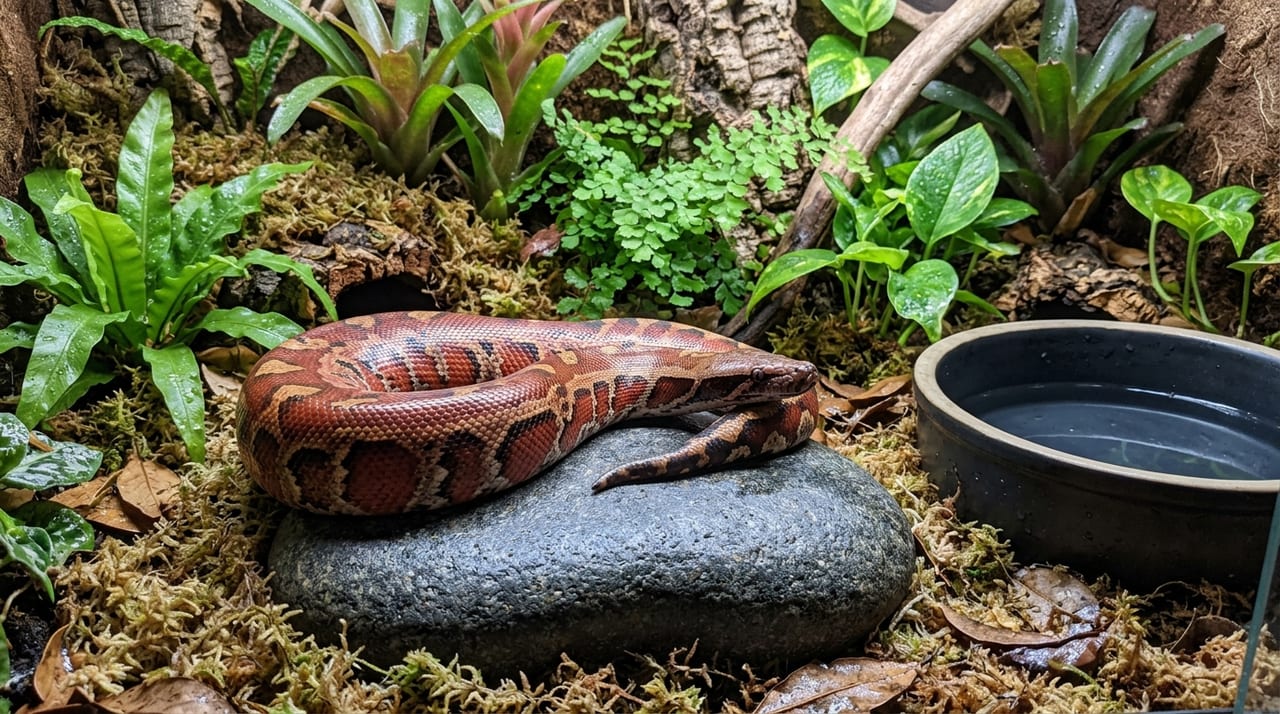
Interior Layout: - Substrate: Paper towels (hygienic and easy to maintain) or coconut husk chips (more naturalistic) - Shelters: Cork bark, wooden hides, or PVC pipe—large enough for the entire body to fit inside - Branches and driftwood: Provide vertical movement space. Aodaisho are fairly arboreal. - Water Bowl: Large enough for full-body soaking (used especially before shedding)
Temperature and Humidity Management
Aodaisho are ectothermic, so creating a temperature gradient (thermoconvex) is essential.
Temperature Settings: | Zone | Target Temperature | |---|---| | Warm side | 28–32°C | | Cool side | 22–26°C | | Night | 18–22°C | | Winter (without hibernation) | 20–25°C |
Heating Equipment: - Under-tank or side-mounted heating pads - Far-infrared heaters
Pair heating with a thermostat to prevent overheating.
Humidity: 50–70% is ideal. Increase to 70–80% before and during shedding (use a larger water bowl or misting). Excessive dryness causes incomplete shedding.
Hibernation: In indoor captivity, maintaining 20–25°C allows year-round activity, which is the standard approach. Natural hibernation (dropping below 10°C) is possible but management is challenging; year-round husbandry is recommended for beginners.
Feeding
Frozen Mice and Rats as Primary Food: In captivity, frozen mice (pink mice, fuzzy mice, adult mice) are the standard diet. Thaw them and warm to body temperature (35–40°C) before offering to encourage feeding response.
Size Guidelines: - Hatchlings and young snakes: Pink mice (large) to fuzzy mice - Subadults: Fuzzy to small mice - Adults: Adult mice to rats
A good feeding size is approximately the diameter of the snake's thickest body part, or slightly smaller.
Feeding Frequency: - Hatchlings: 1–2 times per week - Subadults and adults: Once every 7–14 days
Addressing Feeding Refusal: New environments, inadequate ventilation, incorrect temperature, and breeding season (spring to early summer) can trigger refusal. Adjusting thaw temperature, adding scent (egg or frog scent when transitioning from live to frozen), or darkening the enclosure often helps.
Handling (Interaction)
Aodaisho are relatively docile once acclimated and well-suited for handling among Japanese native species. However, observe these precautions:
Acclimation: 1. Leave the snake undisturbed in its enclosure for the first two weeks (prioritize environmental adjustment) 2. Start with short sessions (5–10 minutes) 3. Approach from the front rather than grabbing from behind; show the snake your hand first, then lift slowly 4. Once acclimated, 30 minutes to 1 hour of handling is possible
Important Notes: - Avoid handling for 24–48 hours after feeding (disrupts digestion and can cause regurgitation) - Do not handle during pre-shedding or shedding (when eyes are milky white) to minimize stress - Bites do occur but are harmless (non-venomous). Wash and disinfect if bleeding occurs.
Shedding Care
Aodaisho shed regularly as they grow (hatchlings shed approximately monthly; adults every 2–3 months).
Signs of Pre-Shedding: - Eyes appear milky white (like cataracts) - Body color becomes dull - Loss of appetite or refusal to feed - More time spent alone
Managing Incomplete Shedding: Increase humidity before shedding and provide a large water container for full-body soaking. If incomplete shedding occurs, soak the snake in warm water (30–35°C) for 15–20 minutes to soften remaining skin, then gently rub with a cotton swab or finger.
Health Management and Common Issues
Common Problems: - Mites (external parasites): Common in WC individuals. Use reptile-specific mite treatments (use specialized products under professional guidance) - Mouth rot (stomatitis): Redness and discharge around the mouth. Requires antibiotic treatment; consult a reptile specialist - Pneumonia (respiratory infection): Wheezing, nasal discharge, and bubbling during respiration. Increase temperature to 30°C or above and seek veterinary care - Impaction: Results from accidental substrate ingestion. Use paper towels or large gravel to prevent this issue
Tips When Purchasing from Breeders
When looking for Aodaisho on platforms like Br-Choku, confirm the following:
- CB (captive-bred) status: Verify the snake is acclimated to frozen mice
- Last feeding date: An indicator of recent health condition
- Number of sheds: Two or more sheds in a hatchling indicates a more robust individual
- Body condition: Check that ribs are not prominently visible due to poor weight
Summary
The Aodaisho, as Japan's endemic native snake, combines three advantages: ease of acquisition, hardiness, and suitability for handling—making it an ideal beginner reptile species. With proper enclosure sizing, temperature gradients, and consistent feeding with frozen mice, long-term care of 10+ years is achievable. The experience of observing and keeping a creature native to Japan's own countryside in a vivarium becomes a special hobby that deepens understanding of Japan's natural environment and culture.