Source: Wikimedia Commons
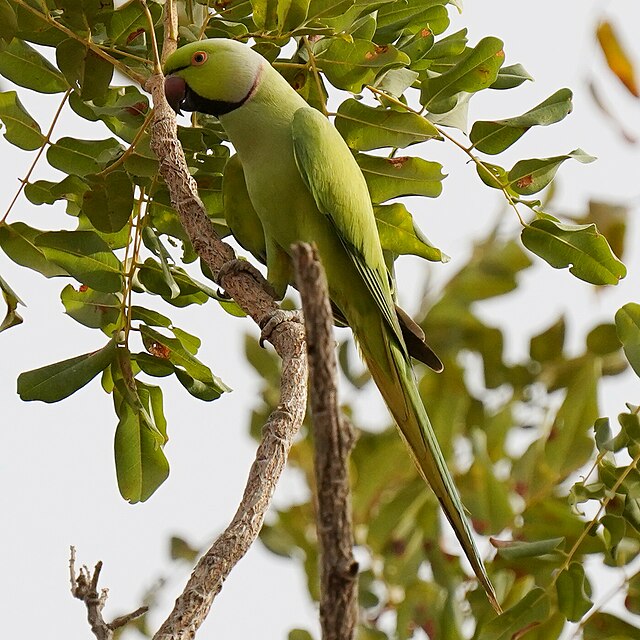
Indian Ringneck Parakeet
IntermediatePsittacula krameri
Elegant slender parakeet with long tail. Males have distinctive neck ring. Good talkers with many color mutations.
Difficulty
Intermediate
Temperature
15〜30℃
Lifespan
20-30 years
Size
37-43cm (including tail)
Humidity
40〜60%
Diet
Pellets, seeds, vegetables, fruits
About
The rose-ringed parakeet, also known as the ring-necked parakeet, is a medium-sized parrot in the genus Psittacula, of the family Psittaculidae. It has a disjunct native range in tropical northern Africa and the Indian subcontinent, and is now introduced into many other parts of the world where feral populations have established themselves having been bred for the exotic pet trade and then escaped.
Source: Wikipedia (CC BY-SA 4.0)
Lifespan of the Indian Ringneck Parakeet
The Indian Ringneck Parakeet lives 20-30 years.
Size of the Indian Ringneck Parakeet
The Indian Ringneck Parakeet grows to 37-43cm (including tail).
Basic Info
Origin
Indian subcontinent and tropical northern Africa
Lifespan
20-30 years
Size
37-43cm (including tail)
Temperature
15〜30℃
Humidity
40〜60%
Diet
Care Specifications
Semi-aggressivePairBreeding: Moderate
Captive Breeding
Egg-laying
- Clutch size
- 4〜6
- Incubation days
- 22〜23 days
- Sexual maturity
- 36 mo
Breeding season: Breeding activity typically peaks in late winter to spring (approximately January–April in Northern Hemisphere aviculture)
Breeding notes
Breeding behaviour may commence around 2 years of age, but consistent reproductive success is generally achieved from the third year onward. Males develop the characteristic neck ring at approximately 3 years, which marks morphological sexual maturity.
Breeding requires planning, proper husbandry, and responsibility. These figures are general guidelines.
Sources: Animal Diversity Web – Psittacula krameri / Parrot Magazine – Indian Ringneck Parakeet (Psittacula krameri manillensis)
Morphs (Varieties)
Representative color morphs of the rose-ringed parakeet. Sex-linked inheritance is denoted as recessive in this schema.
RecessiveVisual only with two copies; one copy = het (carrier).
BlueLutinoCinnamonAlbino
DominantVisual with a single copy; no distinct super form.
Grey
A curated selection of notable morphs. Inheritance modes are a breeding-planning guide; actual appearance varies with combos.
Calls & Media
Calls / Song
Song · © Thierry THOMAS · xeno-canto XC1076870 (CC BY-NC 4.0)
Call · © Peter Boesman · xeno-canto XC1081379 (CC BY-NC 4.0)
Sources: xeno-canto
References & Sources
Edited & verified by: BreederDirect editorial team
The taxonomic, regulatory, and husbandry data on this page are compiled and verified against the authoritative primary sources below.
Taxonomy & Authority
Accepted name: Psittacula krameri (Scopoli, 1769)
Synonyms: Alexandrinus krameri, Psittacus krameri
Authority databases: GBIF
Nomenclature follows global taxonomic authority databases.
Regulations & Conservation Status
Not CITES-listed
Psittacula krameri. One of four species (Agapornis roseicollis / Melopsittacus undulatus / Nymphicus hollandicus / Psittacula krameri) explicitly excluded from CITES Appendix II by notation. Not subject to CITES.
Sources: CITES Psittaciformes spp. Appendix II Annotation
Regulations may change. Always verify the latest information with the relevant authorities.
Indian Ringneck Parakeet Listings
Loading latest listingsFind listings for this species