Complete Guide to Earth Pond and Earth Floor Goldfish Cultivation | Natural Filtration, Green Water Management, and Breeder-Style Rearing Methods
This guide explains the traditional methods of earth pond and earth floor goldfish cultivation used by specialized breeders. Covering the mechanics of natural filtration using Arakida soil, the formation and management of green water (blue water), stocking density guidelines, overwintering, predator control, and mud management—this practical guide shows how natural environment-based cultivation brings out superior body shape and coloration in goldfish.
Key Takeaways
This guide explains the traditional methods of earth pond and earth floor goldfish cultivation used by specialized breeders. Covering the mechanics of natural filtration using Arakida soil, the formation and management of green water (blue water), stocking density guidelines, overwintering, predator control, and mud management—this practical guide shows how natural environment-based cultivation brings out superior body shape and coloration in goldfish.
Related Species
Earth Pond and Earth Floor Goldfish Cultivation
Earth pond (doike) and earth floor (doma) goldfish cultivation refers to goldfish rearing in large-scale spaces using natural soil—clay-based soil or Arakida soil—as substrate rather than concrete or resin. This method has been traditionally used by specialized goldfish breeders in major production regions (Yatomi, Aichi; Yamato-Koriyama, Nara; Edogawa Ward, Tokyo; etc.) and excels at selection, breeding, and mass rearing.
In recent years, small to medium-scale earth ponds and plastic tub cultivation using yards and balconies have been reassessed among hobbyist goldfish enthusiasts, and this method is gaining attention in the cultivation of large-sized ranchu and high-quality ornamental goldfish.
Benefits of Earth Pond and Earth Floor Cultivation
Natural Filtration and Ecosystem Formation
Abundant aerobic and anaerobic bacteria colonize the soil substrate, naturally performing not only the breakdown of ammonia and nitrite (nitrification) but also the denitrification of nitrate (anaerobic decomposition).
- Surface (aerobic layer): Nitrification of ammonia → nitrite → nitrate
- Deep layer (anaerobic layer): Denitrification of nitrate → nitrogen gas
In mature earth ponds where this system is functioning, water change frequency can be significantly reduced. Some professional goldfish breeders say that "mature earth ponds can be maintained with only a few water changes per year."
Natural Generation of Microorganisms and Live Food
The following microorganisms naturally develop in the soil and water, serving as live food for goldfish:
- Daphnia: High-protein live food that promotes growth in fry
- Copepods and midge larvae: Nutrient-rich organisms
- Green algae and diatoms: Phytoplankton that naturally develop in water (the basis of green water)
Especially during fry-rearing periods, cultivation in earth ponds promotes development through live food feeding, making it easier to raise individuals with good body shape and coloration.
Water Temperature Stability
Large earth ponds have high water volumes, providing strong buffering against temperature fluctuations and preventing sudden water temperature changes. Water temperature changes gradually with seasonal transitions, creating an environment where goldfish can easily acclimate.
How to Build an Earth Pond
Site Selection
- Sunlight: Partial shade with sunlight in the morning and shade in the afternoon is ideal (prevents excessive growth of blue-green algae and moss from excess direct sunlight)
- Drainage: A location where rainwater doesn't accumulate, or where drainage can be ensured
- Water source access: Access to tap water or well water for water changes
Pond Structure
Small-scale earth pond (for hobbyists)
- Volume: 200–1,000 L
- Depth: 30–60 cm (too shallow causes large water temperature fluctuations)
- Area: 1–4 m²
Large-scale earth pond (for breeders)
- Volume: 1,000–10,000 L or more
- Depth: 60–100 cm
- Area: 4–20 m² or more
Choosing Substrate
| Substrate | Characteristics |
|---|---|
| Arakida soil | Traditional goldfish substrate. Clay-based, doesn't crumble easily, excellent for bacterial colonization |
| Akadama soil | Easy to obtain with pH-balancing properties. Gradually breaks down |
| River sand and gravel | Good for bacterial colonization but produces less live food |
| Black soil (humus mix) | Abundant daphnia production. Water tends to become brown |
Substrate thickness should be approximately 5–15 cm. If too thick, anaerobic conditions become too strong, risking hydrogen sulfide generation.
Water Startup
Immediately after creating an earth pond, soil particles stir up easily and water becomes turbid.
- Fill the pond with water: If using tap water, dechlorinate it (for large volumes, let stand for a few days or use a liquid dechlorinator)
- Establish green water (blue water): Leave exposed to sunlight for 1–2 weeks to allow plankton to proliferate and form green water
- Verify ammonia and nitrite: Always test with a kit before introducing fish (should be zero)
- Introduce goldfish: Start with a small number and observe for 1–2 weeks before adding more
Management
Water Quality Management Approach
In mature earth ponds where natural filtration functions, water quality remains stable if stocking density is appropriate.
Basic Management Parameters
| Parameter | Target | Action |
|---|---|---|
| Ammonia (NH₃) | 0 mg/L | If elevated: increase water changes, reduce stocking |
| Nitrite (NO₂) | 0 mg/L | Same as above |
| Nitrate (NO₃) | ≤40 ppm | Partial water changes weekly to monthly |
| pH | 7.0–8.5 | Tends to rise in green water state; adjust with water changes |
Stocking Density
Proper density management is essential to maximize the natural filtration capacity of earth ponds.
- Overstocking is strictly prohibited as it exceeds natural filtration capacity and causes rapid ammonia increase
- Guideline: 5–10 adult fish (15 cm) per square meter (depending on pond depth and maturity)
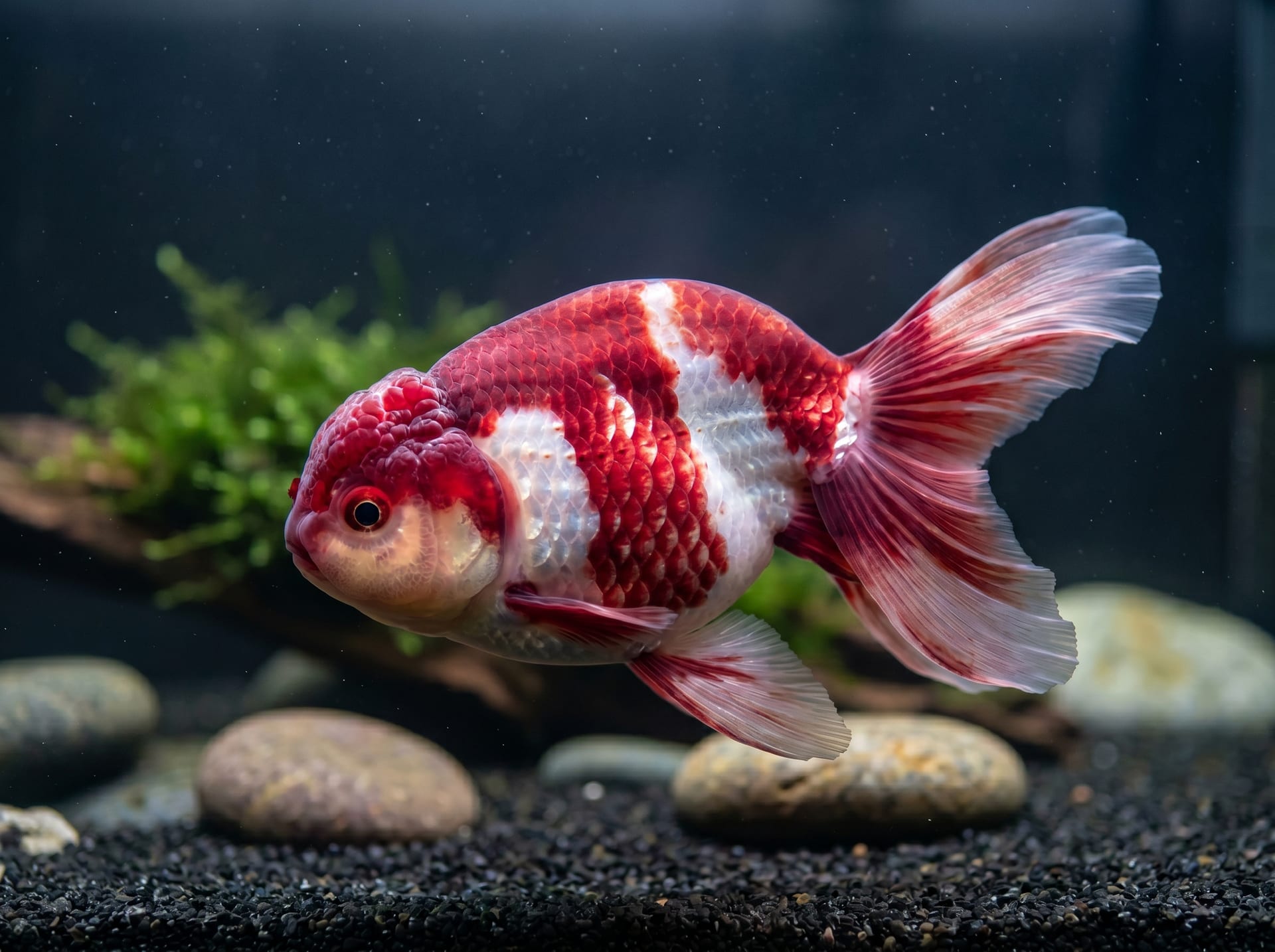
- Reduce density for large varieties such as ranchu
Green Water (Blue Water) Management
Moderate green water is beneficial in earth ponds, but excessive blue-green algae (such as Microcystis) is harmful.
Good green water: Even mixture of diatoms and green algae (bright green, transparent)
Bad blue-green algae: Excessive blue-green algae bloom (murky dark green, foam, odor)
Blue-green algae suppression strategies:
- Increase water change frequency
- Reduce direct sunlight by 30–50% with shade cloth
- Increase aeration (air pumping)
Overwintering Management
- When water temperature drops to 10°C or below, goldfish enter hibernation (semi-dormancy)
- Gradually reduce food based on water temperature; stop feeding below 8°C
- In regions where ponds freeze, use insulation covers (vinyl sheets or insulating material)
- The pond bottom must be deep enough for goldfish to hide (minimum 30 cm or more)
Precautions for Earth Pond Cultivation
Predator Control
Outdoor cultivation faces predation risks from wild birds (herons, kingfishers, crows) and mammals (cats, raccoon dogs).
- Install bird netting (20–40 mm mesh) over the entire pond
- Raise pond sides at least 50 cm above ground
- Cover at night
Mud Management
Over time, fish waste, uneaten food, and organic matter accumulate on the soil bottom.
- Annual or biannual bottom cleaning: Temporarily move goldfish to another container and remove part of the bottom mud (approximately 1/3 of the total)
- Complete mud removal is prohibited as it destroys beneficial bacteria
- Removed mud can be reused as plant fertilizer
Parasite and Disease Management
In earth ponds mimicking natural environments, parasites such as fish lice (Argulus) and anchor worms (Lernaea) can easily invade.
- Regular observation of fish (1–2 times per week)
- New fish must be quarantined for at least 2 weeks
- If fish lice are confirmed, perform early physical removal and medicated bath (such as Refish)
Why Breeders Use Earth Ponds
The reason specialized goldfish breeders insist on earth ponds is not merely tradition.
- Cost-effectiveness: Low maintenance costs even for large-scale rearing
- Easy-to-select body development: Natural feed and low-stress cultivation in a natural environment develop superior body shape
- Natural coloration: Natural color enhancement from green water and live food
- Breeding conditions: Seasonal changes (water temperature and light intensity) naturally cycle, making breeding induction easier
Even at home, you can experience the "true nature" of goldfish cultivation by trying small earth ponds or plastic tub rearing using Arakida soil. Please challenge yourself to try traditional earth pond cultivation.