Beginner's Checklist for Buying Living Animals | A Guide to Buying Without Failure
A checklist for those purchasing living animals for the first time, covering preparations before purchase, questions to ask breeders, how to identify healthy individuals, and preparing your reception environment.

Key Takeaways
A checklist for those purchasing living animals for the first time, covering preparations before purchase, questions to ask breeders, how to identify healthy individuals, and preparing your reception environment.
Buying living animals for the first time is always accompanied by both excitement and considerable anxiety. You may wonder, "How do I choose the right individual?" or "What should I do after it arrives?" The questions never end. By preparing thoroughly in advance, you can prevent troubles and start your life with your new animal off on the right foot. This article introduces a checklist of important points to remember when purchasing a living animal for the first time.
Pre-Purchase Preparation Checklist
Before bringing home your animal, confirm that the following preparations are complete.
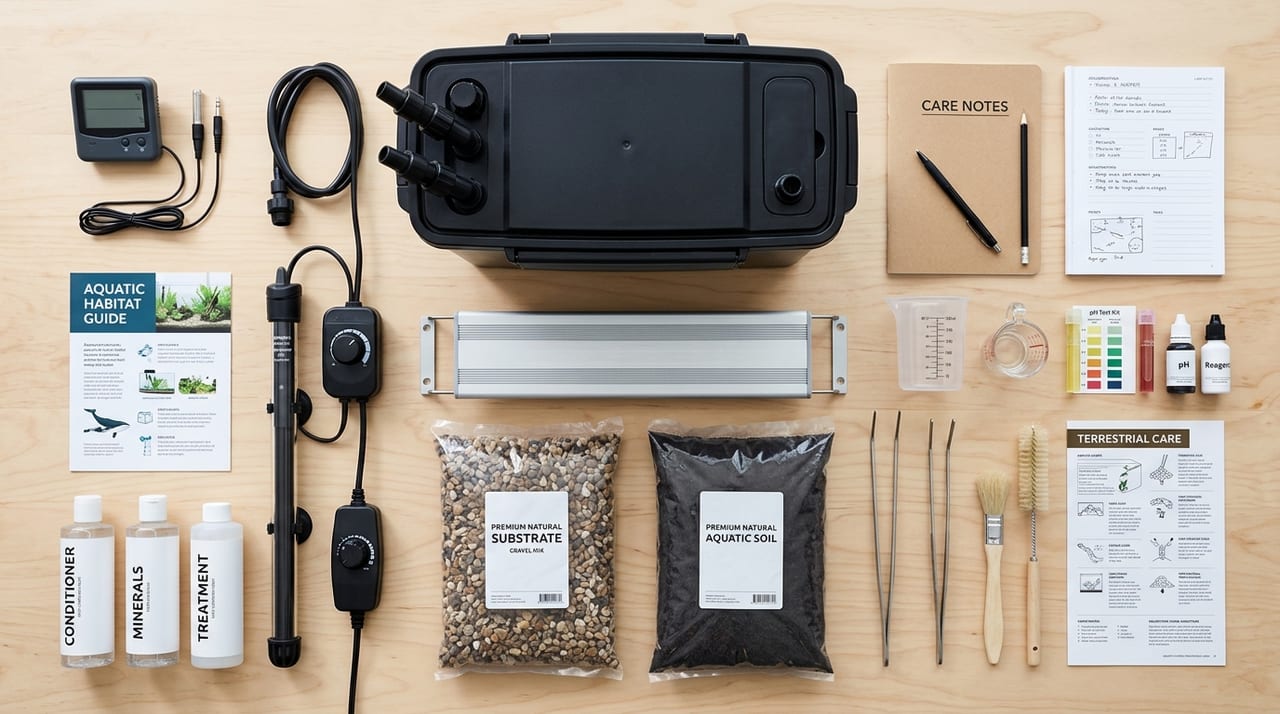
Preparing the Husbandry Environment
- I researched the necessary cage/tank size for husbandry and prepared it
- I gathered temperature control equipment (heater, thermostat, cooling fan)
- I prepared lighting equipment (if necessary)
- I installed a filter and air pump (for aquatic animals)
- I laid bedding/substrate
- I installed hiding places and shelters
- I prepared water conditioner and dechlorinator (for aquatic animals)
- I installed a thermometer/hygrometer
Setting Up the Husbandry Environment
- For tanks: I cycled the water for at least 1–2 weeks to establish filter bacteria
- For cages: I confirmed that temperature and humidity stabilize within proper ranges
- I verified that all equipment operates properly (heater, filter, lighting, etc.)
Other Preparations
- I prepared appropriate food
- I confirmed there is an exotic animal veterinary clinic nearby
- I learned basic knowledge from books and websites about husbandry
- I obtained family consent
- For apartments/condos: I confirmed that keeping pets is permitted
Questions to Ask Breeders
To purchase from a trustworthy breeder, try asking the following questions.
About the Individual
- When was the date of birth (hatching date)?
- Has the sex been confirmed?
- Can you provide information about the parent animals (breed/lineage)?
- Please tell me about the current husbandry environment (temperature, humidity, food)
- Has the animal ever had illness or injury?
- Does it have a good appetite? What is it eating?
Regarding Shipping
- What packing method will be used for shipping?
- What days can shipping occur and how many days does delivery take?
- Is there a guarantee against DOA (dead on arrival)? What are the conditions?
After-Sales Support
- Can I consult about husbandry after purchase?
- What is the response if problems occur?
How to Identify Healthy Individuals
Learn the key points for identifying healthy individuals from photos and descriptions.
For Reptiles
- Eyes are clear and fully open
- Body is free of wounds or sores
- Tail and limbs have no deformities
- Body shape is not extremely thin (hip bones are not protruding)
- No signs of incomplete shedding
For Fish
- Fins are not torn or damaged
- Body surface has no white spots or cottony growth
- Swimming is normal with no tilting or sinking
- Body color is vibrant with no discoloration
For Birds
- Feathers are glossy and not fluffed (fluffed plumage is a sign of poor health)
- Eyes are clear with no discharge or mucus
- Feet have good grip strength
- Droppings are normal
Preparing Your Reception Environment
Perform a final environmental check before your animal arrives.
Confirmation the Day Before Arrival
- Confirm temperature and humidity are within proper ranges in the husbandry environment
- For tanks, check water quality (pH, ammonia, nitrite)
- Prepare necessary tools (tweezers, water acclimation containers, etc.) on hand
- Confirm expected arrival time using the tracking number
Precautions on Arrival Day
- Stay home as much as possible so you can receive it immediately
- Open the package in a quiet place, calmly
- Perform temperature and water acclimation thoroughly before moving to the husbandry environment
- Do not feed on the first day of arrival; prioritize acclimating to the environment
- For several days after introduction, observe quietly
Buy Your First Living Animal with Confidence on BreederDirect
On BreederDirect, you can purchase living animals directly from breeders, so you can get detailed information about individuals and husbandry methods directly. Even if you're anxious about purchasing a living animal for the first time, you can easily ask breeders questions through the messaging feature. Find your meeting with a trustworthy breeder on BreederDirect.
Common Mistakes and How to Avoid Them
Common mistakes with a first animal are more often about "wrong order" than lack of knowledge.
Mistake 1: Bringing Home the Animal Before Setting Up the Husbandry Environment
Tanks take several weeks to set up, and reptiles take several days to confirm stable temperature gradients. Working backward from the day you bring it home, complete the environment first and confirm that temperature and water quality are stable in the empty setup before placing your order.
Mistake 2: Making a Purchase Without Asking Questions Out of Hesitation
Current temperature and humidity, the type and frequency of food being given, and the timing of the last shedding or spawning are information that determines how you'll manage the animal after purchase. These are not difficult questions to ask; they are the ones breeders most want to answer.
Mistake 3: Handling the Animal from the First Day of Arrival
Shipping is the greatest stress for the animal. On the first day, keep the lights low and leave it alone; feeding and handling should wait until the next day or later, as this will actually result in a faster acclimation.