LED Lighting Selection Guide | Aquarium and Plant Growth Lights
Explains LED lighting selection in detail: spectrum and PAR basics, differences between aquatic plant, coral, and horticultural types, cost-effectiveness comparisons, and more.
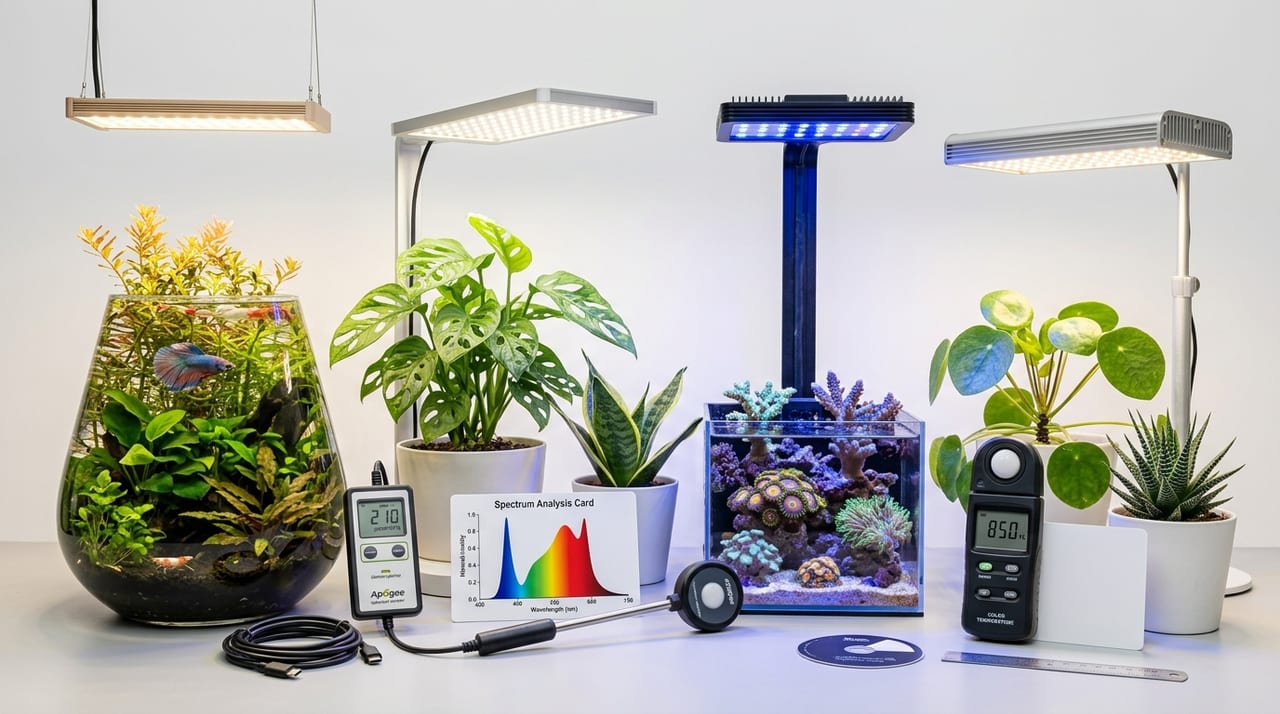
Key Takeaways
Explains LED lighting selection in detail: spectrum and PAR basics, differences between aquatic plant, coral, and horticultural types, cost-effectiveness comparisons, and more.
LED lighting is essential equipment for raising aquatic life and plants in aquariums, as well as for indoor plant cultivation. However, since the required specifications vary significantly depending on the application, basic knowledge is necessary to choose an appropriate product. This article explains LED lighting fundamentals—from spectrum and PAR values to selection methods for different uses.
Spectrum and PAR Basics
We'll explain the fundamental terminology you should know at minimum when selecting LED lighting.
Spectrum (Light Wavelength)
- Light's color varies by wavelength, and its effects on plants and organisms vary accordingly
- Blue light (400–500 nm): promotes stem and leaf growth in plants. In aquariums, it enhances water clarity and transparency.
- Red light (600–700 nm): most efficient for plant photosynthesis. Promotes flowering and fruiting.
- Green light (500–600 nm): not widely utilized by plants, but appears brightest to the human eye.
- UV (ultraviolet light): necessary for some reptiles. Also has the effect of bringing out fluorescent colors in corals.
PAR Value (Photosynthetically Active Radiation)
- PAR (Photosynthetically Active Radiation) is a metric that indicates the amount of light effective for plant photosynthesis.
- The unit is expressed in μmol/m²/s.
- Guidelines for aquatic plant tanks: low-light species 30–50, medium-light species 50–100, high-light species 100 or higher.
- Higher values are not necessarily better; it's important to choose light levels suited to the plants you're cultivating.
Color Temperature (Kelvin)
- A numerical value representing the color tone of light. Lower values indicate warm colors (reddish light), while higher values indicate cool colors (bluish-white light).
- Aquatic plant tanks: 6500–8000 K is popular for its natural appearance.
- Coral tanks: bluish-white light at 10,000–20,000 K brings out coral coloration.
- Plant cultivation: full-spectrum light (white light containing red and blue) is mainstream.
Characteristics of Aquatic Plant LED Lighting
We'll explain how to select LED lighting for cultivating beautiful aquatic plants.
Required Specifications
- Full-spectrum types that include red and blue light in good balance are the standard.
- PAR values should be matched to the type of aquatic plants you want to grow.
- Color temperatures around 6500–8000 K are suited to natural aquatic landscapes.
- Choose a wattage that provides appropriate light output for your tank size.
Installation Tips
- Light intensity varies with distance from the water surface, so if using a hanging fixture, adjust the height.
- Verify that light reaches uniformly all the way to the edges of the tank.
- Manage lighting hours with a timer (8–10 hours per day is the standard).
- Excessively long lighting periods tend to promote algae growth.
Characteristics of Coral LED Lighting
Coral cultivation requires especially strong light.
Required Specifications
- A spectrum containing strong blue light (420–480 nm) is essential.
- High PAR values are necessary to promote photosynthesis in the zooxanthellae within corals.
- Models equipped with UV LEDs bring out fluorescent proteins in corals.
- Dimming features allow you to adjust light intensity according to coral species and placement.
Important Notes
- The required light intensity varies significantly depending on coral type (soft corals < LPS < SPS).
- When first introducing lighting, do not apply strong light all at once; gradually increase intensity (photoacclimation).
- Periodically check that LED light output hasn't declined (LEDs degrade over time).
Characteristics of Plant Growth LED Lighting
We'll explain LED lighting used for cultivating houseplants and succulents indoors.
Required Specifications
- A spectrum centered on red and blue light (red:blue ratio typically around 3:1–5:1).
- In recent years, full-spectrum types with natural white light have also become popular.
- Choose light intensity suited to the size of your plants and the installation distance.
- Choosing models with low heat output allows you to place lights closer to plants.
Installation Tips
- The basic approach is to position light directly above the plant.
- Refer to the manufacturer's recommended distance between light source and plant.
- Manage lighting hours with a timer (12–16 hours per day is typical).
- When cultivating multiple plants, arrange them to avoid uneven light distribution.
Cost-Effectiveness Considerations
LED lighting spans a wide price range, so let's clarify how to think about cost-effectiveness.
Initial and Maintenance Costs
- LED lighting has higher initial costs than fluorescent or metal halide lamps, but offers lower electricity costs.
- LED lifespan is typically 30,000–50,000 hours, requiring no replacement for several years.
- Inexpensive products may have insufficient light output or unbalanced spectrum, so exercise caution.
Selection Tips
- Clarify the minimum specifications that meet your needs, then select accordingly.
- Refer to reviews and feedback from actual users.
- Choosing products with longer warranty periods provides peace of mind.
- Also consider expandability (whether you can add units and connect them).
Enhance Your Breeding Environment with BreederDirect
BreederDirect features many breeders experienced in animal and plant care. You can consult directly with breeders about the optimal lighting environment for the organisms and plants you purchase. By choosing appropriate lighting, you can bring out the full appeal of your animals and plants.
Common Mistakes and Solutions
Lighting selection mistakes arise from not realizing that catalog numbers and the actual light reaching organisms are two different things.
Mistake 1: Judging Brightness by Wattage Power consumption is not an indicator of light output. When comparing, use PAR values; if those are unavailable, look at lumens and beam angle together. Even with the same wattage, the PAR at the tank floor can vary more than twofold depending on whether a lens is used.
Mistake 2: Trying to Compensate for Insufficient Light Intensity with Longer Hours If you extend lighting hours without sufficient intensity, aquatic plants and corals won't grow while algae will proliferate. The principle is to first ensure adequate intensity, then keep lighting hours to 8–10 hours.
Mistake 3: Installing Without Measuring Distance from the Water Surface PAR value drops inversely to the square of distance. Changing the hanging position by just 5 cm significantly alters the light reaching the tank, so after installation, verify actual measurements or recommended ranges below the water surface.