Summer Management Guide for Japanese Beetles: Heat Control, Substrate Changes, and Adult Care
A comprehensive management guide to prevent failures in summer Japanese beetle care. We cover heat control strategies, timing for substrate changes, tips for extending adult lifespan, and breeding methods.
Key Takeaways
A comprehensive management guide to prevent failures in summer Japanese beetle care. We cover heat control strategies, timing for substrate changes, tips for extending adult lifespan, and breeding methods.
Summer is Peak Season for Japanese Beetle Care! But Don't Let Your Guard Down
Once the rainy season ends, Japanese beetle season truly begins. Children running around with insect cages in hand is an iconic summer scene, but this period is actually when care failures are most common. Whether you can manage summer-specific problems like high heat, dryness, and fruit fly outbreaks significantly impacts adult beetle lifespan and breeding success rates.
In this article, we've compiled essential points for summer Japanese beetle management in an easy-to-understand format for beginners.
Heat Control is the Top Priority! What Temperatures Are Difficult for Japanese Beetles?
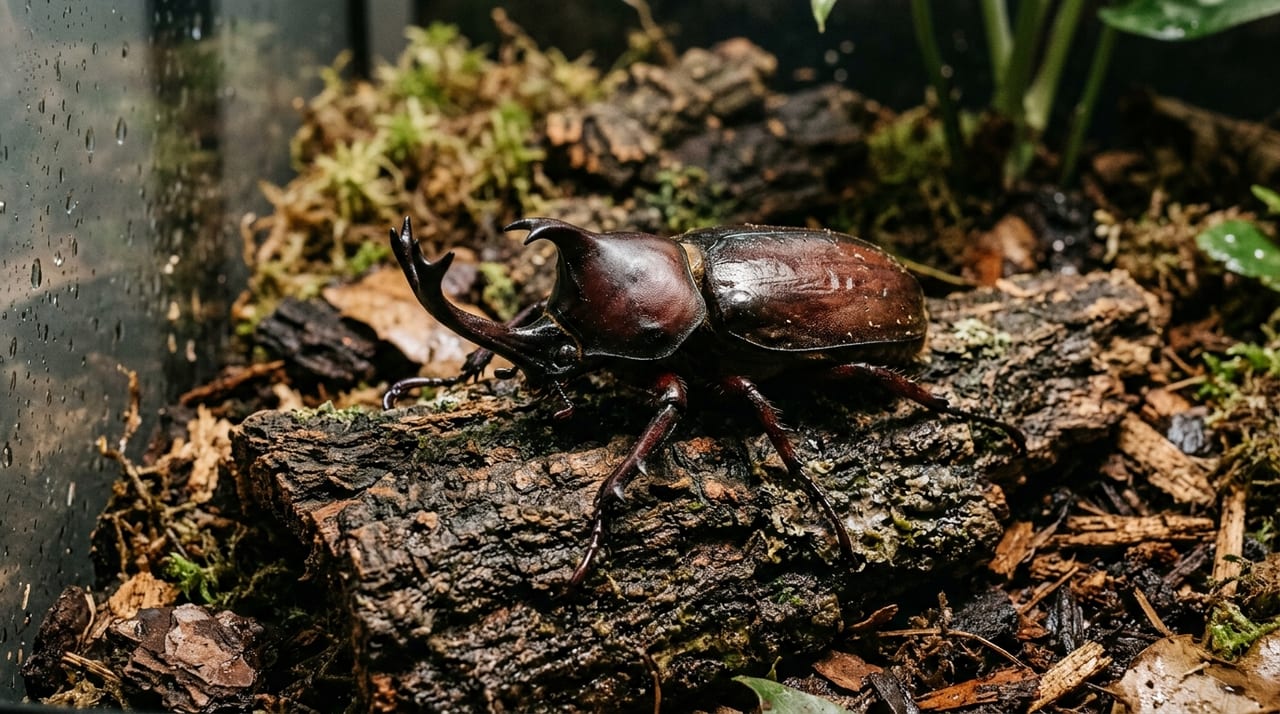
Japanese beetles are surprisingly sensitive to heat. In the wild, they shelter from heat by hiding in tree shade or underground, but in a cage, there's nowhere to escape.
The appropriate breeding temperature is around 20-28°C (68-82°F). Above 30°C (86°F), they consume energy rapidly, and at 32-33°C (90-91°F) and higher, they can weaken in just a short time. Even indoors during midsummer, temperatures easily exceed 30°C unless you avoid windows and sunny spots, so careful placement is essential.
Specific Heat Management Strategies
- Place in shade with good ventilation: Choose locations like north-facing hallways or entryways where direct sunlight doesn't reach and it's relatively cool.
- Be careful with air conditioning: Direct airflow from cooling causes dryness and rapid temperature fluctuations. If using AC, ideally maintain around 26°C (79°F) in an environment where the entire room cools evenly.
- Use ice packs or cooling products: Simply placing a frozen water-filled plastic bottle beside the cage can lower temperature locally. However, be mindful of humidity management from condensation.
- Secure the cage lid properly: While ventilation is needed, traditional insect cage lids accelerate substrate drying. If it becomes too dry, adjust by partially covering the lid with plastic wrap.
Substrate Management is Most Challenging in Summer! Timing and Method for Changes
Fermented substrate (insect matting made from composted leaf litter) deteriorates much faster in summer. Higher temperatures increase bacterial activity, accelerating substrate breakdown.
Signs That Substrate Change Is Needed
- Surface becomes dark and slimy
- Ammonia odor is present
- Fruit flies or white mites proliferate
- Substrate becomes hard and adults can't burrow
Summer typically requires substrate changes roughly every 2-3 weeks. Compare this to winter, when monthly or every other month is usually sufficient—significantly more work!
Replacement Steps
- Remove adults from the cage and temporarily place them in a separate container
- Discard all old substrate (for breeding containers, check for eggs and larvae first!)
- Add fresh fermented substrate to a depth of 5-10 cm (2-4 inches)
- Lightly mist the surface to add moisture (squeeze test: should clump but crumble easily)
- Return adults to complete
Important: Excessive moisture causes the substrate to become waterlogged, weakening the beetles. The correct moisture level is when squeezed substrate forms a ball but no water drips.
Tips for Extending Adult Lifespan: Balancing Food, Activity, and Rest
Wild adult Japanese beetles live approximately 1-3 months. However, in captivity with proper management, they can live 4-5 months.
Jelly is the Staple Food
Commercial insect jelly (16-32g types) is nutritionally balanced and ideal for Japanese beetle care. In particular, jelly formulated with protein and trehalose is known to support stamina and longevity.
- Change frequency: Every 2-3 days (replace sooner in summer as it spoils quickly)
- One piece may not be enough (males are particularly hungry)
- Watermelon and banana can be offered, but they spoil easily and have too much moisture, so they're not recommended
Honoring Their Nocturnal Nature
Japanese beetles are nocturnal. They rest underground during the day and are active at night. Forcibly digging them out to handle during the day or keeping them in bright environments causes stress and weakness. Observe and interact with them in the evening and later.
Managing Male and Female Cohabitation
Keeping males and females in the same cage results in continuous mating, exhausting the female. If you're not aiming to breed, separate housing is recommended. If breeding is your goal, keep them together for 3-5 days, then separate them.
Try Breeding! How to Set Up a Breeding Container
If you have both males and females, why not try breeding? Summer (July-August) is peak breeding season for Japanese beetles.
What You Need for Breeding
- A large container (storage bin recommended, 30L or larger)
- Fermented substrate (mature type preferred)
- Climbing wood and feeding platform
How to Set Up a Breeding Container
- Firmly pack substrate into the lower half of the container (about 15 cm)
- Loosely add substrate to the upper half (5-10 cm)
- Mist the surface to add appropriate moisture
- Place food jelly and climbing wood, then add male and female together
After 1-2 weeks, move the female to a separate container and leave the breeding container undisturbed. By late August through September, when you excavate the substrate, you should find white, round eggs or small larvae (first to second instar).
Eggs hatch in approximately 2 weeks at 25-28°C (77-82°F). Larvae grow in the soil until the following summer, pupate, and emerge as adults.
Summary: Careful Summer Management Makes Japanese Beetles Even More Enjoyable
The three most important aspects of summer Japanese beetle care are temperature control, substrate changes, and food freshness. Neglecting any one of these can lead to premature weakness in adults or breeding failure.
It may seem challenging, but daily observation and consistent care are the secrets to longevity. Successfully raising healthy Japanese beetles for extended periods deepens your attachment to them. This summer, please challenge yourself to practice careful, attentive management.