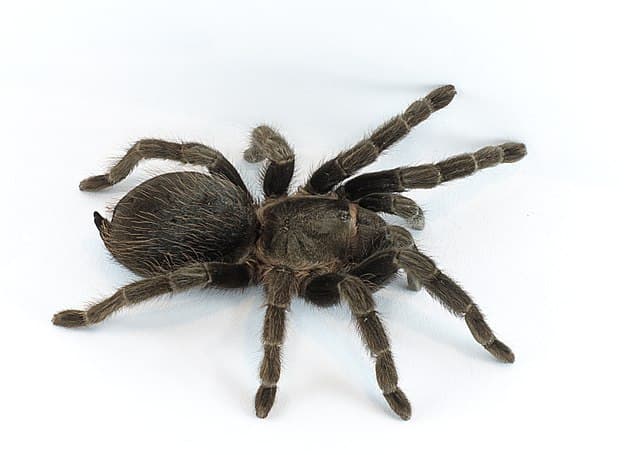
Source: Wikimedia Commons
Tarantula
IntermediateAmong the worlds largest spiders. Despite hairy appearance, many species are docile. Mexican Red Knee popular for beginners.
Difficulty
Intermediate
Temperature
20〜28℃
Lifespan
10-30 years (female)
Size
Leg span 10-25cm
Humidity
60〜80%
Diet
Insects like crickets (2-4 times monthly)
About
Tarantulas are large, hairy spiders belonging to the family Theraphosidae, with over 1,000 described species in nearly 200 genera. They are distributed across tropical and subtropical regions of the Americas, Africa, Asia, and Australia, occupying diverse habitats from arid deserts to rainforest canopies. Body length ranges from roughly 3 to 13 cm depending on species. They are divided broadly into terrestrial burrowing species and arboreal species. In captivity, enclosure size is matched to the individual, and temperatures of 24–28°C are maintained. Prey such as crickets or dubia roaches is offered one to two times per week. Many New World species possess urticating hairs on the abdomen, which can cause skin and eye irritation and must be handled with care. Females of many species are remarkably long-lived, some exceeding 20 years. Their dramatic appearance and species diversity have established tarantulas as one of the most popular invertebrate pets worldwide.
Source: Wikipedia (CC BY-SA 4.0)
Basic Info
Origin
tropical and subtropical regions of the Americas, Africa, Asia, and Australia
Lifespan
10-30 years (female)
Size
Leg span 10-25cm
Temperature
20〜28℃
Humidity
60〜80%
Diet
Insects like crickets (2-4 times monthly)
Care Guide
Enclosure
Plastic container sized for species
Temperature
24-28°C
Humidity
40-80% depending on species
Feeding
Avoid feeding before and after molting
Notes
Venomous but mild in most species. Watch for urticating hairs
SpiderLargeMoltsLong-lived
Tarantula FAQ
QHow difficult is it to keep Tarantula?
A
Intermediate. This is an intermediate-level species. Some prior experience and knowledge of environmental management are recommended.
QWhat is the ideal temperature for Tarantula?
A
The ideal temperature for Tarantula is 20〜28℃. Recommended humidity is 60〜80%. Avoid sudden temperature changes and maintain a stable environment.
QWhat is the lifespan of Tarantula?
A
The average lifespan of Tarantula is 10-30 years (female). With proper care and nutrition, they can live a long and healthy life.
QHow large does Tarantula get?
A
Tarantula typically reaches Leg span 10-25cm as an adult. Size may vary depending on care conditions and individual genetics.
QWhat should I feed Tarantula?
A
Tarantula feeds on: Insects like crickets (2-4 times monthly). Aim for a balanced diet with appropriate feeding frequency.
QWhat is the typical price for Tarantula?
A
The price of Tarantula varies significantly depending on morph, size, and lineage. Check our market price page for the latest pricing information.
Related Species
Find listings for this species
Browse Insect ListingsRelated Articles
Tarantula Enclosure Setup — Arboreal vs Terrestrial Layouts
Tarantula enclosure setup: arboreal vs terrestrial configurations, substrate depth, humidity control, ventilation, and feeding guidelines.
Tarantula Feeding & Care Beginner Guide — Species Selection, Feeding & Handling
Getting started with tarantula keeping: beginner-friendly species, feeding methods, enclosure setup, molting care, and handling safety.
Introduction to Tarantula Care
Tarantulas can be surprisingly easy pets. Covers species difficulty levels from beginner-friendly Grammostola to advanced Poecilotheria, with temperature, humidity, and feeding basics.
How Much Does Insect Keeping Cost? Monthly Running Costs Explained
Monthly insect keeping costs for beetles and stag beetles: substrate, jelly, temperature control, and annual breeding cost estimates.