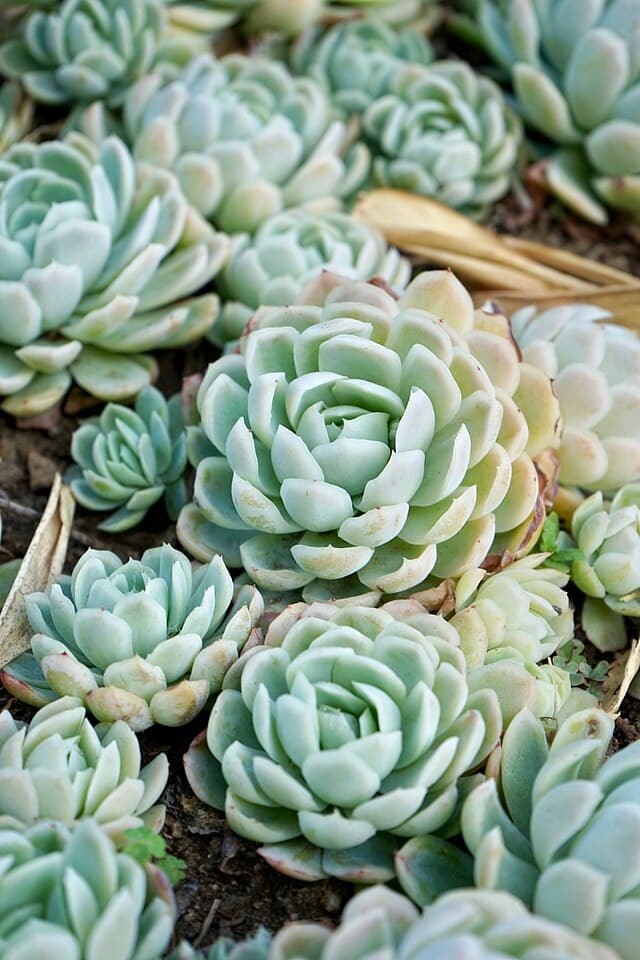
Echeveria
BeginnerOthonna capensis
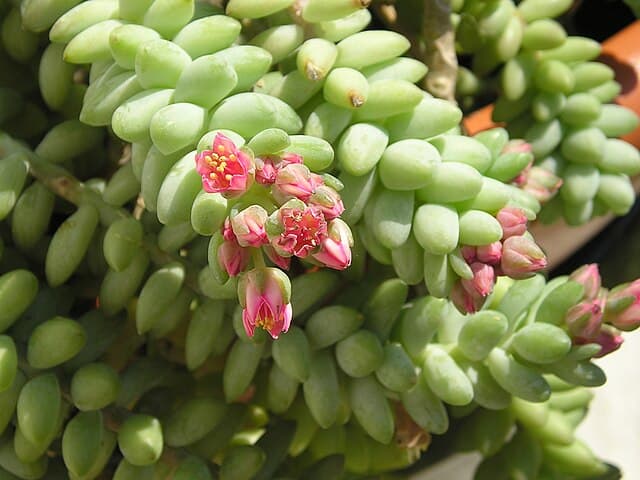
A purple-tinged red trailing succulent. Leaves turn vivid purple-red when temperatures drop. Similar care to String of Pearls, popular for hanging displays.
Ruby Necklace (Othonna capensis) is a trailing succulent in the family Asteraceae, native to the Cape Province of South Africa. In standard conditions the plant produces elongated, banana-shaped leaves in green to blue-green, but cool temperatures, bright sun, and drought stress trigger vivid coloration ranging from deep purple to ruby-red—the source of its popular name. It superficially resembles String of Pearls (Curio rowleyanus) but differs in leaf shape and more intense seasonal coloration. Small yellow flowers are produced in autumn. Stems trail 30–60 cm. Plants prefer bright light to full sun and tolerate direct sunlight better than many trailing succulents. Watering should be conservative with good drainage. Cold tolerance extends to approximately 0–5°C. Propagation by stem cuttings is straightforward.
Origin
South Africa (Cape Province)
Lifespan
Perennial
Size
Trailing (30-80cm)
Temperature
5〜30℃
Humidity
30〜50%
Water sparingly. Keep on dry side
Sun intensifies ruby-red coloring
When soil dries. Reduce in winter
Beautiful purple-red in autumn-winter cool
Best displayed hanging
Beginner. This is a beginner-friendly species. No special equipment or experience is required, and it can be kept successfully with basic care setup.
The ideal temperature for Ruby Necklace is 5〜30℃. Recommended humidity is 30〜50%. Avoid sudden temperature changes and maintain a stable environment.
Find listings for this species
The average lifespan of Ruby Necklace is Perennial. With proper care and nutrition, they can live a long and healthy life.
Ruby Necklace typically reaches Trailing (30-80cm) as an adult. Size may vary depending on care conditions and individual genetics.
Ruby Necklace feeds on: Water sparingly. Keep on dry side. Aim for a balanced diet with appropriate feeding frequency.
The price of Ruby Necklace varies significantly depending on morph, size, and lineage. Check our market price page for the latest pricing information.