Source: Wikimedia Commons
Echeveria
BeginnerEcheveria spp.
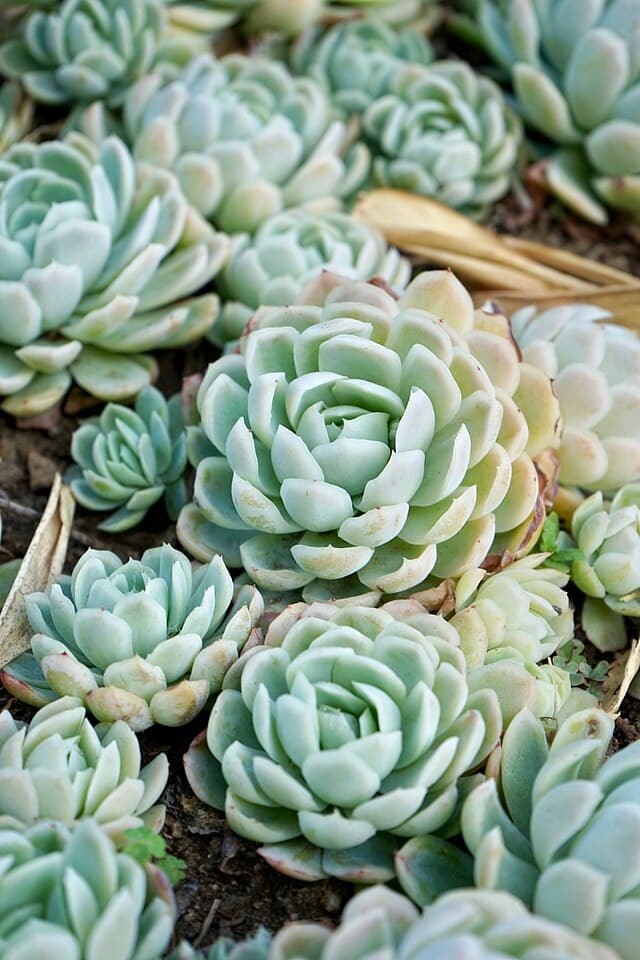
The quintessential rosette succulent, with flower-like leaf arrangements in hundreds of species. Beautiful stress coloring in autumn/winter. Easy leaf propagation makes collecting irresistible.
Difficulty
Beginner
Temperature
5〜35℃(適温10〜25℃)
Size
3-30cm rosette
Humidity
30〜50%
Diet
Water: when dry in spring/fall / reduce in summer and winter
About
Echeveria is a large genus of succulent plants in the family Crassulaceae, comprising over 180 species native to semi-arid regions of Mexico, Central America, and northwestern South America. Plants form tight rosettes of fleshy leaves that range in color from pale green and blue to vivid purple and pink, with many cultivars developing intensified hues during cool temperatures. Growth is relatively slow, and mature rosette diameters range from about 5 to 30 cm depending on species. Well-draining soil is essential, and plants require full sun to maintain compact form. Watering should be infrequent, allowing the substrate to dry thoroughly between applications. High humidity and poor air circulation during summer can cause crown rot. Propagation is straightforward via leaf cuttings, stem cuttings, or offsets, contributing to the genus's enormous popularity among collectors worldwide.
Source: Wikipedia (CC BY-SA 4.0)
Basic Info
Origin
semi-desert areas of Central America, Mexico and northwestern South America
Size
3-30cm rosette
Temperature
5〜35℃(適温10〜25℃)
Humidity
30〜50%
Diet
Water: when dry in spring/fall / reduce in summer and winter
Care Guide
Soil
Succulent mix. Akadama, Kanuma, pumice blend also works
Light
Full sun preferred. Insufficient light causes etiolation
Propagation
Easy via leaf propagation, beheading, or offset division
Notes
Leaf bloom (powder) rubs off easily. Water at the base, not on leaves
Beginner-friendlyRosetteStress coloringCollectible
Echeveria FAQ
QHow difficult is it to keep Echeveria?
A
Beginner. This is a beginner-friendly species. No special equipment or experience is required, and it can be kept successfully with basic care setup.
QWhat is the ideal temperature for Echeveria?
A
The ideal temperature for Echeveria is 5〜35℃(適温10〜25℃). Recommended humidity is 30〜50%. Avoid sudden temperature changes and maintain a stable environment.
QHow large does Echeveria get?
A
Echeveria typically reaches 3-30cm rosette as an adult. Size may vary depending on care conditions and individual genetics.
Echeveria Q&A
Find listings for this species