Source: Wikimedia Commons
Conophytum
IntermediateRelated to lithops. Small squishy spheres clustering together are adorable. Winter grower active autumn-winter.
Difficulty
Intermediate
Temperature
5〜25℃
Lifespan
10+ years
Size
1-3cm (per head)
Humidity
30〜50%
About
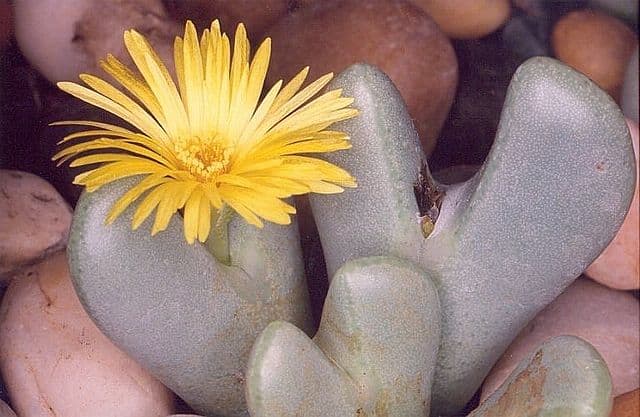
Conophytum is a genus of dwarf succulent plants in the family Aizoaceae, endemic to the winter-rainfall regions of southern Namibia and the Cape Provinces of South Africa, where they grow in rocky quartz fields and gravel plains. Closely related to Lithops, they have similarly fused, highly succulent leaf pairs that form button-shaped, cone-shaped, or bilobed bodies just a few centimeters across. Common names include cone plants, dumplings, and button plants. In autumn, solitary flowers emerge from the central fissure in colors ranging from white and yellow to vivid pink, magenta, and orange; many species are night-blooming. As winter-growing plants, they are active from autumn through spring and enter a dry dormancy in summer, protected by their papery outer skin. Watering should be very light during the growing season and completely withheld in summer. Fast-draining mineral soil and ample light are essential.
Source: Wikipedia (CC BY-SA 4.0)
Basic Info
Origin
southern Namibia and the western and southern Cape Provinces of South Africa
Lifespan
10+ years
Size
1-3cm (per head)
Temperature
5〜25℃
Humidity
30〜50%
Care Guide
Sunlight
Bright location. Avoid direct summer sun
Watering
Mist autumn-spring. Complete drought in summer
Growing season
Grows autumn-spring. Dormant in summer
Shedding
Sheds once yearly — no water during shedding
Notes
Weak to heat and humidity — ensure good ventilation
Winter growerClusteringSquishyShedding
Conophytum FAQ
QHow difficult is it to keep Conophytum?
A
Intermediate. This is an intermediate-level species. Some prior experience and knowledge of environmental management are recommended.
QWhat is the ideal temperature for Conophytum?
A
The ideal temperature for Conophytum is 5〜25℃. Recommended humidity is 30〜50%. Avoid sudden temperature changes and maintain a stable environment.
QWhat is the lifespan of Conophytum?
A
The average lifespan of Conophytum is 10+ years. With proper care and nutrition, they can live a long and healthy life.
Conophytum Q&A
Find listings for this species