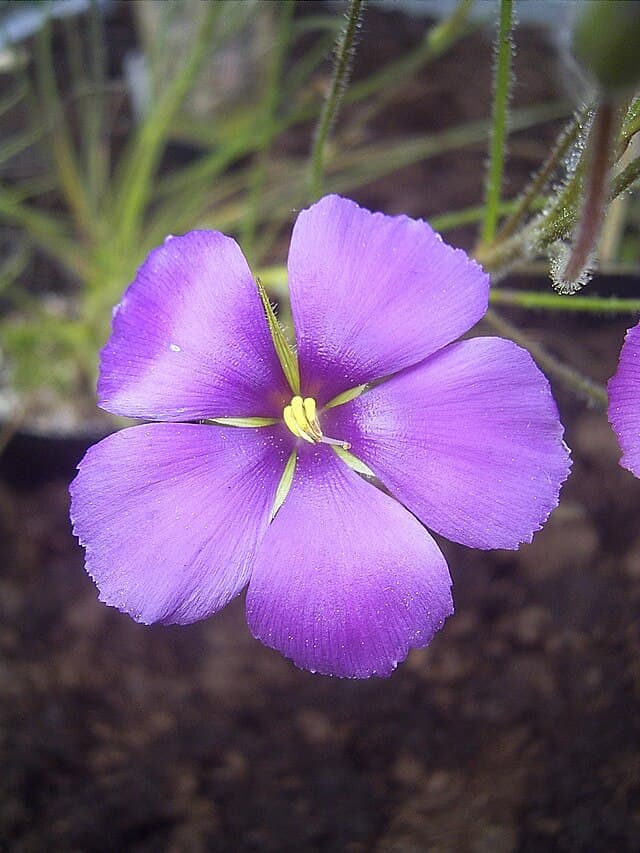
Source: Wikimedia Commons
Byblis Gigantea
AdvancedByblis gigantea
A large perennial Byblis from Western Australia with spectacular mucilage-covered long leaves.
Difficulty
Advanced
Temperature
10〜30℃
Lifespan
5+ years
Size
30-60cm
Humidity
60〜90%
Diet
Insects (auto-capture)
About
Byblis gigantea is a large perennial carnivorous plant native to the sandy heathlands and seasonal wetlands of southwestern Western Australia. Unlike the annual B. liniflora, it is a woody-stemmed perennial that reaches 30–60 cm in height and persists for several years. It shares the genus' characteristic iridescent shimmer from its dense, mucilaginous tentacles, which passively trap insects. Attractive pale purple to pink flowers are produced during the growing season. The plant follows the Mediterranean-type climate cycle of southwestern Australia, growing actively during the cool, wet winter and reducing activity in the dry, warm summer. Cultivation is challenging: it requires sandy, acidic, well-drained media, wet-dry seasonal cycling, smoke treatment for seed germination, bright direct sunlight, and moderate temperatures (15–28°C). It is a specialist subject for experienced growers.
Basic Info
Origin
Southwestern Western Australia, sandy coastal heathlands and seasonal wetlands
Lifespan
5+ years
Size
30-60cm
Temperature
10〜30℃
Humidity
60〜90%
Diet
Insects (auto-capture)
Care Guide
Size
Large
Perennial
Perennial
Rarity
Hard to obtain
Light
Full sun
CarnivorousByblisLargePerennial
Byblis Gigantea FAQ
QHow difficult is it to keep Byblis Gigantea?
A
Advanced. This is an advanced-level species. It requires specialized equipment and advanced husbandry skills with precise environmental control.
QWhat is the ideal temperature for Byblis Gigantea?
A
The ideal temperature for Byblis Gigantea is 10〜30℃. Recommended humidity is 60〜90%. Avoid sudden temperature changes and maintain a stable environment.
QWhat is the lifespan of Byblis Gigantea?
A
The average lifespan of Byblis Gigantea is 5+ years. With proper care and nutrition, they can live a long and healthy life.
QHow large does Byblis Gigantea get?
A
Byblis Gigantea typically reaches 30-60cm as an adult. Size may vary depending on care conditions and individual genetics.
QWhat should I feed Byblis Gigantea?
A
Byblis Gigantea feeds on: Insects (auto-capture). Aim for a balanced diet with appropriate feeding frequency.
QWhat is the typical price for Byblis Gigantea?
A
The price of Byblis Gigantea varies significantly depending on morph, size, and lineage. Check our market price page for the latest pricing information.
Related Species
Find listings for this species
Browse Carnivorous Plant ListingsRelated Articles
Complete Beginner's Guide to Carnivorous Plants
Everything beginners need to start growing carnivorous plants: soil, watering, light, tray culture, overwintering, and recommended starter species.
Carnivorous Plant Encyclopedia — Popular Species & Care Guide
An encyclopedia of popular carnivorous plants with trapping methods, care difficulty, and environment needs for each.
How Much Does Carnivorous Plant Growing Cost? Monthly Running Costs Explained
Monthly carnivorous plant care costs: soil, distilled water, and lighting, with Nepenthes vs. Venus flytrap cost comparisons.
Carnivorous Plant Growth Rate & Size — Species-by-Species Guide
Carnivorous plant growth rates and sizes for Venus flytraps, Nepenthes, and Sarracenia, with tips for growing larger traps.