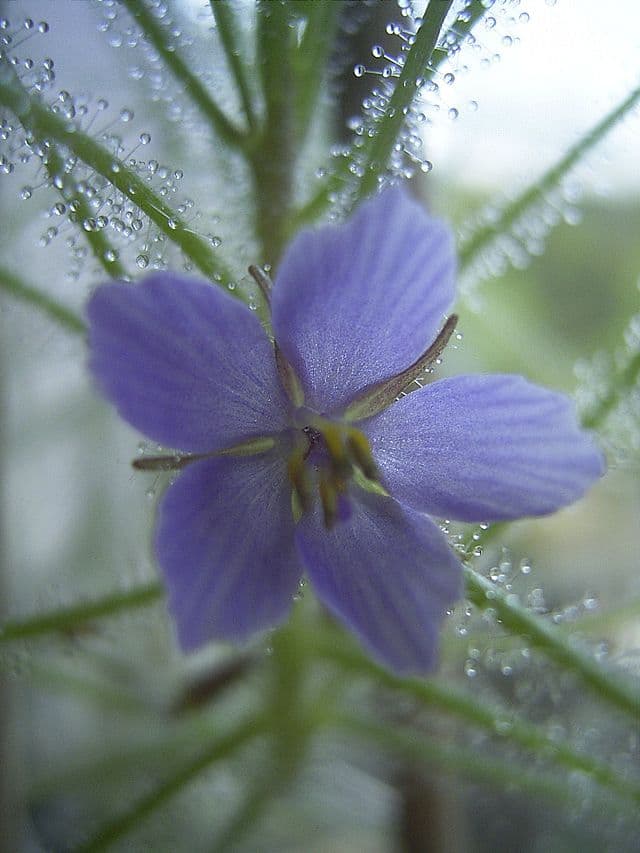
Source: Wikimedia Commons
Byblis Liniflora
IntermediateByblis liniflora
An Australian carnivorous plant with rainbow-glistening mucilage, called Rainbow Plant.
Difficulty
Intermediate
Temperature
10〜30℃
Lifespan
1-2 years (annual)
Size
10-30cm
Humidity
60〜90%
Diet
Insects (auto-capture)
About
Byblis liniflora, the rainbow plant, is an annual carnivorous plant native to the tropical wetlands and grasslands of northern Australia (Northern Territory and northern Queensland) and Timor. Its common name refers to the spectacular iridescent shimmer produced by the dense, gland-tipped mucilaginous tentacles covering its thread-like leaves—a prismatic rainbow effect in sunlight. Like all Byblis, it captures insects passively by adhesion to this sticky surface but lacks the ability to move its tentacles or leaves. It is treated as an annual in cultivation, germinating in autumn to spring and completing its cycle the same season. Cultivation uses sphagnum or peat-perlite media, tray watering with pure or rainwater, and full sun with warm temperatures (20–35°C). Seed germination may benefit from smoke treatment (smoke water soaking) as in other Australian fire-adapted flora.
Basic Info
Origin
Northern Australia (Northern Territory and northern Queensland) and Timor, tropical grasslands and seasonal wetlands
Lifespan
1-2 years (annual)
Size
10-30cm
Temperature
10〜30℃
Humidity
60〜90%
Diet
Insects (auto-capture)
Care Guide
Mucilage
Rainbow glistening
Lifespan
Annual
Seeds
Maintain from seed
Light
Full sun
CarnivorousByblisRainbowAnnual
Byblis Liniflora FAQ
QHow difficult is it to keep Byblis Liniflora?
A
Intermediate. This is an intermediate-level species. Some prior experience and knowledge of environmental management are recommended.
QWhat is the ideal temperature for Byblis Liniflora?
A
The ideal temperature for Byblis Liniflora is 10〜30℃. Recommended humidity is 60〜90%. Avoid sudden temperature changes and maintain a stable environment.
QWhat is the lifespan of Byblis Liniflora?
A
The average lifespan of Byblis Liniflora is 1-2 years (annual). With proper care and nutrition, they can live a long and healthy life.
QHow large does Byblis Liniflora get?
A
Byblis Liniflora typically reaches 10-30cm as an adult. Size may vary depending on care conditions and individual genetics.
QWhat should I feed Byblis Liniflora?
A
Byblis Liniflora feeds on: Insects (auto-capture). Aim for a balanced diet with appropriate feeding frequency.
QWhat is the typical price for Byblis Liniflora?
A
The price of Byblis Liniflora varies significantly depending on morph, size, and lineage. Check our market price page for the latest pricing information.
Related Species
Find listings for this species
Browse Carnivorous Plant ListingsRelated Articles
Complete Beginner's Guide to Carnivorous Plants
Everything beginners need to start growing carnivorous plants: soil, watering, light, tray culture, overwintering, and recommended starter species.
Carnivorous Plant Encyclopedia — Popular Species & Care Guide
An encyclopedia of popular carnivorous plants with trapping methods, care difficulty, and environment needs for each.
How Much Does Carnivorous Plant Growing Cost? Monthly Running Costs Explained
Monthly carnivorous plant care costs: soil, distilled water, and lighting, with Nepenthes vs. Venus flytrap cost comparisons.
Carnivorous Plant Growth Rate & Size — Species-by-Species Guide
Carnivorous plant growth rates and sizes for Venus flytraps, Nepenthes, and Sarracenia, with tips for growing larger traps.