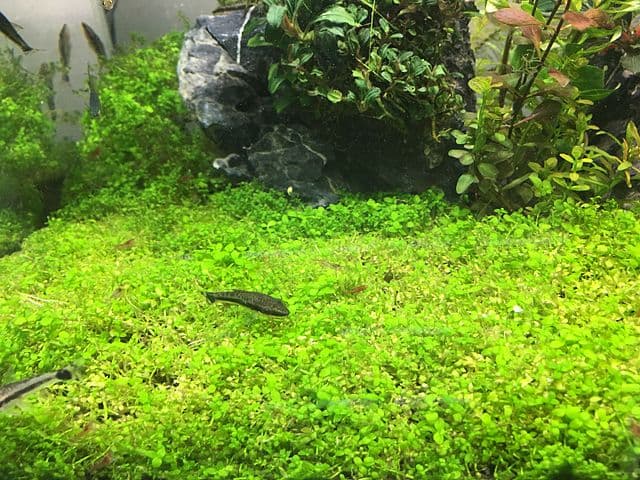
Glossostigma
IntermediateRiccia fluitans
A liverwort used as a foreground plant, beautiful when covered in oxygen bubbles. Fixed to stones or driftwood. The sight of oxygen bubbles during photosynthesis is magical. ADA spread this Japanese aquascaping technique worldwide.
Riccia fluitans is a liverwort (division Marchantiophyta) in the family Ricciaceae, naturally a free-floating aquatic plant occurring across temperate to tropical water bodies worldwide. Its transformation into a celebrated foreground carpet plant is credited to Takashi Amano, who devised and popularized the technique of pressing it over rocks with fine stainless-steel mesh or wool mat netting to hold it submerged. Under high light and pressurized CO2, photosynthesis adorns the thallus with thousands of sparkling oxygen bubbles simultaneously — the quintessential 'pearling' spectacle that has come to symbolize the Nature Aquarium aesthetic. Growth is rapid but attachment is inherently unstable; the thallus frequently detaches from netting and must be periodically re-tied. Sensitivity to water-parameter fluctuations adds to the maintenance challenge. Stainless mesh is the preferred attachment medium for long-term management.
Origin
Worldwide, in temperate to tropical aquatic habitats
Size
Spreads as creeping mat
Temperature
20〜28℃
CO2 injection essential + liquid fertilizer
High light essential
Pressurized CO2 required
Tie to rocks or driftwood with thread
Has buoyancy, must be fixed to rocks
Intermediate. This is an intermediate-level species. Some prior experience and knowledge of environmental management are recommended.
The ideal temperature for Riccia fluitans is 20〜28℃. Avoid sudden temperature changes and maintain a stable environment.
Riccia fluitans typically reaches Spreads as creeping mat as an adult. Size may vary depending on care conditions and individual genetics.
Find listings for this species
Riccia fluitans feeds on: CO2 injection essential + liquid fertilizer. Aim for a balanced diet with appropriate feeding frequency.
The price of Riccia fluitans varies significantly depending on morph, size, and lineage. Check our market price page for the latest pricing information.