來源:Wikimedia Commons
Shinisaurus crocodilurus
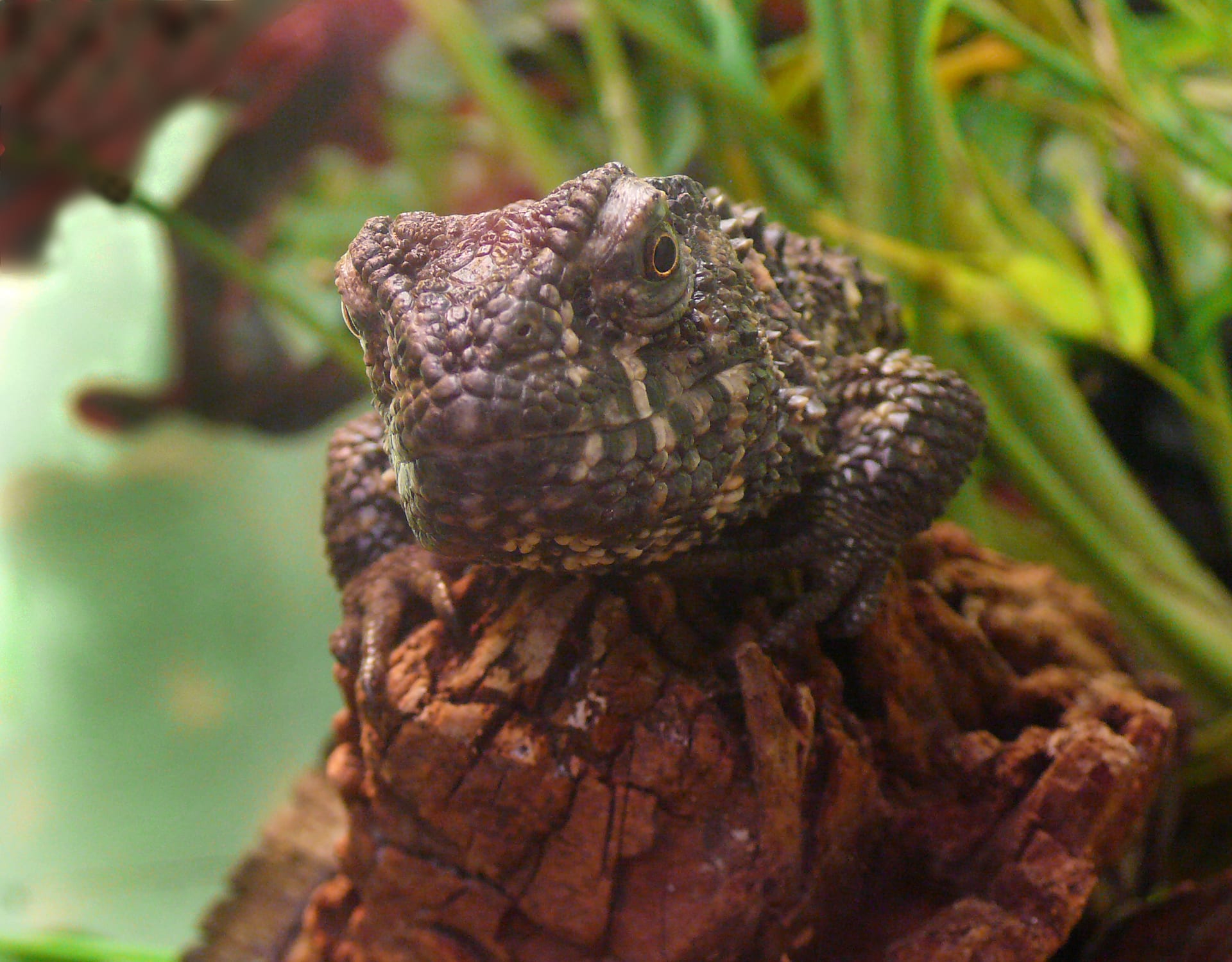
A semiaquatic lizard living along streams in southern China and north-eastern Vietnam. Rows of raised bony scales running down the back and tail recall a crocodile, and give the animal its name. It reaches 40-46 cm and is brown, some individuals marked with red or yellow.
The Chinese crocodile lizard (Shinisaurus crocodilurus) is a semiaquatic lizard confined to Guangxi and Guangdong in southern China and to north-eastern Vietnam. It is the only living species in the family Shinisauridae and the genus Shinisaurus, the survivor of a lineage whose fossil record reaches back to the Early Cretaceous more than 120 million years ago. It lives along streams in subtropical evergreen broadleaf forest at 200-760 m, basking on rocks and on branches overhanging the water and diving in to escape danger. That habit has earned it the local name luoshuigou, the dog that falls in the water, while its long motionless spells have given it the name dashuishe, the great sleeping snake. It is a sit-and-wait predator, taking insects, earthworms, tadpoles and small fish. Habitat destruction from dams and mining, bycatch from poison and electrofishing, and illegal collection for the pet trade have caused a steep decline, and the IUCN assesses it as Endangered.
Source: Wikipedia (CC BY-SA 4.0)
Chinese Crocodile Lizard的壽命為人工飼養下10年以上(據飼養者報告,有超過15年的個體)。
Chinese Crocodile Lizard的成體體型為Total length 40-46cm, males slightly larger。
It is viviparous, with a gestation of about nine months and two to seven young born in April and May, each 10-15 cm long and weighing around 4 g.
產地
Southern China (Guangxi, Guangdong, Guizhou and Hunan, although the Hunan population is believed extirpated) and north-eastern Vietnam (Bac Giang and Quang Ninh), along streams in subtropical evergreen broadleaf forest at 200-760 m
編輯與資料核驗: BreederDirect編輯部
本頁的分類·法規·飼養資料依據下列權威第一手來源編製並核驗。
尋找此物種的商品
壽命
人工飼養下10年以上(據飼養者報告,有超過15年的個體)
體型
Total length 40-46cm, males slightly larger
濕度
40〜70%
Carnivorous: insects, earthworms, tadpoles, small fish and frogs
In the wild it lives at 200-760 m, where summer air temperatures peak at 38 C, winters fall to -4 C and the day-night swing is wide. In captivity hold the water at 19-27 C, then from around November lower it to about 15 C for a hibernation of three to four months; this winter cooling is regarded as essential for captive breeding. Its habitat receives some 2,000 mm of rain a year and is almost permanently shrouded in mist, so keep humidity high.
Semiaquatic, so use an aquaterrarium that combines land and water. In one successful breeding setup a cage of about 91 x 36 x 36 cm gave a third of its floor to a water basin roughly 6 cm deep, with branches arranged to overhang the water. Always provide basking branches and retreats that let the animal hide, such as a hollow log or loose bark.
A sit-and-wait predator that watches for prey from branches overhanging the water, taking insects, earthworms, tadpoles, small fish and frogs. In captivity crickets, mealworms and earthworms form the bulk of the diet. Juveniles take the same foods in smaller sizes.
Strongly territorial: in the wild a single lizard usually occupies an entire pool or stretch of stream. Dominance is settled by gaping, tail-swinging and a push-up display in which the forelimbs are straightened. It does not tolerate company, so house it singly except when breeding.
It has been listed on CITES Appendix I since 2 January 2017. Under Japan's Species Conservation Act it is an internationally endangered species, and transferring one within Japan requires an individual registration certificate; trading or transferring an unregistered animal breaches that Act. It is neither a specified animal nor an invasive alien species under Japanese law. It was placed on Appendix II on 18 January 1990 and moved to Appendix I in 2017 as poaching and international trade increased. Although its lineage is close to the helodermatid lizards, a 2023 proteomic analysis of its mandibular glands found no toxin-related proteins, so it is not venomous. Wild-caught animals have repeatedly been reported sold as captive-bred, so always check the registration certificate and the origin. Rearing the young is difficult and genuinely captive-bred animals rarely reach the market.
適合高級。這是一個高級難度的物種。需要專業設備和精確環境控制的高級飼養技能。
Chinese Crocodile Lizard的平均壽命為人工飼養下10年以上(據飼養者報告,有超過15年的個體)。透過適當的護理和營養,牠們可以長壽健康地生活。
Chinese Crocodile Lizard成年後通常可達Total length 40-46cm, males slightly larger。大小可能因飼養條件和個體遺傳而異。
Chinese Crocodile Lizard的食物為:Carnivorous: insects, earthworms, tadpoles, small fish and frogs。目標是適當的餵食頻率和均衡的飲食。
Chinese Crocodile Lizard的價格因品系、大小和血統而有很大差異。請查看我們的市場價格頁面獲取最新價格資訊。
最後更新: 2026年9月17日