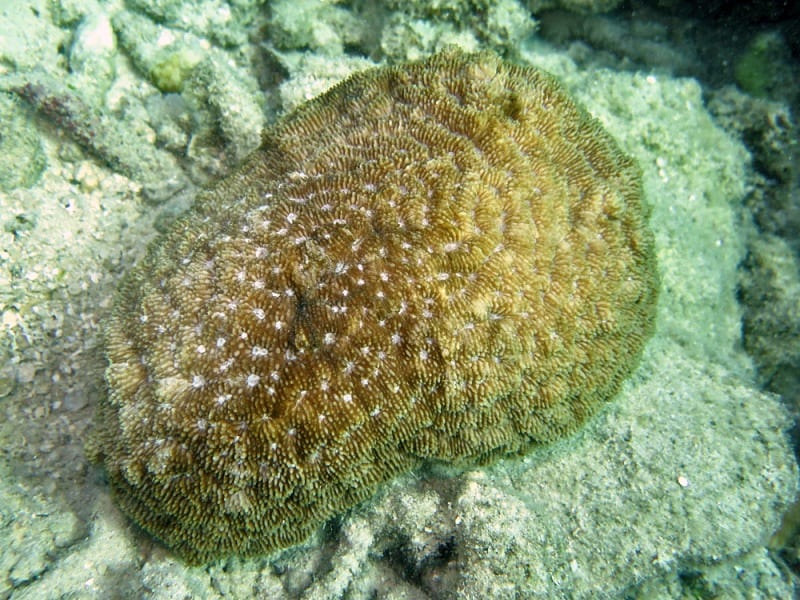
 © Anne Hoggett / CC BY 3.0
Sandalolitha
Sandalolitha, known in Japanese as Helmet Stone Coral, is a large free-living coral in the mushroom coral family (Fungiidae). Unlike corals that anchor themselves to the reef, it lives unattached on the sand or rubble, forming a rounded to oval dome that gives the species its common name. Its surface lacks the axial groove seen in some related corals; instead, countless small corallites sit packed tightly together, creating a distinctive, almost pebbled texture. Coloration ranges from pale to deep brown and can shade into green, and many individuals show corallite centers that fade to white, giving each coral its own subtle pattern. It's a hardy, easy-to-manage species that suits keepers just starting out with corals.
View Sandalolitha encyclopedia →成交手續費 0%!2026年9月30日前註冊,前 2 筆成交免佣金!
繁殖者 招募中!
在 BreederDirect 上架,直接銷售給全國各地的客戶!
我們承諾的 6 個透明度標準
在珊瑚的上架商品中,繁殖者會明示下列資訊。避免過度捕撈的野生個體,確保養殖/CB為主、實物照片、飼育難度資訊的透明度。
- 養殖個體
- 實物照片
- 難度明示
- Frag/Colony
- 飼育資訊
- 標明流通名
查看全部210個品種
珊瑚分類正在招募認證繁殖者
繁殖者正在陸續註冊,即將上架。設定上架通知,不錯過新商品。
「接收上架通知」需免費註冊會員即可設定。當有符合您儲存條件的新商品上架時,我們會以郵件和站內通知提醒您。
已註冊的繁殖者(搶先看)
關於Sandalolitha
Sandalolitha is a large free-living dome-shaped coral with tightly packed corallites and no axial groove — a hardy species well suited to coral-keeping beginners.
迎接Sandalolitha前需要了解的7件事
1Placement on Substrate
As a free-living species, it isn't attached to rock — simply set it on sand or a stable spot in the tank. Give it enough open space around it to display its full dome shape.
2Corallites Without a Groove
Look closely and you'll see tightly packed, individual corallites with no axial groove running across the surface. This texture is one way to tell it apart from related mushroom corals.
3Color Varies by Individual
Coloration ranges from pale to dark brown and can lean toward green. Corallite centers sometimes fade to white, so no two individuals look quite the same.
4Watch for Debris on the Surface
Being free-living, it doesn't always sit in an ideal position, so sand or detritus can settle on top of it. A gentle current helps keep the surface clear.
5Moderate Light and Flow
Rather than placing it under intense light or direct strong flow, a calmer spot such as near rockwork tends to keep it more stable.
6Leave Room from Other Corals
It grows into a large dome shape, so contact with neighboring corals can trigger stinging responses. Leave generous spacing when placing it.
7Acclimate Slowly
When introducing it to your tank, avoid sudden shifts in temperature or water chemistry. A slow drip acclimation helps it settle in without stress.
Sandalolitha的常見問題
- Q.Is Sandalolitha suitable for beginners?
- A.Yes, it's considered a hardy, beginner-friendly species. As long as basic water quality is maintained and it's placed appropriately, it's manageable even for first-time coral keepers.
- Q.Does it need to be glued to rock?
- A.No, it's a free-living coral, so no gluing or attachment is needed. It's simply placed on sand or a stable spot in the tank.
- Q.What does "no axial groove" mean?
- A.It means the surface has no groove running across it — instead, individual corallites sit tightly packed side by side. This is one way to distinguish it from related mushroom corals.
- Q.Why does coloration vary between individuals?
- A.Colors range from pale to dark brown and can lean toward green, and corallite centers sometimes fade to white. This is a natural feature of the species, so each coral looks a little different.
- Q.Is it safe to place near other corals?
- A.Since it grows into a large dome, contact with neighboring corals can trigger stinging responses. It's best to leave generous spacing around it.
適合飼養Sandalolitha的實用工具
在圖鑑中詳細了解Sandalolitha
查看Sandalolitha的圖鑑條目 →
收錄飼養難度、壽命、體長、食性等基礎資料。