Source: Wikimedia Commons
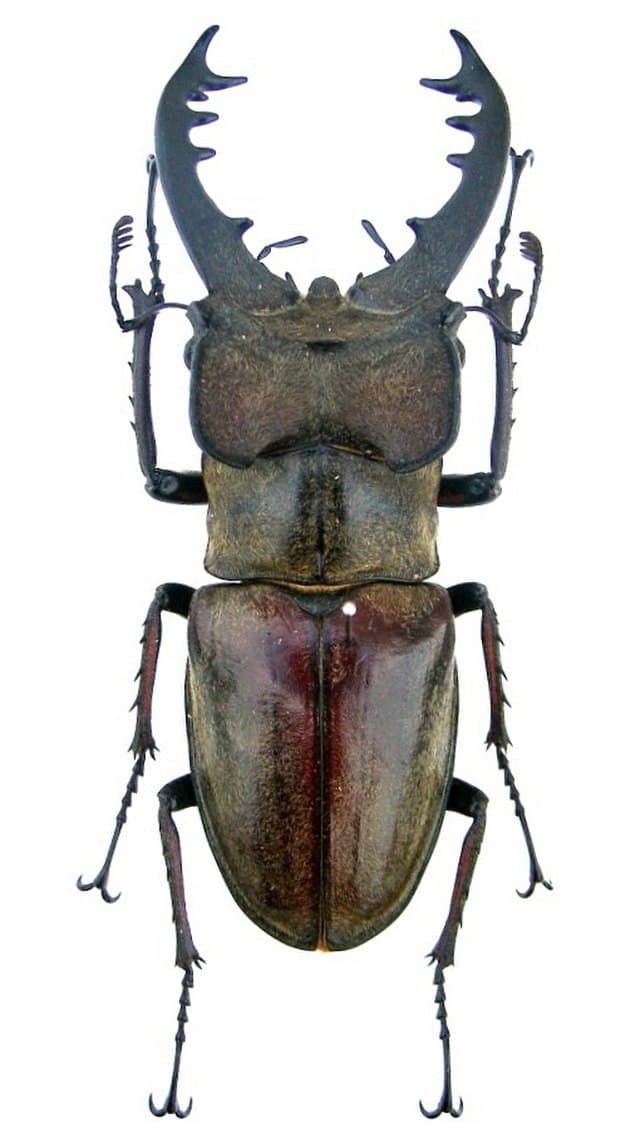
Miyama Stag Beetle
AdvancedBeautiful stag beetle from Japanese mountains. Crown-like head protrusion is distinctive. Requires cool temperatures for keeping.
Difficulté
Advanced
Température
20〜28℃
Durée de vie
Adult 2-3 months
Taille
Up to 75mm
Humidité
60〜80%
Régime alimentaire
Beetle jelly
À propos
Lucanus maculifemoratus, the miyama stag beetle, inhabits mountainous forests of Japan at elevations above approximately 400 meters, with a range extending from Hokkaido to Kyushu. It is distinguished by prominent ear-like projections on the head and highly variable mandible forms, classified into base-tooth, Fuji-mountain, and water-buffalo types. Adults reach 35–75 mm in length and display brownish to dark brown coloration with distinctive yellow hairs near the leg bases. As an alpine species, it is extremely sensitive to high temperatures; captive husbandry requires strict temperature management at 15–22°C, typically necessitating a dedicated insect cooling unit. Adult lifespan is 2–3 months, which is brief even by stag beetle standards. Egg-laying occurs in hardwood logs or fermented substrate. Revered as a symbol of the Japanese summer mountains, the miyama stag beetle's unique head projections and imposing size make it a beloved and sought-after native species.
Informations de base
Origine
mountainous regions of Japan, from Hokkaido to Kyushu
Durée de vie
Adult 2-3 months
Taille
Up to 75mm
Température
20〜28℃
Humidité
60〜80%
Régime alimentaire
Beetle jelly
Guide d'entretien
Temperature
15-22°C (high temperature forbidden)
Adult lifespan
Very short adult lifespan
Collecting
Can be collected at lights in summer
Breeding
Captive breeding is difficult
Notes
Weakens rapidly above 25°C — air conditioning essential
Japanese nativeCrown protrusionCool-lovingShort-lived
FAQ Miyama Stag Beetle
QQuelle est la difficulté de garder Miyama Stag Beetle ?
A
Advanced. C'est une espèce de niveau avancé. Elle nécessite un équipement spécialisé et des compétences avancées en élevage avec un contrôle environnemental précis.
QQuelle est la température idéale pour Miyama Stag Beetle ?
A
La température idéale pour Miyama Stag Beetle est 20〜28℃. L'humidité recommandée est 60〜80%. Évitez les changements brusques de température et maintenez un environnement stable.
QQuelle est la durée de vie de Miyama Stag Beetle ?
A
La durée de vie moyenne de Miyama Stag Beetle est Adult 2-3 months. Avec des soins et une alimentation appropriés, ils peuvent vivre longtemps en bonne santé.
QQuelle taille atteint Miyama Stag Beetle ?
A
Miyama Stag Beetle atteint généralement Up to 75mm à l'âge adulte. La taille peut varier selon les conditions de soins et la génétique individuelle.
QQue dois-je donner à manger à Miyama Stag Beetle ?
A
Miyama Stag Beetle se nourrit de : Beetle jelly. Visez un régime équilibré avec une fréquence d'alimentation appropriée.
QQuel est le prix typique de Miyama Stag Beetle ?
A
Le prix de Miyama Stag Beetle varie considérablement selon le morph, la taille et la lignée. Consultez notre page de prix du marché pour les dernières informations.
Espèces apparentées
Trouver des annonces pour cette espèce
Parcourir les annonces InsectArticles connexes
Stag Beetle Breeding Temperature Control — Species-Specific Optimal Ranges
Stag beetle temperature control: species-specific ranges for Dorcus, Prosopocoilus, and Lamprima — cooling methods and seasonal cycling.
Foreign Stag Beetle Overwintering Guide — Tropical vs Temperate Species
Guide to overwintering imported stag beetles: heating for tropical species, dormancy for temperate species, and species-specific temperatures.
Complete Stage Management for Stag Beetles & Rhinoceros Beetles: Larvae, Pupa & Post-Eclosion Care
Stage-by-stage care guide for stag beetles and rhinoceros beetles: larval substrate and temperature management, pupal cell preparation, and post-eclosion adult care with timing and transition tips.
Complete Stag Beetle Species Guide — Characteristics and Difficulty of Japanese and Popular Imported Species
Comprehensive guide to stag beetle species: Japanese natives like Dorcus hopei and Lucanus maculosus, plus popular imports like Giraffa, Palawan, and Caucasus stag beetles.