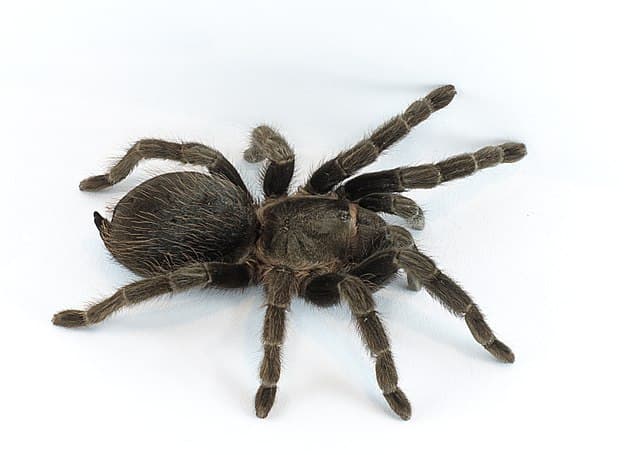
Source: Wikimedia Commons
Tarantula
IntermediateAmong the worlds largest spiders. Despite hairy appearance, many species are docile. Mexican Red Knee popular for beginners.
Difficulté
Intermediate
Température
20〜28℃
Durée de vie
10-30 years (female)
Taille
Leg span 10-25cm
Humidité
60〜80%
Régime alimentaire
Insects like crickets (2-4 times monthly)
À propos
Tarantulas are large, hairy spiders belonging to the family Theraphosidae, with over 1,000 described species in nearly 200 genera. They are distributed across tropical and subtropical regions of the Americas, Africa, Asia, and Australia, occupying diverse habitats from arid deserts to rainforest canopies. Body length ranges from roughly 3 to 13 cm depending on species. They are divided broadly into terrestrial burrowing species and arboreal species. In captivity, enclosure size is matched to the individual, and temperatures of 24–28°C are maintained. Prey such as crickets or dubia roaches is offered one to two times per week. Many New World species possess urticating hairs on the abdomen, which can cause skin and eye irritation and must be handled with care. Females of many species are remarkably long-lived, some exceeding 20 years. Their dramatic appearance and species diversity have established tarantulas as one of the most popular invertebrate pets worldwide.
Source: Wikipedia (CC BY-SA 4.0)
Informations de base
Origine
tropical and subtropical regions of the Americas, Africa, Asia, and Australia
Durée de vie
10-30 years (female)
Taille
Leg span 10-25cm
Température
20〜28℃
Humidité
60〜80%
Régime alimentaire
Insects like crickets (2-4 times monthly)
Guide d'entretien
Enclosure
Plastic container sized for species
Temperature
24-28°C
Humidity
40-80% depending on species
Feeding
Avoid feeding before and after molting
Notes
Venomous but mild in most species. Watch for urticating hairs
SpiderLargeMoltsLong-lived
FAQ Tarantula
QQuelle est la difficulté de garder Tarantula ?
A
Intermediate. C'est une espèce de niveau intermédiaire. Une certaine expérience préalable et des connaissances en gestion environnementale sont recommandées.
QQuelle est la température idéale pour Tarantula ?
A
La température idéale pour Tarantula est 20〜28℃. L'humidité recommandée est 60〜80%. Évitez les changements brusques de température et maintenez un environnement stable.
QQuelle est la durée de vie de Tarantula ?
A
La durée de vie moyenne de Tarantula est 10-30 years (female). Avec des soins et une alimentation appropriés, ils peuvent vivre longtemps en bonne santé.
QQuelle taille atteint Tarantula ?
A
Tarantula atteint généralement Leg span 10-25cm à l'âge adulte. La taille peut varier selon les conditions de soins et la génétique individuelle.
QQue dois-je donner à manger à Tarantula ?
A
Tarantula se nourrit de : Insects like crickets (2-4 times monthly). Visez un régime équilibré avec une fréquence d'alimentation appropriée.
QQuel est le prix typique de Tarantula ?
A
Le prix de Tarantula varie considérablement selon le morph, la taille et la lignée. Consultez notre page de prix du marché pour les dernières informations.
Espèces apparentées
Trouver des annonces pour cette espèce
Parcourir les annonces InsectArticles connexes
Tarantula Enclosure Setup — Arboreal vs Terrestrial Layouts
Tarantula enclosure setup: arboreal vs terrestrial configurations, substrate depth, humidity control, ventilation, and feeding guidelines.
Tarantula Feeding & Care Beginner Guide — Species Selection, Feeding & Handling
Getting started with tarantula keeping: beginner-friendly species, feeding methods, enclosure setup, molting care, and handling safety.
How Much Does Insect Keeping Cost? Monthly Running Costs Explained
Monthly insect keeping costs for beetles and stag beetles: substrate, jelly, temperature control, and annual breeding cost estimates.
Insect Lifespan — Adult & Larval Stages of Beetles and Stag Beetles
Beetle and stag beetle lifespans by species for both adults and larvae, with tips on temperature and diet to extend adult longevity.