Source: Wikimedia Commons
Hercules Beetle
IntermediateHercules beetle
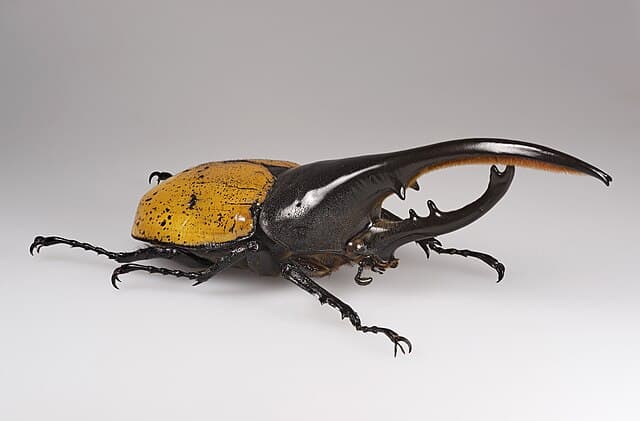
Worlds largest beetle. Massive horns reaching 180mm are breathtaking. Central/South American origin. Dream species for beetle keepers.
Difficulté
Intermediate
Température
20〜28℃
Durée de vie
Adult 6-12 months, larva 1-2 years
Taille
Up to 180mm (including horn)
Humidité
60〜80%
Régime alimentaire
Beetle jelly (adult), fermented substrate (larva)
À propos
Dynastes hercules, the Hercules beetle, is the longest extant beetle species and one of the largest flying insects on Earth. It is native to the tropical rainforests of southern Mexico, Central America, South America, and the Lesser Antilles. Males can reach a total length of up to 180 mm, including their distinctive paired horns—a long cephalic horn and a thoracic horn used to grasp and flip rivals. Elytra color shifts from yellowish-green to black with changing humidity, a unique trait among large beetles. Captive husbandry requires an oversized enclosure with fermented substrate at least 20 cm deep, maintained at 20–25°C; temperatures above 28°C are harmful. The larval stage lasts one to two years and demands substantial substrate volumes. Females lay 30–50 eggs per clutch in fermented mat. Adults feed on beetle jelly or banana and live approximately 6–12 months. As the undisputed king of beetles, Hercules beetles are the most coveted species among collectors worldwide.
Source: Wikipedia (CC BY-SA 4.0)
Informations de base
Origine
the tropical forests of southern Mexico, Central America, South America, and the Lesser Antilles
Durée de vie
Adult 6-12 months, larva 1-2 years
Taille
Up to 180mm (including horn)
Température
20〜28℃
Humidité
60〜80%
Régime alimentaire
Beetle jelly (adult), fermented substrate (larva)
Guide d'entretien
Temperature
20-25°C (heat-sensitive)
Larval period
1-2 years. Large container needed
Substrate
Larvae consume large amounts of fermented substrate
Emergence
Do not disturb pupal chamber
Notes
Temperature control is critical — use wine cooler etc.
Worlds largestKing of beetlesDream speciesTemperature critical
FAQ Hercules Beetle
QQuelle est la difficulté de garder Hercules Beetle ?
A
Intermediate. C'est une espèce de niveau intermédiaire. Une certaine expérience préalable et des connaissances en gestion environnementale sont recommandées.
QQuelle est la température idéale pour Hercules Beetle ?
A
La température idéale pour Hercules Beetle est 20〜28℃. L'humidité recommandée est 60〜80%. Évitez les changements brusques de température et maintenez un environnement stable.
QQuelle est la durée de vie de Hercules Beetle ?
A
La durée de vie moyenne de Hercules Beetle est Adult 6-12 months, larva 1-2 years. Avec des soins et une alimentation appropriés, ils peuvent vivre longtemps en bonne santé.
QQuelle taille atteint Hercules Beetle ?
A
Hercules Beetle atteint généralement Up to 180mm (including horn) à l'âge adulte. La taille peut varier selon les conditions de soins et la génétique individuelle.
QQue dois-je donner à manger à Hercules Beetle ?
A
Hercules Beetle se nourrit de : Beetle jelly (adult), fermented substrate (larva). Visez un régime équilibré avec une fréquence d'alimentation appropriée.
QQuel est le prix typique de Hercules Beetle ?
A
Le prix de Hercules Beetle varie considérablement selon le morph, la taille et la lignée. Consultez notre page de prix du marché pour les dernières informations.
Q&R sur Hercules Beetle
Espèces apparentées
Trouver des annonces pour cette espèce
Parcourir les annonces InsectArticles connexes
Stag Beetle Breeding Temperature Control — Species-Specific Optimal Ranges
Stag beetle temperature control: species-specific ranges for Dorcus, Prosopocoilus, and Lamprima — cooling methods and seasonal cycling.
Rhinoceros Beetle Larvae Care — Mat Management & Temperature for Large Specimens
Rhinoceros beetle larvae care: fermented mat selection, container sizing, replacement timing, temperature management, and pupation chamber preparation.
Hercules Beetle Care & Breeding — From Larvae to Eclosion
Hercules beetle care and breeding from larval stage to adult eclosion: substrate, temperature management, and pupal cell care.
Hercules Beetle Care Guide — Raising the World's Largest Beetle
Guide to keeping Dynastes hercules: adult and larva care, enclosure size, temperature, diet, substrate changes, and breeding tips.