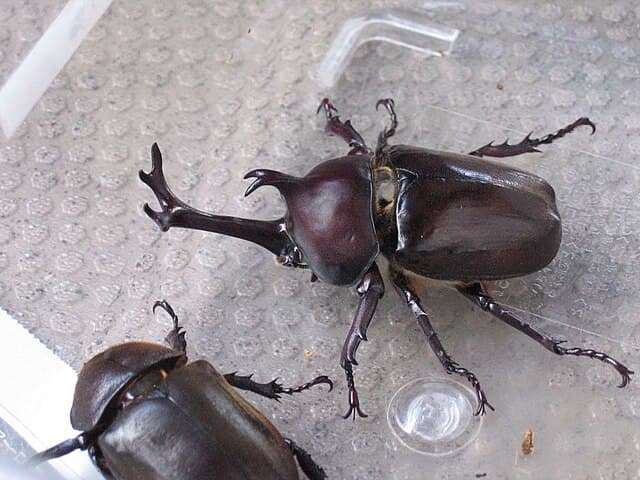
Source: Wikimedia Commons
Japanese Rhinoceros Beetle
BeginnerAllomyrina dichotoma
A Japanese summer icon. Popular from kids to adults. Larvae grow in leaf compost, pupating into adults in about a month. Perfect starter beetle.
Difficulté
Beginner
Température
20〜28℃
Durée de vie
Adult 2-3 months / Larva ~10 months
Taille
30-80mm (including horn)
Humidité
60〜80%
Régime alimentaire
Jelly (adult) / Leaf compost & fermented mat (larva)
À propos
The Japanese rhinoceros beetle (Allomyrina dichotoma), known in Japan as kabutomushi, is one of the most iconic beetle species in East Asia. Found throughout Japan, China, the Korean Peninsula, Vietnam, Myanmar, Thailand, and Taiwan, it inhabits broad-leaved forests with temperate to subtropical climates. Males are distinguished by a prominent cephalic horn used in combat with rival males over territory and mating rights. Adults measure 30–80 mm in length and display a glossy dark-brown coloration. They are nocturnal, congregating at tree sap flows of oak and chestnut trees. In captivity, they require a mid-sized enclosure with at least 15 cm of fermented substrate, temperatures of 20–28°C, and humidity of 60–80%. Females lay 20–30 eggs in fermented substrate, and larvae develop over approximately one year. Their impressive horns, manageable care requirements, and cultural status as Japan's "king of insects" make them the most popular pet beetle in the country.
Source: Wikipedia (CC BY-SA 4.0)
Informations de base
Origine
continental Asia, including Japan, China, the Korean Peninsula, and Southeast Asia
Durée de vie
Adult 2-3 months / Larva ~10 months
Taille
30-80mm (including horn)
Température
20〜28℃
Humidité
60〜80%
Régime alimentaire
Jelly (adult) / Leaf compost & fermented mat (larva)
Guide d'entretien
Enclosure
Medium plastic case. Substrate depth 15cm+
Breeding
Lay in fermented mat. ~20-30 eggs per female
Larva Care
Change substrate every 2-3 months. Use nutrient-rich mat for larger adults
Notes
Males fight. Add bark pieces to prevent flipping
Beginner-friendlyDomesticSummer classicEasy breeding
FAQ Japanese Rhinoceros Beetle
QQuelle est la difficulté de garder Japanese Rhinoceros Beetle ?
A
Beginner. C'est une espèce adaptée aux débutants. Aucun équipement spécial ni expérience n'est requis, et elle peut être maintenue avec succès avec une installation de soins de base.
QQuelle est la température idéale pour Japanese Rhinoceros Beetle ?
A
La température idéale pour Japanese Rhinoceros Beetle est 20〜28℃. L'humidité recommandée est 60〜80%. Évitez les changements brusques de température et maintenez un environnement stable.
QQuelle est la durée de vie de Japanese Rhinoceros Beetle ?
A
La durée de vie moyenne de Japanese Rhinoceros Beetle est Adult 2-3 months / Larva ~10 months. Avec des soins et une alimentation appropriés, ils peuvent vivre longtemps en bonne santé.
QQuelle taille atteint Japanese Rhinoceros Beetle ?
A
Japanese Rhinoceros Beetle atteint généralement 30-80mm (including horn) à l'âge adulte. La taille peut varier selon les conditions de soins et la génétique individuelle.
QQue dois-je donner à manger à Japanese Rhinoceros Beetle ?
A
Japanese Rhinoceros Beetle se nourrit de : Jelly (adult) / Leaf compost & fermented mat (larva). Visez un régime équilibré avec une fréquence d'alimentation appropriée.
QQuel est le prix typique de Japanese Rhinoceros Beetle ?
A
Le prix de Japanese Rhinoceros Beetle varie considérablement selon le morph, la taille et la lignée. Consultez notre page de prix du marché pour les dernières informations.
Espèces apparentées
Trouver des annonces pour cette espèce
Parcourir les annonces InsectArticles connexes
Stag Beetle Breeding Temperature Control — Species-Specific Optimal Ranges
Stag beetle temperature control: species-specific ranges for Dorcus, Prosopocoilus, and Lamprima — cooling methods and seasonal cycling.
Rhinoceros Beetle Larvae Care — Mat Management & Temperature for Large Specimens
Rhinoceros beetle larvae care: fermented mat selection, container sizing, replacement timing, temperature management, and pupation chamber preparation.
Hercules Beetle Care Guide — Raising the World's Largest Beetle
Guide to keeping Dynastes hercules: adult and larva care, enclosure size, temperature, diet, substrate changes, and breeding tips.
Growing Bigger Rhinoceros Beetles — Bloodline, Substrate & Temperature Techniques
Techniques for raising larger rhinoceros beetles: selecting quality bloodlines, high-nutrition substrates, and temperature-controlled growth strategies.