Chinese Money Plant
BeginnerPilea peperomioides
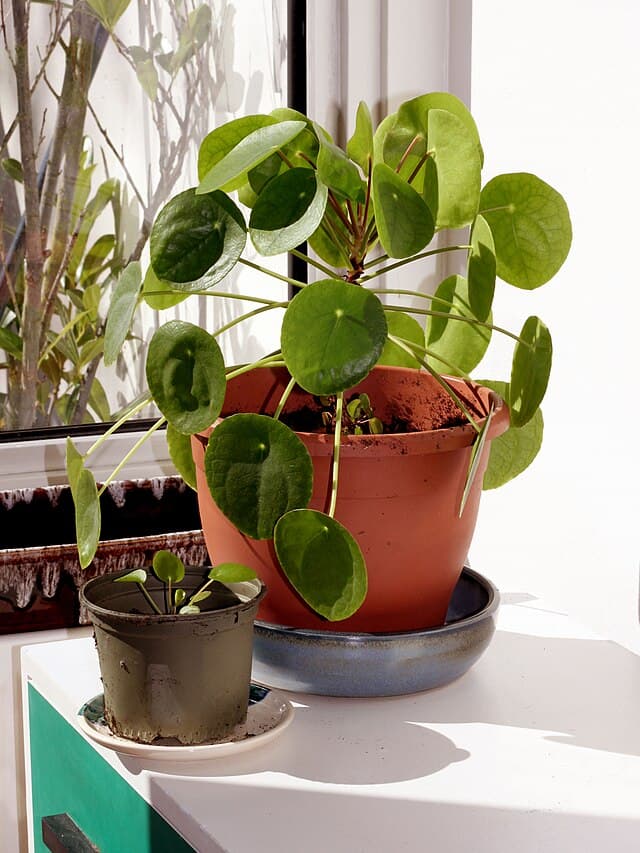
A Chinese plant with round coin-like leaves spreading parasol-like from stems. Called 'Chinese Money Plant', it easily propagates via offsets and grows compactly in bright spots.
Pilea peperomioides, the Chinese money plant, UFO plant, or pancake plant, is a perennial in the family Urticaceae, native to Yunnan province in China. Its most distinctive feature is its round, coin-shaped leaves held horizontally on slender, upright stems — a unique silhouette unlike any other common houseplant. Introduced to Europe in the 1970s by a Norwegian missionary before being formally described by botanists, it spread through personal sharing, earning the nickname 'friendship plant' or 'pass-it-on plant'. The plant readily produces offshoots (pups) at the base, which are easily separated and potted for propagation or gifting. It prefers bright indirect light; rotating the pot periodically ensures even, symmetrical leaf spread. Water moderately, allowing the soil to dry between waterings to prevent root rot. Compact, charming, and endlessly shareable, it is an ideal introductory houseplant.
Origin
Yunnan Province, China
Lifespan
Perennial
Size
15-40cm
Temperature
15〜25℃
Humidity
40〜60%
Liquid fertilizer monthly in spring-fall
Bright indirect light optimal
Water thoroughly when topsoil dries
Rotate pot regularly as it leans toward light
Offsets emerge from base. Separate to propagate
Beginner. This is a beginner-friendly species. No special equipment or experience is required, and it can be kept successfully with basic care setup.
The ideal temperature for Pilea peperomioides is 15〜25℃. Recommended humidity is 40〜60%. Avoid sudden temperature changes and maintain a stable environment.
Find listings for this species
The average lifespan of Pilea peperomioides is Perennial. With proper care and nutrition, they can live a long and healthy life.
Pilea peperomioides typically reaches 15-40cm as an adult. Size may vary depending on care conditions and individual genetics.
Pilea peperomioides feeds on: Liquid fertilizer monthly in spring-fall. Aim for a balanced diet with appropriate feeding frequency.
The price of Pilea peperomioides varies significantly depending on morph, size, and lineage. Check our market price page for the latest pricing information.