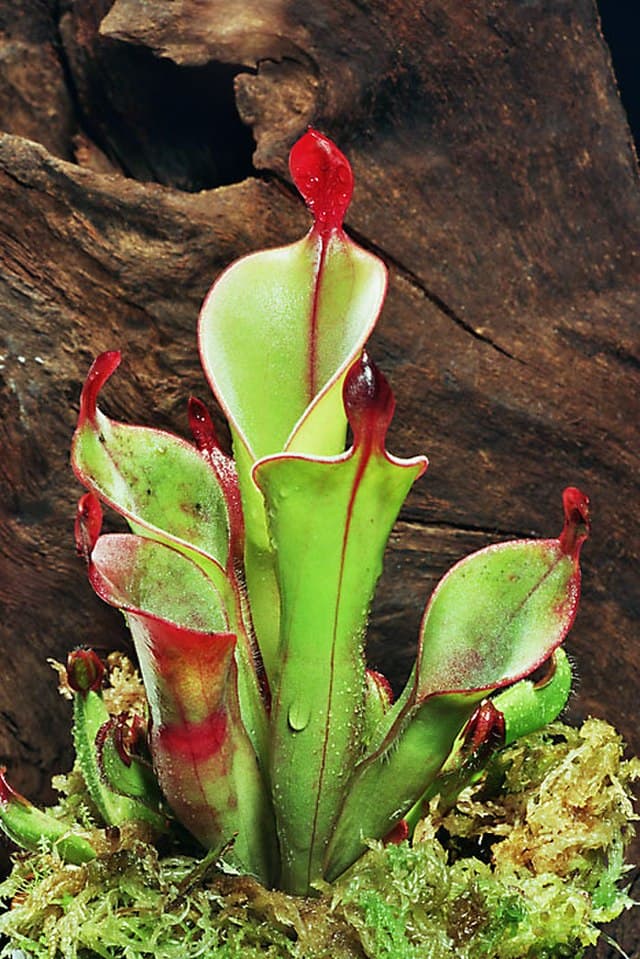
Source: Wikimedia Commons
Heliamphora Chimantensis
AdvancedHeliamphora chimantensis
A beautiful Heliamphora from Chimanta Tepui with stunningly red-colored tubes.
Difficulty
Advanced
Temperature
10〜30℃
Lifespan
10+ years
Size
10-25cm
Humidity
60〜90%
Diet
Insects (auto-capture)
About
Heliamphora chimantensis is a Heliamphora endemic to the Chimanta massif (Chimanta-Tepui) in Venezuela, a complex of connected tepuis in the Guiana Highlands. It is a relatively large species that develops striking deep-red coloration in its pitchers under adequate light—a quality that makes it particularly prized among Heliamphora collectors for its ornamental appeal. As a high-altitude tepui species, it requires exacting cool growing conditions: daytime temperatures of 18–22°C, night temperatures of 8–14°C, humidity of 70–90%, and well-aerated sphagnum media with pure or rainwater. Bright indirect light maximizes the attractive red coloration. High summer temperatures are the principal challenge in cultivation, often necessitating cooling equipment.
Basic Info
Origin
Chimanta-Tepui massif, Guiana Highlands, Venezuela
Lifespan
10+ years
Size
10-25cm
Temperature
10〜30℃
Humidity
60〜90%
Diet
Insects (auto-capture)
Care Guide
Color
Turns red
Temperature
10-22°C
Humidity
High humidity essential
Light
Strong light for red
CarnivorousHeliamphoraRedChimanta
Heliamphora Chimantensis FAQ
QHow difficult is it to keep Heliamphora Chimantensis?
A
Advanced. This is an advanced-level species. It requires specialized equipment and advanced husbandry skills with precise environmental control.
QWhat is the ideal temperature for Heliamphora Chimantensis?
A
The ideal temperature for Heliamphora Chimantensis is 10〜30℃. Recommended humidity is 60〜90%. Avoid sudden temperature changes and maintain a stable environment.
QWhat is the lifespan of Heliamphora Chimantensis?
A
The average lifespan of Heliamphora Chimantensis is 10+ years. With proper care and nutrition, they can live a long and healthy life.
QHow large does Heliamphora Chimantensis get?
A
Heliamphora Chimantensis typically reaches 10-25cm as an adult. Size may vary depending on care conditions and individual genetics.
QWhat should I feed Heliamphora Chimantensis?
A
Heliamphora Chimantensis feeds on: Insects (auto-capture). Aim for a balanced diet with appropriate feeding frequency.
QWhat is the typical price for Heliamphora Chimantensis?
A
The price of Heliamphora Chimantensis varies significantly depending on morph, size, and lineage. Check our market price page for the latest pricing information.
Heliamphora Chimantensis Q&A
Related Species
Find listings for this species
Browse Carnivorous Plant ListingsRelated Articles
Complete Beginner's Guide to Carnivorous Plants
Everything beginners need to start growing carnivorous plants: soil, watering, light, tray culture, overwintering, and recommended starter species.
Carnivorous Plant Encyclopedia — Popular Species & Care Guide
An encyclopedia of popular carnivorous plants with trapping methods, care difficulty, and environment needs for each.
How Much Does Carnivorous Plant Growing Cost? Monthly Running Costs Explained
Monthly carnivorous plant care costs: soil, distilled water, and lighting, with Nepenthes vs. Venus flytrap cost comparisons.
Carnivorous Plant Growth Rate & Size — Species-by-Species Guide
Carnivorous plant growth rates and sizes for Venus flytraps, Nepenthes, and Sarracenia, with tips for growing larger traps.