Source: Wikimedia Commons
Catopsis Berteroniana
IntermediateCatopsis berteroniana
A bromeliad carnivorous plant that traps insects with waxy leaf surfaces, drowning them in leaf-cup water for nutrients.
Difficulty
Intermediate
Temperature
10〜30℃
Lifespan
5-10 years
Size
20-50cm
Humidity
60〜90%
Diet
Insects (auto-capture)
About
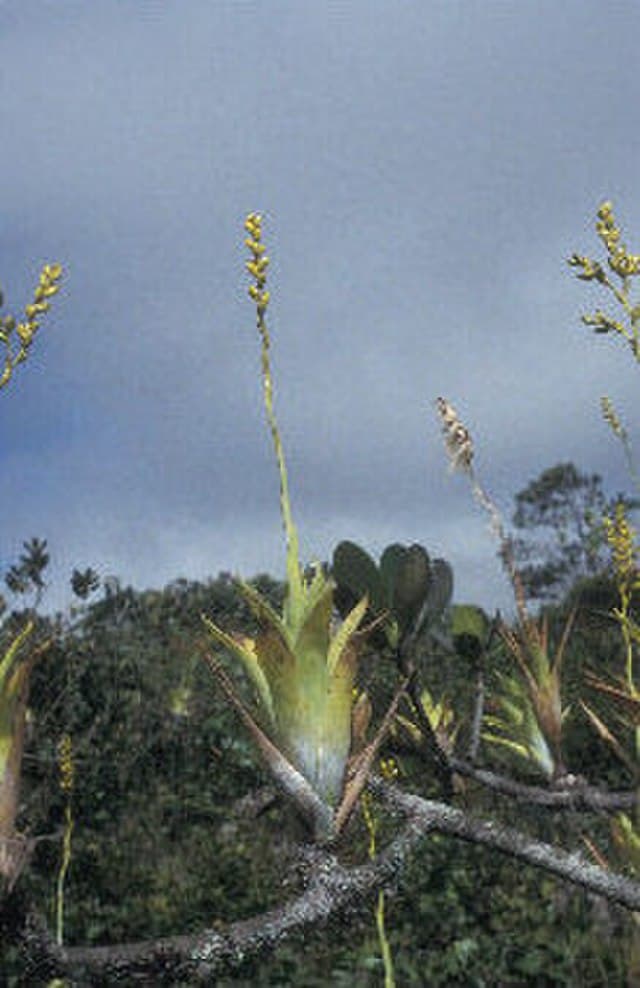
Catopsis berteroniana is a bromeliad (family Bromeliaceae) native to southern Florida, Central America, the Caribbean, and tropical South America, where it grows as an epiphyte in humid forests. It is considered the most carnivorous member of the Bromeliaceae, though it is debated as a true carnivore: the inner leaf surfaces are coated with ultraviolet-reflective white farina (waxy powder) that attracts and possibly disorients insects, causing them to fall into the central water-holding tank formed by the overlapping leaf bases. Trapped insects drown and are decomposed by microbial activity in the tank water, with the plant absorbing the released nutrients through specialized leaf trichomes. No digestive enzymes are produced by the plant itself. Cultivation follows bromeliad culture: epiphytic well-draining media, pure or rainwater in the central tank, high humidity, and warm temperatures (20–35°C).
Basic Info
Origin
Southern Florida, Central America, Caribbean, and tropical South America, humid forest epiphytes
Lifespan
5-10 years
Size
20-50cm
Temperature
10〜30℃
Humidity
60〜90%
Diet
Insects (auto-capture)
Care Guide
Trapping
Waxy slip-trap
Epiphyte
Tree-dwelling
Watering
Keep water in leaf cup
Light
Bright indirect light
CarnivorousCatopsisBromeliadEpiphyte
Catopsis Berteroniana FAQ
QHow difficult is it to keep Catopsis Berteroniana?
A
Intermediate. This is an intermediate-level species. Some prior experience and knowledge of environmental management are recommended.
QWhat is the ideal temperature for Catopsis Berteroniana?
A
The ideal temperature for Catopsis Berteroniana is 10〜30℃. Recommended humidity is 60〜90%. Avoid sudden temperature changes and maintain a stable environment.
QWhat is the lifespan of Catopsis Berteroniana?
A
Catopsis Berteroniana Q&A
Find listings for this species