Hercules Ecuatorianus
AdvancedEcuadorian subspecies of Hercules beetle. Smaller than nominate but unique horn shape.
Schwierigkeit
Advanced
Temperatur
20〜28℃
Lebensdauer
Adult 6-12 months
Größe
100-140mm
Luftfeuchtigkeit
60〜80%
Ernährung
Insect jelly
Über uns
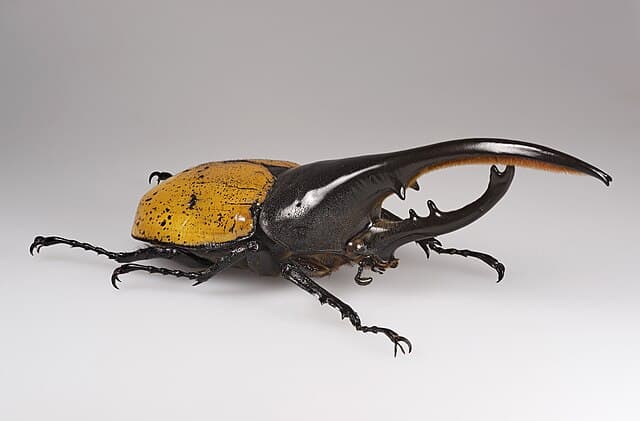
Dynastes hercules ecuatorianus is a subspecies of the Hercules beetle endemic to Ecuador, where it inhabits cloud forests and humid montane regions. Males reach 100–140 mm in total length, somewhat smaller than the nominate subspecies but displaying a distinctive horn morphology with proportionally sturdier thoracic and cephalic horns. Elytra coloration shifts from yellowish-green to black with changes in humidity. Optimal captive temperature is 20–25°C; heat above 28°C is harmful. Large enclosures with deep fermented substrate are required. Egg-laying occurs in the substrate; larvae develop over approximately 12–24 months. Adults eat beetle jelly or banana and live approximately 6–12 months. Relatively more accessible in the trade than the nominate Guadeloupe subspecies, D. h. ecuatorianus offers Hercules beetle enthusiasts a distinctive subspecies to rear with its own characteristic horn form.
Grundinformationen
Herkunft
cloud forests and montane regions of Ecuador
Lebensdauer
Adult 6-12 months
Größe
100-140mm
Temperatur
20〜28℃
Luftfeuchtigkeit
60〜80%
Ernährung
Insect jelly
Pflegeanleitung
Temperature
Maintain 20-25°C
Housing
Large case with deep insect mat
Larval period
Long at 18-24 months
Notes
Humidity important. Maintain 60-70%
EcuatorianusSubspeciesEcuadorHorn
Hercules Ecuatorianus-FAQ
QWie schwierig ist es, Hercules Ecuatorianus zu halten?
A
Advanced. Dies ist eine Art für Fortgeschrittene. Sie erfordert spezialisierte Ausrüstung und fortgeschrittene Haltungskenntnisse mit präziser Umgebungskontrolle.
QWas ist die ideale Temperatur für Hercules Ecuatorianus?
A
Die ideale Temperatur für Hercules Ecuatorianus ist 20〜28℃. Die empfohlene Luftfeuchtigkeit beträgt 60〜80%. Vermeiden Sie plötzliche Temperaturänderungen und halten Sie eine stabile Umgebung aufrecht.
QWie ist die Lebenserwartung von Hercules Ecuatorianus?
A
Die durchschnittliche Lebensdauer von Hercules Ecuatorianus beträgt Adult 6-12 months. Bei richtiger Pflege und Ernährung können sie ein langes und gesundes Leben führen.
QWie groß wird Hercules Ecuatorianus?
A
Hercules Ecuatorianus erreicht als Erwachsener typischerweise 100-140mm. Die Größe kann je nach Haltungsbedingungen und individueller Genetik variieren.
QWas sollte ich Hercules Ecuatorianus füttern?
A
Hercules Ecuatorianus ernährt sich von: Insect jelly. Streben Sie eine ausgewogene Ernährung mit angemessener Fütterungshäufigkeit an.
QWas ist der typische Preis für Hercules Ecuatorianus?
A
Der Preis von Hercules Ecuatorianus variiert erheblich je nach Morph, Größe und Abstammung. Überprüfen Sie unsere Marktpreisseite für aktuelle Preisinformationen.
Verwandte Arten
Angebote für diese Art finden
Insect-Angebote durchsuchenVerwandte Artikel
Hercules Beetle Care & Breeding — From Larvae to Eclosion
Hercules beetle care and breeding from larval stage to adult eclosion: substrate, temperature management, and pupal cell care.
Hercules Beetle Care Guide — Raising the World's Largest Beetle
Guide to keeping Dynastes hercules: adult and larva care, enclosure size, temperature, diet, substrate changes, and breeding tips.
Hercules Beetle Rearing Guide — Complete Care from Larva to Adult
Complete guide to raising Hercules beetles from larva to adult: temperature control, substrate selection, stage-by-stage larval management, and adult feeding and care.
Hercules Beetle Care Guide — Raising Large Adults from Larvae
Complete Hercules beetle care guide: larval substrate selection, temperature management, using fungal substrate jars, and adult care for raising record-sized individuals.