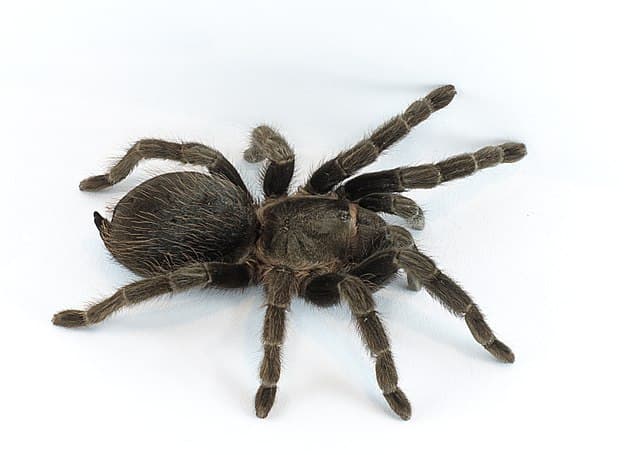
Source: Wikimedia Commons
Tarantula
IntermediateAmong the worlds largest spiders. Despite hairy appearance, many species are docile. Mexican Red Knee popular for beginners.
Schwierigkeit
Intermediate
Temperatur
20〜28℃
Lebensdauer
10-30 years (female)
Größe
Leg span 10-25cm
Luftfeuchtigkeit
60〜80%
Ernährung
Insects like crickets (2-4 times monthly)
Über uns
Tarantulas are large, hairy spiders belonging to the family Theraphosidae, with over 1,000 described species in nearly 200 genera. They are distributed across tropical and subtropical regions of the Americas, Africa, Asia, and Australia, occupying diverse habitats from arid deserts to rainforest canopies. Body length ranges from roughly 3 to 13 cm depending on species. They are divided broadly into terrestrial burrowing species and arboreal species. In captivity, enclosure size is matched to the individual, and temperatures of 24–28°C are maintained. Prey such as crickets or dubia roaches is offered one to two times per week. Many New World species possess urticating hairs on the abdomen, which can cause skin and eye irritation and must be handled with care. Females of many species are remarkably long-lived, some exceeding 20 years. Their dramatic appearance and species diversity have established tarantulas as one of the most popular invertebrate pets worldwide.
Source: Wikipedia (CC BY-SA 4.0)
Grundinformationen
Herkunft
tropical and subtropical regions of the Americas, Africa, Asia, and Australia
Lebensdauer
10-30 years (female)
Größe
Leg span 10-25cm
Temperatur
20〜28℃
Luftfeuchtigkeit
60〜80%
Ernährung
Insects like crickets (2-4 times monthly)
Pflegeanleitung
Enclosure
Plastic container sized for species
Temperature
24-28°C
Humidity
40-80% depending on species
Feeding
Avoid feeding before and after molting
Notes
Venomous but mild in most species. Watch for urticating hairs
SpiderLargeMoltsLong-lived
Tarantula-FAQ
QWie schwierig ist es, Tarantula zu halten?
A
Intermediate. Dies ist eine Art mittleren Schwierigkeitsgrades. Etwas Vorerfahrung und Kenntnisse im Umgebungsmanagement werden empfohlen.
QWas ist die ideale Temperatur für Tarantula?
A
Die ideale Temperatur für Tarantula ist 20〜28℃. Die empfohlene Luftfeuchtigkeit beträgt 60〜80%. Vermeiden Sie plötzliche Temperaturänderungen und halten Sie eine stabile Umgebung aufrecht.
QWie ist die Lebenserwartung von Tarantula?
A
Die durchschnittliche Lebensdauer von Tarantula beträgt 10-30 years (female). Bei richtiger Pflege und Ernährung können sie ein langes und gesundes Leben führen.
QWie groß wird Tarantula?
A
Tarantula erreicht als Erwachsener typischerweise Leg span 10-25cm. Die Größe kann je nach Haltungsbedingungen und individueller Genetik variieren.
QWas sollte ich Tarantula füttern?
A
Tarantula ernährt sich von: Insects like crickets (2-4 times monthly). Streben Sie eine ausgewogene Ernährung mit angemessener Fütterungshäufigkeit an.
QWas ist der typische Preis für Tarantula?
A
Der Preis von Tarantula variiert erheblich je nach Morph, Größe und Abstammung. Überprüfen Sie unsere Marktpreisseite für aktuelle Preisinformationen.
Verwandte Arten
Angebote für diese Art finden
Insect-Angebote durchsuchenVerwandte Artikel
Tarantula Enclosure Setup — Arboreal vs Terrestrial Layouts
Tarantula enclosure setup: arboreal vs terrestrial configurations, substrate depth, humidity control, ventilation, and feeding guidelines.
Tarantula Feeding & Care Beginner Guide — Species Selection, Feeding & Handling
Getting started with tarantula keeping: beginner-friendly species, feeding methods, enclosure setup, molting care, and handling safety.
Introduction to Tarantula Care
Tarantulas can be surprisingly easy pets. Covers species difficulty levels from beginner-friendly Grammostola to advanced Poecilotheria, with temperature, humidity, and feeding basics.
How Much Does Insect Keeping Cost? Monthly Running Costs Explained
Monthly insect keeping costs for beetles and stag beetles: substrate, jelly, temperature control, and annual breeding cost estimates.