Source: Wikimedia Commons
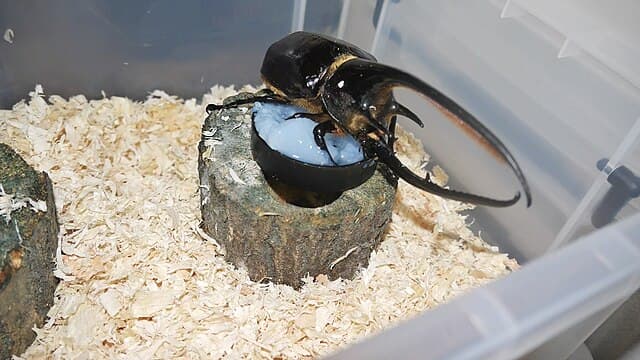
Neptune Beetle
AdvancedRare large beetle from South American highlands. Second largest after Hercules. Jet-black body with long horn is stunning.
Schwierigkeit
Advanced
Temperatur
20〜28℃
Lebensdauer
Adult 6-12 months, larva 2-3 years
Größe
Up to 150mm
Luftfeuchtigkeit
60〜80%
Ernährung
Beetle jelly (adult), fermented substrate (larva)
Über uns
Dynastes neptunus, the Neptune beetle, inhabits high-altitude cloud forests of the Andes in Colombia, Ecuador, and Peru, at elevations roughly between 1,000 and 2,500 meters. It is one of the largest rhinoceros beetles, with males reaching total lengths of 80–150 mm, ranking second only to the Hercules beetle in maximum size. Males bear a long thoracic horn and shorter cephalic horn, with a striking glossy jet-black body coloration. As a highland species, it requires strict low-temperature management at 17–22°C; warmer conditions are detrimental to both adults and larvae. The larval stage spans 2–3 years—exceptionally long for a rhinoceros beetle—and demands large quantities of high-quality fermented substrate. Females lay eggs in fermented substrate, and breeding is moderately challenging. Adults live 6–12 months. While requiring experienced husbandry, the Neptune beetle's jet-black form and impressive proportions make it one of the most revered species in the collecting world.
Grundinformationen
Herkunft
high-altitude Andean cloud forests of Colombia, Ecuador, and Peru
Lebensdauer
Adult 6-12 months, larva 2-3 years
Größe
Up to 150mm
Temperatur
20〜28℃
Luftfeuchtigkeit
60〜80%
Ernährung
Beetle jelly (adult), fermented substrate (larva)
Pflegeanleitung
Temperature
17-22°C (cool temperature essential)
Larval period
2-3 years — very long
Rarity
Rare in trade and expensive
Environment
Wine cooler temperature management essential
Notes
Highland species — Japanese summer is biggest threat
RareJet-blackSouth American highlandLarge
Neptune Beetle-FAQ
QWie schwierig ist es, Neptune Beetle zu halten?
A
Advanced. Dies ist eine Art für Fortgeschrittene. Sie erfordert spezialisierte Ausrüstung und fortgeschrittene Haltungskenntnisse mit präziser Umgebungskontrolle.
QWas ist die ideale Temperatur für Neptune Beetle?
A
Die ideale Temperatur für Neptune Beetle ist 20〜28℃. Die empfohlene Luftfeuchtigkeit beträgt 60〜80%. Vermeiden Sie plötzliche Temperaturänderungen und halten Sie eine stabile Umgebung aufrecht.
QWie ist die Lebenserwartung von Neptune Beetle?
A
Die durchschnittliche Lebensdauer von Neptune Beetle beträgt Adult 6-12 months, larva 2-3 years. Bei richtiger Pflege und Ernährung können sie ein langes und gesundes Leben führen.
QWie groß wird Neptune Beetle?
A
Neptune Beetle erreicht als Erwachsener typischerweise Up to 150mm. Die Größe kann je nach Haltungsbedingungen und individueller Genetik variieren.
QWas sollte ich Neptune Beetle füttern?
A
Neptune Beetle ernährt sich von: Beetle jelly (adult), fermented substrate (larva). Streben Sie eine ausgewogene Ernährung mit angemessener Fütterungshäufigkeit an.
QWas ist der typische Preis für Neptune Beetle?
A
Der Preis von Neptune Beetle variiert erheblich je nach Morph, Größe und Abstammung. Überprüfen Sie unsere Marktpreisseite für aktuelle Preisinformationen.
Verwandte Arten
Angebote für diese Art finden
Insect-Angebote durchsuchenVerwandte Artikel
Stag Beetle Breeding Temperature Control — Species-Specific Optimal Ranges
Stag beetle temperature control: species-specific ranges for Dorcus, Prosopocoilus, and Lamprima — cooling methods and seasonal cycling.
Rhinoceros Beetle Larvae Care — Mat Management & Temperature for Large Specimens
Rhinoceros beetle larvae care: fermented mat selection, container sizing, replacement timing, temperature management, and pupation chamber preparation.
Hercules Beetle Care Guide — Raising the World's Largest Beetle
Guide to keeping Dynastes hercules: adult and larva care, enclosure size, temperature, diet, substrate changes, and breeding tips.
Growing Bigger Rhinoceros Beetles — Bloodline, Substrate & Temperature Techniques
Techniques for raising larger rhinoceros beetles: selecting quality bloodlines, high-nutrition substrates, and temperature-controlled growth strategies.