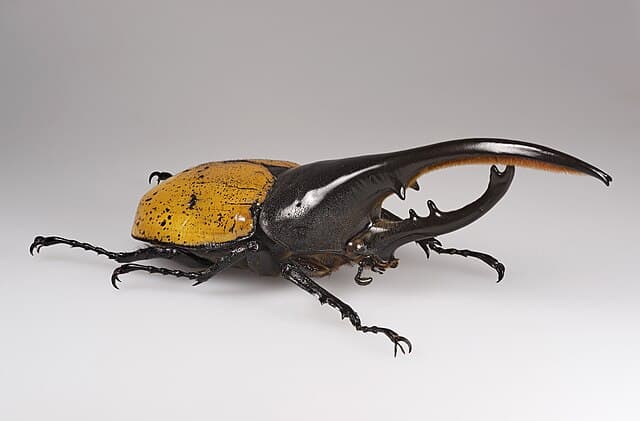
Source: Wikimedia Commons
Hercules Beetle
IntermediateHercules beetle
Worlds largest beetle. Massive horns reaching 180mm are breathtaking. Central/South American origin. Dream species for beetle keepers.
Schwierigkeit
Intermediate
Temperatur
20〜28℃
Lebensdauer
Adult 6-12 months, larva 1-2 years
Größe
Up to 180mm (including horn)
Luftfeuchtigkeit
60〜80%
Ernährung
Beetle jelly (adult), fermented substrate (larva)
Über uns
Dynastes hercules, the Hercules beetle, is the longest extant beetle species and one of the largest flying insects on Earth. It is native to the tropical rainforests of southern Mexico, Central America, South America, and the Lesser Antilles. Males can reach a total length of up to 180 mm, including their distinctive paired horns—a long cephalic horn and a thoracic horn used to grasp and flip rivals. Elytra color shifts from yellowish-green to black with changing humidity, a unique trait among large beetles. Captive husbandry requires an oversized enclosure with fermented substrate at least 20 cm deep, maintained at 20–25°C; temperatures above 28°C are harmful. The larval stage lasts one to two years and demands substantial substrate volumes. Females lay 30–50 eggs per clutch in fermented mat. Adults feed on beetle jelly or banana and live approximately 6–12 months. As the undisputed king of beetles, Hercules beetles are the most coveted species among collectors worldwide.
Source: Wikipedia (CC BY-SA 4.0)
Grundinformationen
Herkunft
the tropical forests of southern Mexico, Central America, South America, and the Lesser Antilles
Lebensdauer
Adult 6-12 months, larva 1-2 years
Größe
Up to 180mm (including horn)
Temperatur
20〜28℃
Luftfeuchtigkeit
60〜80%
Ernährung
Beetle jelly (adult), fermented substrate (larva)
Pflegeanleitung
Temperature
20-25°C (heat-sensitive)
Larval period
1-2 years. Large container needed
Substrate
Larvae consume large amounts of fermented substrate
Emergence
Do not disturb pupal chamber
Notes
Temperature control is critical — use wine cooler etc.
Worlds largestKing of beetlesDream speciesTemperature critical
Hercules Beetle-FAQ
QWie schwierig ist es, Hercules Beetle zu halten?
A
Intermediate. Dies ist eine Art mittleren Schwierigkeitsgrades. Etwas Vorerfahrung und Kenntnisse im Umgebungsmanagement werden empfohlen.
QWas ist die ideale Temperatur für Hercules Beetle?
A
Die ideale Temperatur für Hercules Beetle ist 20〜28℃. Die empfohlene Luftfeuchtigkeit beträgt 60〜80%. Vermeiden Sie plötzliche Temperaturänderungen und halten Sie eine stabile Umgebung aufrecht.
QWie ist die Lebenserwartung von Hercules Beetle?
A
Die durchschnittliche Lebensdauer von Hercules Beetle beträgt Adult 6-12 months, larva 1-2 years. Bei richtiger Pflege und Ernährung können sie ein langes und gesundes Leben führen.
QWie groß wird Hercules Beetle?
A
Hercules Beetle erreicht als Erwachsener typischerweise Up to 180mm (including horn). Die Größe kann je nach Haltungsbedingungen und individueller Genetik variieren.
QWas sollte ich Hercules Beetle füttern?
A
Hercules Beetle ernährt sich von: Beetle jelly (adult), fermented substrate (larva). Streben Sie eine ausgewogene Ernährung mit angemessener Fütterungshäufigkeit an.
QWas ist der typische Preis für Hercules Beetle?
A
Der Preis von Hercules Beetle variiert erheblich je nach Morph, Größe und Abstammung. Überprüfen Sie unsere Marktpreisseite für aktuelle Preisinformationen.
Verwandte Arten
Angebote für diese Art finden
Insect-Angebote durchsuchenVerwandte Artikel
Stag Beetle Breeding Temperature Control — Species-Specific Optimal Ranges
Stag beetle temperature control: species-specific ranges for Dorcus, Prosopocoilus, and Lamprima — cooling methods and seasonal cycling.
Rhinoceros Beetle Larvae Care — Mat Management & Temperature for Large Specimens
Rhinoceros beetle larvae care: fermented mat selection, container sizing, replacement timing, temperature management, and pupation chamber preparation.
Hercules Beetle Care & Breeding — From Larvae to Eclosion
Hercules beetle care and breeding from larval stage to adult eclosion: substrate, temperature management, and pupal cell care.
Hercules Beetle Care Guide — Raising the World's Largest Beetle
Guide to keeping Dynastes hercules: adult and larva care, enclosure size, temperature, diet, substrate changes, and breeding tips.