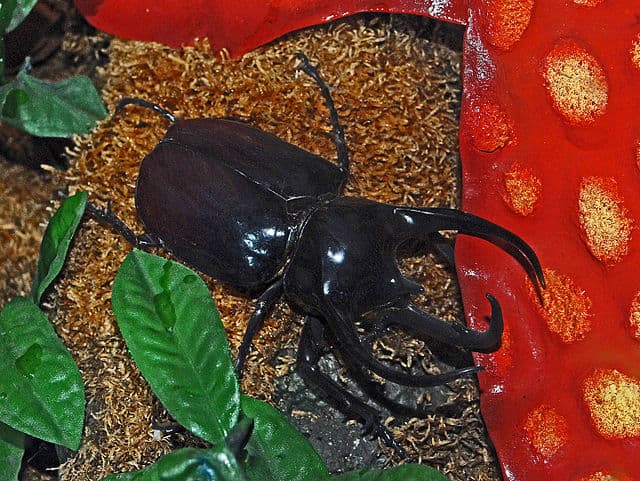
Source: Wikimedia Commons
Caucasus Beetle
IntermediateChalcosoma chiron
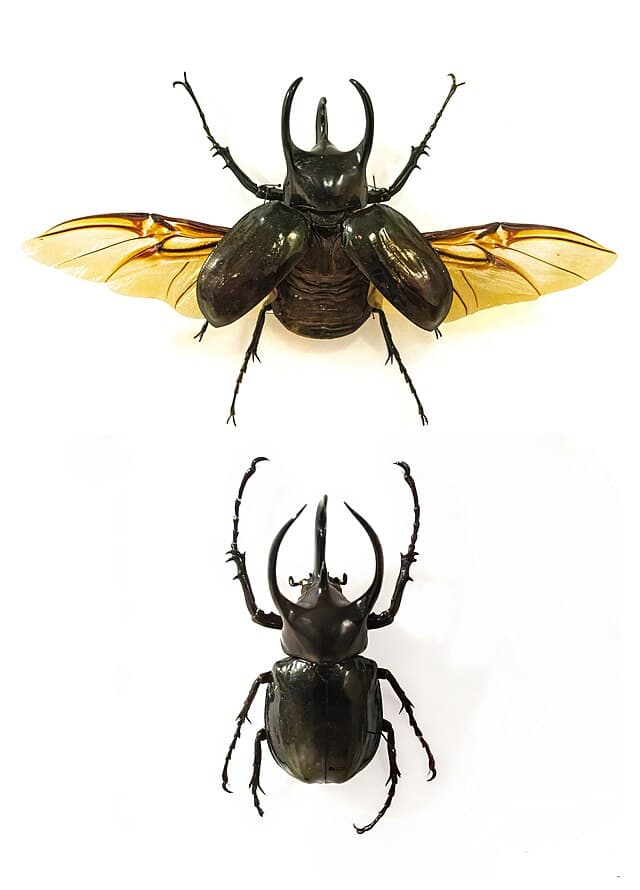
Largest beetle in Southeast Asia. Three long horns and aggressive nature. More accessible than Hercules and popular.
Schwierigkeit
Intermediate
Temperatur
20〜28℃
Lebensdauer
Adult 3-6 months, larva 1 year
Größe
Up to 130mm
Luftfeuchtigkeit
60〜80%
Ernährung
Beetle jelly (adult), fermented substrate (larva)
Über uns
Chalcosoma chiron, commonly called the Caucasus beetle or Atlas beetle, is the largest rhinoceros beetle in Asia, distributed across tropical rainforests of Malaysia, Indonesia, and Thailand. Males bear three prominent horns—one cephalic and two thoracic—and reach total lengths of 50–130 mm. The body displays a lustrous dark green to black coloration. This species is notably aggressive; males use their three horns with great skill in combat over mating rights. Captive temperatures must be kept between 18–25°C, as high heat above 28°C is detrimental. A medium to large enclosure with a fine-mesh lid and at least 15 cm of fermented substrate is recommended. Due to their aggressive temperament, mating should be supervised and kept brief. Adults eat beetle jelly and live approximately 3–8 months. Revered alongside the Hercules beetle as one of the world's strongest beetles, it is a trophy species for serious collectors.
Source: Wikipedia (CC BY-SA 4.0)
Grundinformationen
Herkunft
Southeast Asia, including Malaysia, Indonesia, and Thailand
Lebensdauer
Adult 3-6 months, larva 1 year
Größe
Up to 130mm
Temperatur
20〜28℃
Luftfeuchtigkeit
60〜80%
Ernährung
Beetle jelly (adult), fermented substrate (larva)
Pflegeanleitung
Temperature
18-25°C (very heat-sensitive)
Temperament
Very aggressive — handle with care
Larvae
Fermented substrate. High temperature forbidden
Adult lifespan
Shorter than other beetle species
Notes
Horn grip very strong — pinching is painful
Three hornsLargest in SE AsiaAggressiveCool keeping
Caucasus Beetle-FAQ
QWie schwierig ist es, Caucasus Beetle zu halten?
A
Intermediate. Dies ist eine Art mittleren Schwierigkeitsgrades. Etwas Vorerfahrung und Kenntnisse im Umgebungsmanagement werden empfohlen.
QWas ist die ideale Temperatur für Caucasus Beetle?
A
Die ideale Temperatur für Caucasus Beetle ist 20〜28℃. Die empfohlene Luftfeuchtigkeit beträgt 60〜80%. Vermeiden Sie plötzliche Temperaturänderungen und halten Sie eine stabile Umgebung aufrecht.
QWie ist die Lebenserwartung von Caucasus Beetle?
A
Die durchschnittliche Lebensdauer von Caucasus Beetle beträgt Adult 3-6 months, larva 1 year. Bei richtiger Pflege und Ernährung können sie ein langes und gesundes Leben führen.
QWie groß wird Caucasus Beetle?
A
Caucasus Beetle erreicht als Erwachsener typischerweise Up to 130mm. Die Größe kann je nach Haltungsbedingungen und individueller Genetik variieren.
QWas sollte ich Caucasus Beetle füttern?
A
Caucasus Beetle ernährt sich von: Beetle jelly (adult), fermented substrate (larva). Streben Sie eine ausgewogene Ernährung mit angemessener Fütterungshäufigkeit an.
QWas ist der typische Preis für Caucasus Beetle?
A
Der Preis von Caucasus Beetle variiert erheblich je nach Morph, Größe und Abstammung. Überprüfen Sie unsere Marktpreisseite für aktuelle Preisinformationen.
Verwandte Arten
Angebote für diese Art finden
Insect-Angebote durchsuchenVerwandte Artikel
Stag Beetle Breeding Temperature Control — Species-Specific Optimal Ranges
Stag beetle temperature control: species-specific ranges for Dorcus, Prosopocoilus, and Lamprima — cooling methods and seasonal cycling.
Rhinoceros Beetle Larvae Care — Mat Management & Temperature for Large Specimens
Rhinoceros beetle larvae care: fermented mat selection, container sizing, replacement timing, temperature management, and pupation chamber preparation.
Hercules Beetle Care Guide — Raising the World's Largest Beetle
Guide to keeping Dynastes hercules: adult and larva care, enclosure size, temperature, diet, substrate changes, and breeding tips.
Growing Bigger Rhinoceros Beetles — Bloodline, Substrate & Temperature Techniques
Techniques for raising larger rhinoceros beetles: selecting quality bloodlines, high-nutrition substrates, and temperature-controlled growth strategies.