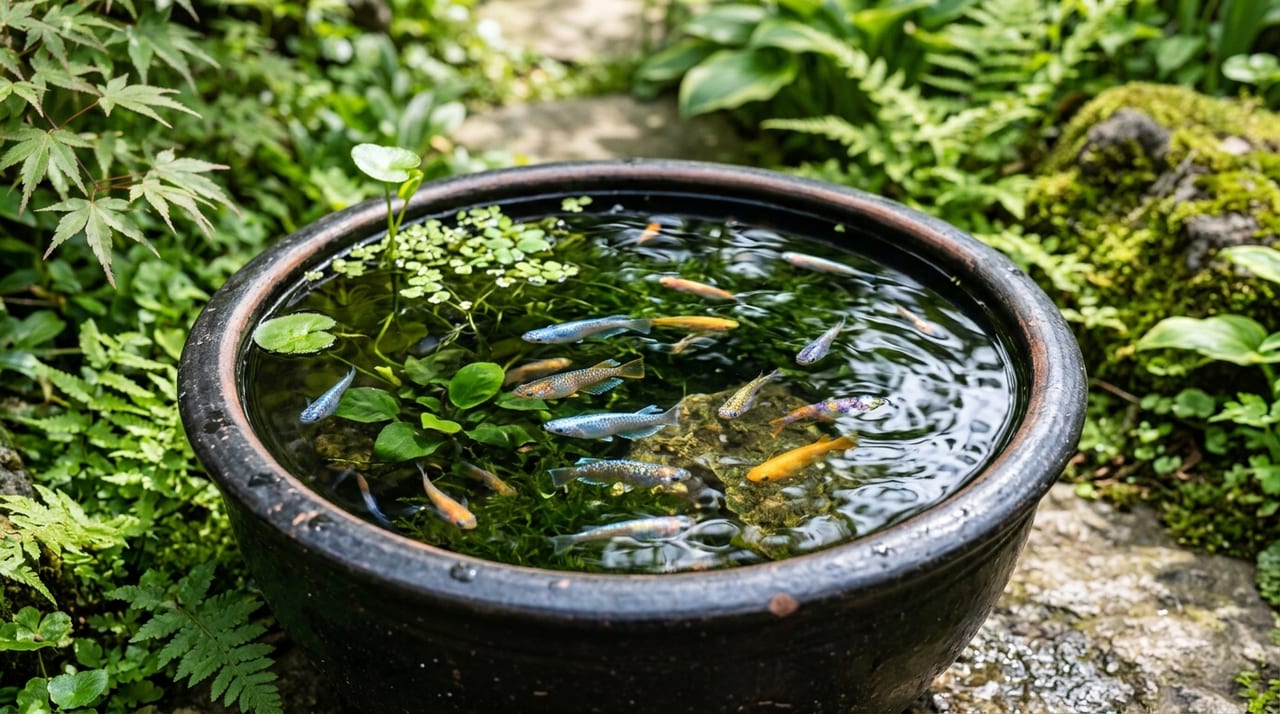
Medaka summer care: shading with sudare and floating plants, aeration, and tips for water changes and feeding in hot weather.
要點總結
Medaka summer care: shading with sudare and floating plants, aeration, and tips for water changes and feeding in hot weather.
Outdoor medaka keeping carries significant risks during Japanese summers. Water temperatures in sun-exposed containers can reach 35°C or higher, which is lethal for medaka. Smaller containers experience more dramatic temperature swings, reaching dangerous levels in a short time.
Medaka naturally inhabit rice paddies and streams with larger water volumes. Ensure a minimum of 10 liters of water capacity in your containers. More water means gentler temperature changes and less stress. Dark-colored containers absorb more sunlight and heat up faster—switch to lighter containers in summer or wrap the outside with reed screens.
Install reed screens or yoshizu above containers to block direct sunlight. Cover about half for partial shade—full coverage is not ideal. Float water hyacinth or water lilies on the surface for natural shade that also provides oxygen and spawning beds.
Reconsidering placement itself is also important. Locations that receive morning sun but are shaded by buildings in the afternoon are ideal. Containers placed directly on concrete or asphalt get heated from below—place them on elevated platforms or shelving with airspace underneath.
High water temperatures dramatically reduce dissolved oxygen. Even for outdoor keeping, adding aeration with a solar-powered air pump provides reassurance. Surface water movement promotes oxygen uptake and helps equalize temperatures.
If aeration isn't available, choosing wide containers improves gas exchange efficiency at the surface. Wide, shallow containers exchange gases more actively than deep, narrow ones. However, ensure a minimum depth of 15cm since too-shallow containers heat up easily.
Summer water changes follow the principle of small amounts, frequently. Large one-time changes cause temperature shock. Always use temperature-matched water. Feed during early morning or evening cool periods, in amounts that leave no leftovers—this is key to water quality maintenance.
Draw dechlorinated water into a bucket and leave outdoors to temperature-match before using for water changes. Limit each change to 1/5–1/4 of the container, every 2–3 days for stable water quality. Summer evaporation is rapid, so also perform frequent top-offs to replace lost water.
Medaka actively spawn in summer, but high temperatures cause egg development abnormalities and reduced hatching rates. Move spawning media with eggs to separate containers and manage in a cool location out of direct sunlight.
Hatched fry are even more heat-sensitive than adults, requiring extra attention. Use larger water volumes for fry containers than adult containers, keeping temperatures below 30°C. Feed powdered food in small amounts, watching for water quality deterioration from uneaten food.
On Buri-Choku, you can purchase carefully bred variety medaka directly from breeders. Feel free to ask breeders about care and summer management.
Aquarium Volume Calculator
Calculate water volume, weight, and heater wattage from tank dimensions
Water Quality Checker
Find compatible fish, shrimp, plants & corals based on pH, temperature & hardness
Breeding Calendar
Visual monthly breeding season guide for each species
Compatibility Checker
Check compatibility between two species on a 5-level scale