Source: Wikimedia Commons
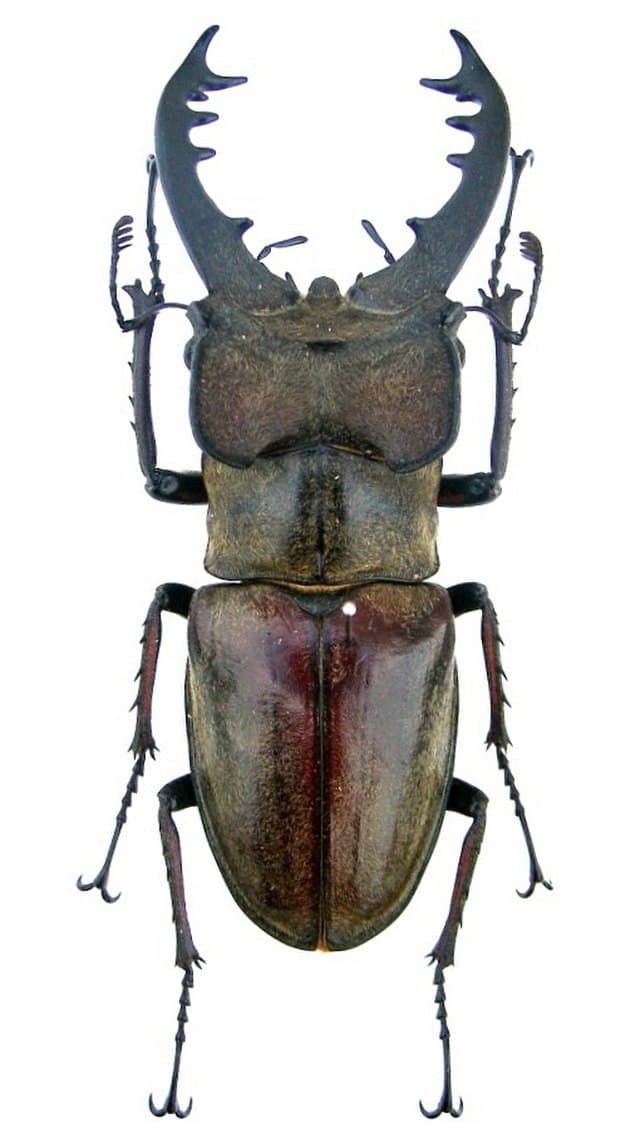
Miyama Stag Beetle
AdvancedBeautiful stag beetle from Japanese mountains. Crown-like head protrusion is distinctive. Requires cool temperatures for keeping.
Dificultad
Advanced
Temperatura
20〜28℃
Esperanza de vida
Adult 2-3 months
Tamaño
Up to 75mm
Humedad
60〜80%
Dieta
Beetle jelly
Acerca de
Lucanus maculifemoratus, the miyama stag beetle, inhabits mountainous forests of Japan at elevations above approximately 400 meters, with a range extending from Hokkaido to Kyushu. It is distinguished by prominent ear-like projections on the head and highly variable mandible forms, classified into base-tooth, Fuji-mountain, and water-buffalo types. Adults reach 35–75 mm in length and display brownish to dark brown coloration with distinctive yellow hairs near the leg bases. As an alpine species, it is extremely sensitive to high temperatures; captive husbandry requires strict temperature management at 15–22°C, typically necessitating a dedicated insect cooling unit. Adult lifespan is 2–3 months, which is brief even by stag beetle standards. Egg-laying occurs in hardwood logs or fermented substrate. Revered as a symbol of the Japanese summer mountains, the miyama stag beetle's unique head projections and imposing size make it a beloved and sought-after native species.
Información básica
Origen
mountainous regions of Japan, from Hokkaido to Kyushu
Esperanza de vida
Adult 2-3 months
Tamaño
Up to 75mm
Temperatura
20〜28℃
Humedad
60〜80%
Dieta
Beetle jelly
Guía de cuidado
Temperature
15-22°C (high temperature forbidden)
Adult lifespan
Very short adult lifespan
Collecting
Can be collected at lights in summer
Breeding
Captive breeding is difficult
Notes
Weakens rapidly above 25°C — air conditioning essential
Japanese nativeCrown protrusionCool-lovingShort-lived
Preguntas frecuentes de Miyama Stag Beetle
Q¿Qué tan difícil es mantener Miyama Stag Beetle?
A
Advanced. Esta es una especie de nivel avanzado. Requiere equipo especializado y habilidades avanzadas de cría con control ambiental preciso.
Q¿Cuál es la temperatura ideal para Miyama Stag Beetle?
A
La temperatura ideal para Miyama Stag Beetle es 20〜28℃. La humedad recomendada es 60〜80%. Evita cambios bruscos de temperatura y mantén un ambiente estable.
Q¿Cuál es la esperanza de vida de Miyama Stag Beetle?
A
La esperanza de vida promedio de Miyama Stag Beetle es Adult 2-3 months. Con cuidados y nutrición adecuados, pueden vivir una vida larga y saludable.
Q¿Qué tamaño alcanza Miyama Stag Beetle?
A
Miyama Stag Beetle típicamente alcanza Up to 75mm como adulto. El tamaño puede variar según las condiciones de cuidado y la genética individual.
Q¿Qué debo alimentar a Miyama Stag Beetle?
A
Miyama Stag Beetle se alimenta de: Beetle jelly. Apunta a una dieta equilibrada con una frecuencia de alimentación adecuada.
Q¿Cuál es el precio típico de Miyama Stag Beetle?
A
El precio de Miyama Stag Beetle varía significativamente según el morfo, tamaño y linaje. Consulta nuestra página de precios de mercado para información actualizada.
Especies relacionadas
Buscar listados de esta especie
Explorar listados de InsectArtículos relacionados
Stag Beetle Breeding Temperature Control — Species-Specific Optimal Ranges
Stag beetle temperature control: species-specific ranges for Dorcus, Prosopocoilus, and Lamprima — cooling methods and seasonal cycling.
Foreign Stag Beetle Overwintering Guide — Tropical vs Temperate Species
Guide to overwintering imported stag beetles: heating for tropical species, dormancy for temperate species, and species-specific temperatures.
Complete Stage Management for Stag Beetles & Rhinoceros Beetles: Larvae, Pupa & Post-Eclosion Care
Stage-by-stage care guide for stag beetles and rhinoceros beetles: larval substrate and temperature management, pupal cell preparation, and post-eclosion adult care with timing and transition tips.
Complete Stag Beetle Species Guide — Characteristics and Difficulty of Japanese and Popular Imported Species
Comprehensive guide to stag beetle species: Japanese natives like Dorcus hopei and Lucanus maculosus, plus popular imports like Giraffa, Palawan, and Caucasus stag beetles.